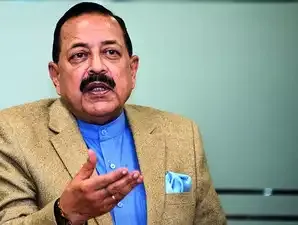
Minister of state for Departments of Atomic Energy, Space, S&T, PMO and Personnel Training, Jitendra Singh discusses at the ET Roundtable India's nuclear ambitions in the SHANTI Bill era. Says ISRO's recent PSLV incidents and future launches will be planned after issues are 'fixed'.
Excerpts:
What is the roadmap for the SHANTI Act?
The process of making rules to the Act has begun but we are taking time given that this is going to change the entire format of our nuclear energy-related activity - opening up to private and non-government sectors and agencies. The new framework is going to be more accommodating while not compromising on the essential safeguards. We have to take into consideration the expectations of stakeholders who are going to partner with us. It has to be carried forward diligently to target the expected outcomes. I don't think it will be fair to tie initiatives of this scale down to a tight time frame. Still, we might come out with the rules not later than 2-3 months or so.
How has the private sector responded to the SHANTI Act?
There is good response from the private sector and from foreign collaborators. When the US Secretary of State was holding parleys with our minister of external affairs recently, he talked more about the SHANTI Act than about anything else. That was flattering to hear.
Will we see changes in the FDI format for nuclear power?
We are working on that but I think, we will be guided by the framework which already exists. We cannot have something totally different from what is in place after due deliberation. But if some specificity is to be infused, we will do that.
Nuclear power is more costly than solar and thermal power and foreign technologies even more so. Who is going to buy such expensive power?
I agree that it is expensive. Initially, the quantum of generation is lesser. As we upscale, the cost is going to come down. To pursue this is no longer a choice for many reasons. The world is moving to clean energy, we can't be left behind. When we talk of Aatmanirbhar Bharat, geopolitically, we have to seek our own source. Currently, we depend on petroleum fuel which is largely imported. Even countries which export petroleum are moving out of that sector because they are foreseeing a virtual closure of their business happening through that sector. For certain tasks you have to bring in nuclear energy because it is a 24X7 uninterrupted source of energy which is not always the case with renewable energy. All decisions are motivated by these facts. Currently, light water reactors are costly - almost double of PHWR - because most of the equipment is from other countries. One of the unwritten motivations behind opening up to private players is that the investment comes in a bigger field and we start developing domestically. Then, the cost will come down dramatically.
How does BJP justify revising its position - from opposing the Indo-US nuclear deal in 2008 to now bringing in the SHANTI Act?
A lot has changed in 18 years. There is significant technology change - it is now much more sophisticated and more secure. Even the structure and sizing of reactors have changed. Geopolitical conditions have changed and the economy is opening up. In the changed milieu, it is not actually going back on a decision. It's a re-look at things which will happen. After a couple of years or a decade, we might look into other aspects because it is a dynamically changing sector. For example, that time you didn't have small module reactors and clean energy concerns were just beginning.
What about the liability question? It was BJP's Opposition then that led to bringing the supplier liability link up in the CLNDA which deterred investors from coming to India.
It seems it has been totally compromised (in SHANTI Act), which is not so. The operator is free to engage in an agreement with the supplier, the government will be out of it. At his level, the operator can do that. There are many ancillary activities and factors that the government should not have to handle.
ISRO's PSLV-linked failures have raised questions. Are the failure reasons similar for the May 2025 and January 2026 cases? What about future launches?
It will be wrong to conclude that the same lapse has happened. What seems to be the issue is not the same as last year's. That has been fixed and something else came up. We are looking into that. We already have an SOP in place. We have a failure redressal committee which is already working on it. We don't take it as a failure because the number of first-time successes that India has had, on an average, would be higher than possibly the US - whether it's Mangalyaan or Chandrayaan. But, we will plug the lapses. Regarding new PSLV launches, no, not yet. We have to fix the issues.
Do you think this incident has hit India's credibility as a cost efficient, non-service provider of small satellite launches?
No, I think some sections of the media have made it out to be like that. We still have so many foreign satellites waiting to launch from that. Some new countries are showing interest.
Gaganyaan un-crewed mission was to happen in early 2026 ahead of the human space flight of 2027. Is it on track?
It has to happen ahead of the actual human flight but I'm not sure whether it'll happen in the beginning of 2026. It might go over to the second half, or the third or last quarter. It was delayed for many reasons. It was planned for the 75th year of Independence. But, in voyages, this can happen because there can be so many imponderables. The other launches planned for the calendar also began to happen. If I miss this Wednesday, I can't be picking up next Wednesday because like marriages, it is decided in heaven. We have to keep in mind the configuration, the position of the planets and the universal setup. Before the human mission, we have several different components and test flights. So, sending up a human being is important but safe return is more important, which will involve a whole of government approach involving many entities. So, we are doing it cautiously.
Are we not losing pace on several fronts keeping both sovereign needs and fast-growing technology and data centre requirements?
Certainly, we have to move on with a reasonable pace and many amendments made in the last 5-6 years is motivated by that sense. Most of the time, when we talk about space we keep talking about satellites, rockets, humans in space, because that sounds very romantic. What India should boast of is the role model we created for other countries and use of space technology for ease of living - from Gatishakti to telemedicine to Swamitva. That is something which gets underreported.
In the National Quantum Mission, in the first cohort, only eight startups were given funding. Only three of them have got going. Also, what is the progress on the ₹1 lakh crore RDI fund launched last year to boost startups?
To be honest even the private sector has been taken by surprise. They never thought that we would suddenly open up the nuclear sector or the space sector or we would be launching the National Quantum Mission. We are among the 4-5 countries in the world, which have an exclusive dedicated National Quantum Mission. On RDI, I think the first lot will take off by this month end, which could be ₹4,000-5,000 crore.
In your home state J&K, people are celebrating the closure of a medical college.
I can't say much on this. It is handled by the Shri Mata Vaishno Devi Shrine Board and it is being headed by the Lieutenant Governor.
There is a growing demand for a separate Jammu state. Some BJP leaders and the Congress are demanding it.
I am a worker of an organisation I belong to and it is not part of the BJP's official line.
What about expanding lateral entry and the Opposition's demand for reservations in it?
More than 40 officials entered the government through lateral entry. The government is open to suggestions on how reservation can be implemented in lateral entry in a feasible manner.