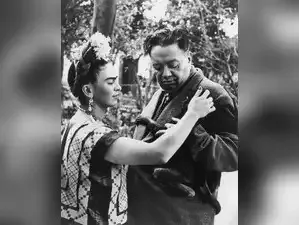
Valentine’s Day 2026: History remembers Frida Kahlo and Diego Rivera as artistic giants, political radicals and cultural icons. What it often struggles to neatly categorise is their love, unruly, passionate, bruising and endlessly creative. As Valentine’s Day 2026 approaches, their forgotten love letters and emotionally charged paintings reveal a romance that refused to be simple, yet left an indelible mark on art and history.
Both were members of the Mexican Communist Party, and their early bond was forged as much through shared ideology as artistic curiosity. Rivera quickly recognised Kahlo’s talent. Affection followed soon after.
On the surface, it is a declaration of love. But the visual language suggests tension. Rivera’s imposing figure faces outward, palette and brushes in hand, positioned as the dominant artistic force. Kahlo stands beside him, physically smaller, her head tilted toward him, one hand resting on his. Her other hand clutches her stomach, a gesture interpreted by scholars as vulnerability, longing or quiet endurance.
Over her lifetime, she produced around 150 works, 65 of them self-portraits. Her unapologetic exploration of pain, identity, gender and the body later cemented her status as a feminist and LGBTQ icon. Within her marriage, she was never merely Rivera’s muse, she was a force negotiating love on her own terms.
In her diary, Kahlo wrote with startling clarity: “Diego = my husband / Diego = my friend / Diego = my mother / Diego = my father / Diego = my son / Diego = me / Diego = Universe.” The web-like strands of her traditional Mexican headdress form a trap around her head, a visual metaphor for love as both nourishment and confinement.
“Nothing compares to your hands, nothing like the green-gold of your eyes. My body is filled with you for days and days. You are the mirror of the night. The violent flash of lightning. The dampness of the earth. The hollow of your armpits is my shelter. My fingers touch your blood. All my joy is to feel life spring from your flower-fountain that mine keeps to fill all the paths of my nerves which are yours.”
The language is visceral, tender and deeply specific. Hands, eyes, skin and even blood become sites of devotion. Kahlo’s letters demonstrate how love, when written honestly, need not be grand, it can live in details.
As Valentine’s Day 2026 invites reflection on love stories that shaped history, Kahlo and Rivera remind the world that romance is not always gentle. Sometimes it is fierce, flawed and consuming, and still capable of producing extraordinary beauty. Their letters and paintings endure not because they were perfect lovers, but because they loved without dilution.
Valentine’s Day 2026 and Love That Refused to Behave
Kahlo and Rivera’s relationship was never designed for fairy tales. It was marked by fierce arguments, mutual infidelities and emotional upheaval. They divorced in 1939, only to remarry a year later. Yet, across 25 years, they continued to paint each other, write to each other and orbit one another’s lives with magnetic inevitability. Their love letters, much like their canvases, remain raw documents of obsession and devotion.Frida Kahlo and Diego Rivera’s First Meeting: Art, Politics and Attraction
The two first met in the late 1920s, when Kahlo, then a young artist recovering from a devastating bus accident, sought advice from Rivera, already a celebrated figure of the Mexican mural movement. Rivera was nearly 20 years older, internationally renowned and politically influential. Kahlo, though still emerging, possessed a visual language unlike any other, intensely personal, symbolic and fearless.Both were members of the Mexican Communist Party, and their early bond was forged as much through shared ideology as artistic curiosity. Rivera quickly recognised Kahlo’s talent. Affection followed soon after.
Frida Kahlo to Diego Rivera’s Marriage and an Uneasy Harmony
Kahlo and Rivera married in 1929. Two years later, while living in San Francisco, Kahlo painted Frida and Diego Rivera (1931), a wedding portrait that quietly captures the contradictions of their union. A ribbon carried by a dove above them reads: “Here you see us, me Frida Kahlo, with my beloved husband Diego Rivera… in the month of April in the year 1931.”On the surface, it is a declaration of love. But the visual language suggests tension. Rivera’s imposing figure faces outward, palette and brushes in hand, positioned as the dominant artistic force. Kahlo stands beside him, physically smaller, her head tilted toward him, one hand resting on his. Her other hand clutches her stomach, a gesture interpreted by scholars as vulnerability, longing or quiet endurance.
Kahlo’s Modernist Voice
To modern viewers, Kahlo’s smaller scale in the painting can appear submissive. Yet historians argue this was a truthful representation rather than symbolic diminishment. Rivera was physically much larger, weighing nearly three times as much as Kahlo. More importantly, Kahlo’s contribution to modernism would soon eclipse such assumptions.Over her lifetime, she produced around 150 works, 65 of them self-portraits. Her unapologetic exploration of pain, identity, gender and the body later cemented her status as a feminist and LGBTQ icon. Within her marriage, she was never merely Rivera’s muse, she was a force negotiating love on her own terms.
‘Diego on My Mind’: Love as Possession
Perhaps the most revealing insight into their emotional bond comes from Diego on My Mind (1943). Begun shortly after their divorce and completed years later, the painting depicts Rivera’s face emblazoned on Kahlo’s forehead, suggesting that he occupied not just her thoughts but her very being.In her diary, Kahlo wrote with startling clarity: “Diego = my husband / Diego = my friend / Diego = my mother / Diego = my father / Diego = my son / Diego = me / Diego = Universe.” The web-like strands of her traditional Mexican headdress form a trap around her head, a visual metaphor for love as both nourishment and confinement.
Frida Kahlo to Diego Rivera: Love Letters Without Restraint
If Kahlo’s paintings hinted at emotional complexity, her love letters removed all restraint. In The Diary of Frida Kahlo: An Intimate Self-Portrait, she praised Rivera’s body with an intimacy rarely seen in historical correspondence, as quoted in a report by Vogue:“Nothing compares to your hands, nothing like the green-gold of your eyes. My body is filled with you for days and days. You are the mirror of the night. The violent flash of lightning. The dampness of the earth. The hollow of your armpits is my shelter. My fingers touch your blood. All my joy is to feel life spring from your flower-fountain that mine keeps to fill all the paths of my nerves which are yours.”
The language is visceral, tender and deeply specific. Hands, eyes, skin and even blood become sites of devotion. Kahlo’s letters demonstrate how love, when written honestly, need not be grand, it can live in details.
Frida Kahlo to Diego Rivera’s Love, Art and Endurance
Despite repeated betrayals and prolonged separations, Kahlo and Rivera remained emotionally tethered. Their remarriage in 1940 did not erase past wounds, but it acknowledged an undeniable truth: they could not fully exist without each other.As Valentine’s Day 2026 invites reflection on love stories that shaped history, Kahlo and Rivera remind the world that romance is not always gentle. Sometimes it is fierce, flawed and consuming, and still capable of producing extraordinary beauty. Their letters and paintings endure not because they were perfect lovers, but because they loved without dilution.