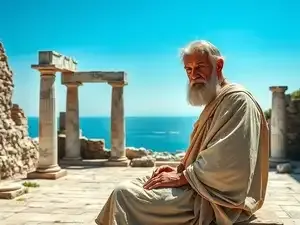
Parmenides of Elea was an ancient Greek philosopher who lived in the early 5th century BCE in the city of Elea, located in present-day southern Italy. He is regarded as one of the most influential pre-Socratic thinkers and the founder of the Eleatic school of philosophy. Parmenides is best known for his revolutionary idea that reality, or “Being,” is unchanging, indivisible, and eternal, and that all change perceived through the senses is an illusion. He presented his ideas in a philosophical poem titled On Nature, in which he argued that reason, not sensory experience, is the only reliable path to truth. His work had a profound impact on later philosophers, including Plato and Aristotle, and shaped the course of Western metaphysics by forcing thinkers to confront fundamental questions about existence, change, and knowledge.
One of his famous quotes is: 'Do not let habit born of long experience force you to use sight or hearing or tongue'.
Meaning of the Parmenides's Quote
This statement of Parmenides of Elea challenged the most basic assumptions humans make about reality. At a time when people trusted their senses to explain the world—what they saw, heard, and felt—Parmenides made a radical claim: the senses deceive us. According to him, true understanding does not come from habit, perception, or popular belief, but from reason.
The meaning of this quote is deceptively simple yet deeply unsettling. Parmenides warns us not to blindly rely on sensory experience just because it feels familiar or because it has worked for us in the past. “Sight, hearing, and tongue” symbolize how humans absorb and repeat information—what we see, what we hear from others, and what we say without reflection. Habit, when left unquestioned, becomes a quiet tyrant. It convinces us that what appears to be true must be true.
Imagine a small coastal town where fishermen have, for generations, believed the sea ends at the horizon. Every day, they sail out, see the same line where sky meets water, and return home convinced the world stops there. One young sailor, however, begins to doubt this inherited certainty. He realizes that his belief is not based on reason, but on repetition—on what his eyes show him and what elders have always said. When he finally sails beyond the familiar line, he discovers new lands, proving that the horizon was not an edge but a limit of perception.
Parmenides’ quote speaks directly to this moment of awakening. He urges us to pause and ask: Am I thinking, or merely repeating? Am I understanding, or simply trusting my senses because they are comfortable? In modern life, this warning feels even more relevant. News, social media, and popular opinion shape what we see, hear, and say. Over time, these patterns harden into habits, and habits turn into “truth.”
Parmenides invites us to step back from this automatic way of living. He reminds us that wisdom begins when we question what seems obvious. True knowledge, in his view, is not noisy or immediate—it is quiet, logical, and often uncomfortable. By resisting the pull of habit and sensory certainty, we take our first step toward deeper understanding.
In a world overflowing with information, this ancient warning still whispers: think carefully, or be ruled by what merely appears to be true.
One of his famous quotes is: 'Do not let habit born of long experience force you to use sight or hearing or tongue'.
Meaning of the Parmenides's Quote
This statement of Parmenides of Elea challenged the most basic assumptions humans make about reality. At a time when people trusted their senses to explain the world—what they saw, heard, and felt—Parmenides made a radical claim: the senses deceive us. According to him, true understanding does not come from habit, perception, or popular belief, but from reason.The meaning of this quote is deceptively simple yet deeply unsettling. Parmenides warns us not to blindly rely on sensory experience just because it feels familiar or because it has worked for us in the past. “Sight, hearing, and tongue” symbolize how humans absorb and repeat information—what we see, what we hear from others, and what we say without reflection. Habit, when left unquestioned, becomes a quiet tyrant. It convinces us that what appears to be true must be true.
Imagine a small coastal town where fishermen have, for generations, believed the sea ends at the horizon. Every day, they sail out, see the same line where sky meets water, and return home convinced the world stops there. One young sailor, however, begins to doubt this inherited certainty. He realizes that his belief is not based on reason, but on repetition—on what his eyes show him and what elders have always said. When he finally sails beyond the familiar line, he discovers new lands, proving that the horizon was not an edge but a limit of perception.
Parmenides’ quote speaks directly to this moment of awakening. He urges us to pause and ask: Am I thinking, or merely repeating? Am I understanding, or simply trusting my senses because they are comfortable? In modern life, this warning feels even more relevant. News, social media, and popular opinion shape what we see, hear, and say. Over time, these patterns harden into habits, and habits turn into “truth.”
Parmenides invites us to step back from this automatic way of living. He reminds us that wisdom begins when we question what seems obvious. True knowledge, in his view, is not noisy or immediate—it is quiet, logical, and often uncomfortable. By resisting the pull of habit and sensory certainty, we take our first step toward deeper understanding.
In a world overflowing with information, this ancient warning still whispers: think carefully, or be ruled by what merely appears to be true.