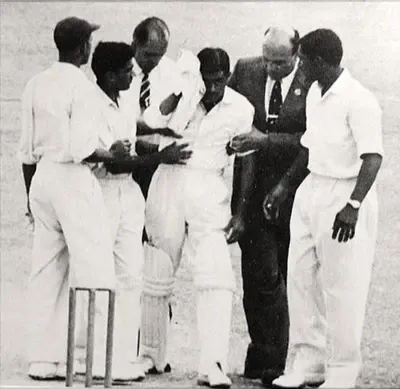
The date was March 17, 1962. The Indian cricket team was touring the West Indies under the leadership of Nari Contractor. The team participated in a colony match against Barbados on that date. Barbados is an eastern Caribbean island, and cricket is followed like a religion in that country.
Nari Contractor suffered a severe batting injury during the second match day. The bouncer which Charlie Griffith delivered to him struck him precisely on the head despite his attempt to dodge. Batters at that time played without helmets which made all injuries extremely hazardous.
Contractor collapsed on the ground because he suffered from intense pain. The players and officials rushed to help him. West Indies captain Frank Worrell was watching the game from the VIP box as a spectator. He descended to the field to begin rescue efforts for Contractor after he assessed the situation.
The dressing room became the first location where Contractor received medical attention before he received treatment at the clinic. His injury required medical treatment because it constituted a dangerous situation. His X-ray results revealed a fracture on his right head area. He required blood and urgent surgery to survive.
Chandu Borde who witnessed the whole event later shared his recollections of the incident. He said:
He said:
"He (Griffith) bowled a bouncer which Nari tried to duck. That bouncer hit on his right side because being a left-hander his right side was towards the bowler. He fell down. I was in the dressing room. I took a glass of water and ran to the wicket. Nari said that he was in a lot of pain. We brought him to the dressing room. Our manager was Ghulam Ahmed. It was decided to take him to a clinic. There was one doctor named Ford. Xray showed a crack on the right side."
Borde added:
The doctor said to Ghulam Ahmed that he has to be operated immediately within one hour otherwise it will be very dangerous. Dr Ford said that he was not a Neuro-surgeon. But they had to operate on him. B+ group blood was required. There were five people. One was Sir Frank Worrell, others were Bapu Nadkarni, Polly Umrigar, myself and Prabhu, a journalist. We had the same blood group
A neuro-surgeon was flown from Trinidad the next day. Contractor survived, and a life was saved. This incident became a major moment in cricket history. The event displayed both teams demonstrating solidarity and support and mutual honor during their most difficult moments.
Also Read | Top 10 Most Beautiful Women Cricketers in WPL 2026
The Way Humanitarian Actions Evolved Into Traditional Practices
Frank Worrell’s blood donation became a symbol that represented both sportsmanship and human compassion. People in India, especially in Kolkata, never forgot his kindness. The Cricket Association of Bengal established a blood donation camp at Eden Gardens in 1981 to commemorate his memory.
The Club House of the Cricket Association of Bengal serves as the location for this blood donation camp. Sports enthusiasts from all parts of the country come to this blood donation camp every year. The blood which they collect gets delivered to government blood banks for storage.
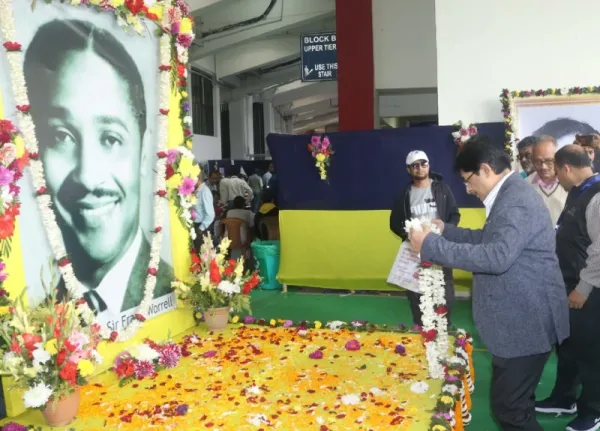 Image Source: CAB
The event features one special element where every year a well-known cricketer signs the certification document for blood donors. Many big names from world cricket have signed these certificates, including Don Bradman, Sunil Gavaskar, Garfield Sobers, Imran Khan, Richie Benaud, Sachin Tendulkar, Syed Mushtaq Ali, Ian Botham, John Wright, and Sanath Jayasuriya.
In the last forty years, many donors from this camp have become blood donation organizers in their own areas. West Bengal ranked last in voluntary blood donations during the late 1970s but now stands as the top state for supporting government blood banks.
The cricket story from 1962 tells about more than sports activities. The story showcases heroic deeds which originate from human connections and compassionate behaviors.
-
'She Left A Sinking Ship' Fans React As Janhvi Kapoor Exits Karan Johar's Dharma Productions

-
'She Left A Sinking Ship' Fans React As Janhvi Kapoor Exits Karan Johar's Dharma Productions

-
Gujarat Forest dept gears up for tiger conservation after tiger sighted in Ratanmahal wildlife sanctuary

-
Spinach is less bitter if you swap boiling water for 1 simple ingredient

-
Spinach is less bitter if you swap boiling water for 1 simple ingredient