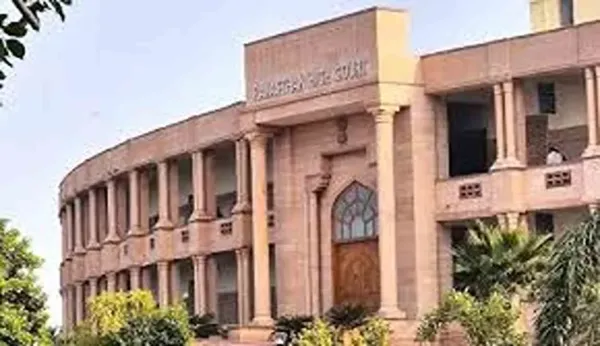
Rajasthan High Court : The Rajasthan High Court has taken a notable administrative step to tackle the growing backlog of pending cases by introducing court hearings on two Saturdays every month. The new arrangement came into effect recently and is part of a broader strategy aimed at improving judicial efficiency and delivering timely justice. However, the move has sparked significant resistance from lawyers’ associations, resulting in an ongoing standoff between the Bar and the Bench.
Decision To Increase Working Days
The decision to hold hearings on select Saturdays was approved during a full bench meeting of the Rajasthan High Court last month. Following this resolution, the court administration revised its annual calendar, declaring certain Saturdays as working days. As a result, the court will now add more than 15 additional working days each year, increasing the total number of working days to around 225.
Court officials believe that extending the working calendar is a practical response to the ever-rising number of cases awaiting disposal. With thousands of matters pending across various benches, the administration views Saturday hearings as an essential measure to reduce delays and improve case clearance rates.
Cause List Released For Saturday Hearings
To operationalize the new schedule, the High Court administration has already issued cause lists for Saturday sittings. Judges have begun listing matters for hearing on these days, signaling that the policy is being implemented without delay. From an administrative perspective, this step reflects a firm commitment to addressing pendency through structural changes rather than temporary measures.
However, the issuance of cause lists has also intensified opposition from sections of the legal fraternity, particularly in Jaipur and Jodhpur, where lawyers have voiced concerns over the unilateral nature of the decision.
Lawyers Announce Voluntary Boycott
Strong resistance has emerged from lawyers’ associations, leading to a voluntary boycott of judicial work on Saturdays. The High Court Bar Association in Jaipur has formally decided to abstain from court proceedings on these days as a form of protest. Similar decisions have been announced by both High Court Bar Associations in Jodhpur.
Lawyers argue that extending court working days directly affects their professional and personal schedules and should not be enforced without comprehensive consultation. Many members of the Bar believe that meaningful dialogue should precede any change that alters long-standing court practices.
Committee Formed To Address Concerns
In response to the growing tension, Acting Chief Justice Sanjeev Prakash Sharma constituted a committee of judges to engage with representatives of the Bar. The committee has been tasked with examining the concerns raised by lawyers and exploring possible solutions.
According to the President of the High Court Bar Association, Jaipur, discussions have taken place, but the committee’s findings have not yet been made public. Despite these ongoing talks, Saturday cause lists continue to be issued, which lawyers see as a sign that their objections are yet to be fully addressed.
Influence Of Supreme Court Advisory
Sources within legal circles indicate that the decision to increase working days was influenced by an advisory from Surya Kant. The advisory reportedly encouraged High Courts across the country to consider extending working days as a way to manage mounting case pendency and ensure quicker justice delivery.
This broader national context has strengthened the High Court administration’s position, as similar measures are being discussed or adopted in other jurisdictions. Officials argue that without systemic changes, delays in justice delivery will continue to undermine public confidence.
Ongoing Deadlock And Uncertain Resolution
While the High Court maintains that Saturday hearings are critical for improving judicial output, lawyers insist that consensus-building is equally important. The absence of a mutually agreed framework has led to an uneasy atmosphere, with both sides standing firm on their respective positions.
As Saturday hearings commence under the revised calendar, the situation remains unresolved. Whether continued dialogue will lead to a compromise or further escalation remains to be seen, but the issue has undoubtedly highlighted the delicate balance between judicial administration and the concerns of the legal community.
-
Budget 2026: Will the duty on gold, silver, and other metals be reduced in the budget? The Finance Minister may make an announcement..

-
The new tax regime failed to break the spell of small savings schemes; PPF, NSC, and Sukanya Samriddhi Yojana still retain their full appeal..

-
The budget is great news for taxpayers; they can expect significant relief under Section 80C and on home loans..

-
8th Pay Commission: From peons to officers... how much will everyone's salary increase? Here's the calculation..

-
Good news for pensioners: These retired employees will receive a 10% increase in their pensions – a big gift from the government..