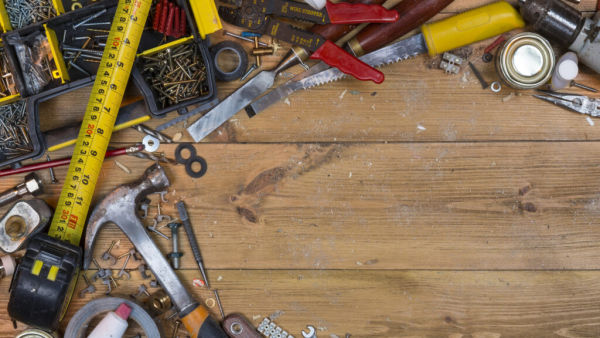
I like old tools. There’s no denying the aesthetic impact a vintage piece of gear brings to your workspace. Brand new power tools may get jobs done with less effort than a hand-powered alternative, but the sweat equity is absolutely part of the experience (sometimes).
I’m not suggesting that you should hand-fasten every screw when putting together your next IKEA bookshelf. Instead, something like the Milwaukee M12 Fuel Installation driver or DeWalt 20V Atomic Multi-Head Drill can be a godsend. I use a drill and other power tools for most home improvement projects and whatever subtasks arise within a job. But there’s something undeniably charming about hand tools, and in my mind, vintage gear holds a special place in any toolbox.
It should be noted that there’s a survivorship bias to overcome. My hand planes are old, for instance. But that doesn’t necessarily mean that old hand planes are definitely better than new ones, just that the ones I bought were good tools that survived to the present. Even so, I’m drawn to old tools that have stories in their handles, steel, and jaws. These are some of my most enduring examples and how they affect my work around the house.
A square-faced lump hammer
Brand: Unknown; year, also a mystery. But my eBay-sourced lump hammer is without a doubt my favorite striking tool. It bears a single mark on the crown of its double-sided head, stating “1000,” as in 1,000 grams. The hammer is heavy enough to drive nails into dense material, which is a handy feature since my home is made of block walls and not timber framing.
The tool also delivers relatively lightweight mobility. The handle is slightly stubby, giving me just enough lever action to swing it hard when I need to, and it’s easy to choke up on the tool for more delicate tapping. The handle is, however, warped, with a notable bend dominating the bottom half of the wooden structure. I’ll eventually get around to replacing it, but I’ll miss the look and feel of this piece.
In truth, any time I need a hammer and can use this one, I do. It’s an ideal middle-weight option with a battle-tested outer shell. The tool is pocked and scratched in places, and covered in a thick patina mixed with a bit of rust and paint flecks — it’s perfect.
Mattock (axe style)
My mattock is an axe-style tool rather than the pick variety. The mattock is among some of the most underrated home improvement tools you’ll encounter, and I use mine regularly for all manner of yardwork. This is a digging hoe and axe combined into one tool. It relies on a pressure fit with a straight handle to operate and I’ve used one for digging, tree felling, root removal, and everything in between. Looking closely, I’ve found that mine has a “47” stamped on the side, presumably to indicate its forging year, as well as the word “equality,” the meaning of which is unclear.
Regardless of its past, the mattock is one of my favorite tools. It tackles so many jobs in the yard, and the tool can even power through plenty of tasks as a blunt striking instrument rather than an impeccably sharpened and honed tool as an axe or other cutter might require. I do sharpen mine, but keep it far rougher and readier than other tools since it’s often involved in digging and similar jobs.
Felling axe
My axe is an “Elwell” model, forged for the British military in 1955. It features the M-shaped “broad arrow” stamp denoting that purpose and the year in surprisingly clear lettering for its age. The axe head weighs a little less than 5 pounds and is seated on a well-patinaed handle with a vibrant, deep color dominating the visual.
The axe is nicely situated as a middle-of-the-road choice for chopping, and I’ve used it for lots of clearance and maintenance tasks. The head shape is also practical, allowing for a long, tapered striking area without going overboard or exposing too much of the blade’s edge to thinning or unprotected backing areas. It’s a balanced chopping tool that’s in great shape even 70 years later.
This axe is undoubtedly the most interesting chopper in my collection and stands out against an oddly misshapen axe that was left in the shed when we moved in and another Swedish model that’s a scout’s hatchet-style tool (and therefore a decent option for starting a campfire). The smaller hatchet gets a decent amount of use, as well, and I often pull out the weird one for bulk demolition tasks that call for bashing up material. Yet, this old warhorse is a definite favorite.
Chisels (specifically a vintage socket chisel)
You can never have enough chisels in your tool collection. Chisels are unique in their ability to cut and shape wood with a range of different styles, lending themselves well to woodworking and beyond. My collection features a few newer tools, including a DeWalt side strike chisel and a set of Stanley chisels. But my favorites are all the older ones I’ve come across through the years. I have a set of aged models, for instance, featuring squared handles that fit softly in the hand and make for a surprisingly nice user experience.
However, my favorite old chisel is a socket-style example with an elongated head. It does not have a very wide blade, but the length is useful. The tool is not a slick (a long-handled carving chisel with a wide blade), but it can act similarly to one because of the long head shape.
Socket chisels are particularly interesting to me. They allow for easy handle changes without much hassle. Sadly, this is one of just two socket-style tools in my chisel collection, and I actually haven’t replaced its blunted handle yet. However, I may remedy this with the ash trees I’m growing in the back yard. In another year or two, these ashes might be large enough to form a few handles for my chisels and other tools.
Half a ‘Youngman’ extension ladder
“Half” is the operative word here. This ladder component was left in the shed when we bought our home. The previous owners apparently didn’t want it and were equally uninterested in figuring out how to get rid of the now-extensionless ladder piece. I genuinely can’t figure out how one half of an extension ladder can disappear while the other gets left behind, but as they say, one man’s trash is another man’s treasure. I’ve continued to use this half-a-ladder, giving a forgotten piece of equipment a completely new arc to its lifecycle. The tool has served me well during roof repairs, renovations throughout the house, and in accessing the attic on a routine basis.
It’s labeled with a “Youngman” badge along the side, and is a lightweight, aluminum ladder. Admittedly, the geometry of the rungs is a little quirky, and climbing it without shoes on ends up hurting a bit. I have other height options, including a work platform that’s really spot on for ceiling tasks and other needs, but this ladder is so easy to maneuver since it’s half the weight and size it’s designed to be. I use it constantly and don’t expect to see that change anytime soon.
Mole grips
The mole grip is my personal go-to gripping tool for any job that demands potent grabbing and turning power. I prefer the locking pliers to alternatives such as an adjustable wrench and even a ratchet and socket at times. The locking pliers have immense grip strength, regardless of your own ability to grab the handles with force. They can be used to lock onto workpieces to keep them steady, or as an extension of your arm at times, when you need a bit of extra reach to place something in its necessary location and perform the installation with your other hand.
I’ve used plenty of mole grip-style pliers, including very old examples owned by my dad and grandfather. When moving away many years ago, I bought a smaller set of locking pliers featuring both the mole-type jaw and longer jaw options, but my fondness for the classic layout has never faded.
I use an Irwin model today that’s new enough in its own right, but mimics the genuine article virtually to a T. It’s a modern build of the trusted classic that’s been going strong for generations. I anticipate that this tool will stay in my toolbox for many years, since Irwin is among the best hand tool brands around, and the build is identical to models I’ve personally seen in use for longer than I’ve been alive. Perhaps best of all, I got the pliers with a 40% discount!
Bricklaying trowels
I found these vintage trowels online, and they lack any kind of distinguishing marks to suggest their branding or actual age. They feature classic, vintage curves in the wooden handles, leaning toward fabrication during a different era of toolmaking. Unlike some of my other tools, these introduce a lighter colored wood into the mix. They might be beech, basswood, or poplar — I’m not sure. What I do know about the handles is that they’re a delight to work with. The tapering is comfortable without sacrificing grip power. They also meet the forged blades perfectly, with no wobble at all.
They are both shaped almost identically, with a large and small option in the ‘set’ I bought (one’s a pointing trowel and the other seems to be a Philadelphia pattern trowel). They fit in nicely with my other troweling tools, including a standard plastering trowel, putty knives, a taping knife, and an interesting addition: The “bucket trowel.” This final one is a tool with rounded edges and an offset head that’s ideal for digging mixed material out of a bucket without cracking the sides and leaking your concrete, plaster, or mortar all over the ground or floor. I’ve used these trowels in many projects, including laying a brick flower bed.
Stanley No. 5 hand plane
Stanley metal hand planes are beautiful tools. They’ve been largely cast in the same standardized format over the last 100 years. The tools quickly overtook the heritage, wooden-bodied design because they’re simply more durable and feature an impeccable set of lockdown solutions to adjust and perfect the positioning of your iron.
For the modern woodworker, this is the heritage tool that can’t be overlooked (although many do still use wooden planes alongside or instead of metal options). The hand plane isn’t a monolith, though. There’s the hand plane and a block plane distinction to consider. Also, among Stanley models and others that use the same framework, you’ll see a range of sizes running from the No. 1 up to a massive No. 8 model with a bevy of subdivisions between these whole-numbered sizes.
I have a few bench planes, but my favorite is the No. 5 Stanley model. The No. 5 is a bit larger than the ubiquitous No. 4. Mine has remnants of blue paint adorning the sides, and its handles are notably aged. The iron came sharp, and whoever owned it before me clearly took good care of the tool. I can’t get enough of this hand tool, and even though it’s slightly niche in its function, I try to find ways to incorporate it wherever I can. Mine’s probably from the 1970s or ’80s, based on the look of the handles.
Vise
My vise isn’t mounted on my workbench. At the moment, it’s sitting in a storage shed outside my regular outdoor workspace and attached to a scrap piece of plywood. I have relied on it as a strange cross between a semi-mobile solution and the purpose it was actually designed to provide. The plywood cutoff it’s situated on is mobile, and I’ve fastened it to numerous temporary bench solutions to create a pop-up vise.
The tool is a small, vintage unit with the name “Handy” forged into its side alongside “Model No. G1.” It’s little but hefty, so it delivers great grabbing power. The action is pretty smooth for an old tool, especially since I haven’t done much to refurbish it. The vise is a neat addition that fits right at home with plenty of old-school charm. A new tool might offer a better range of coverage, but it’s hard to beat the vibes this one has to offer.
Knipex Electrical Installation Pliers
This one’s a slight departure from the brief. These are a relatively new addition to my toolbox (with something in the neighborhood of around two years of service time in the books). Some of my tools are old enough to claim Social Security. I fully expect units like my mattock and axe to make it to triple digits. They don’t have any cracks or noticeable imperfections in their forging, and I don’t subject them to daily abuse like a professional tool user would. Among my newer tools, these Knipex pliers are probably the most likely candidate to follow in that mold.
I have other Knipex gear, but these are a true standout. The satin finish on the chrome vanadium steel and remnants of forge marks throughout the head exude precision and durability. The tool’s jaws have served me well during countless electrical tasks but show literally no signs of wear. The only clue about the tool’s age comes from a discolored, patina-type wear along the insulated handles. I take care of this tool as well as I can, and fully expect it to be passed on when I’m no longer here, hopefully many years down the road.
A Bosch reel mower
This is a new tool. In fact, I’ve used it only three or four times. I bought the mower at the end of the growing season for a discounted price to try out something new in the yard without the associated guilt over potentially abandoning an expensive tool. It’s not an old model, but it does harken back to an old style.
The reel mower has a long history of use, cutting grass more like a pair of scissors rather than relying on the powerful rotational force of a modern, gasoline-powered mower. The blades are positioned around a barrel that spins when the outer wheels are pushed along the ground. It features a wide range of height settings, allowing me to get down low to the ground or deliver a quick trim. I like the tool, and it certainly fits within a throwback vibe that dominates my tool collection. I’m excited to get out and start mowing the yard with this come springtime.