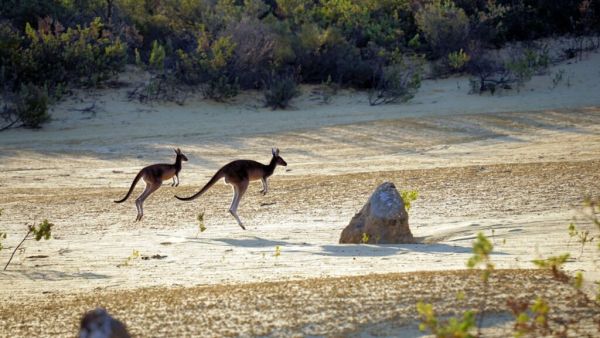
For a long time, scientists believed that the biggest ancestors of today’s kangaroos were simply too heavy to hop. It is considered that these prehistoric marsupials were capable of weighing as much as 250 kilograms. This enabled past studies to claim that their joints and tendons would not have been capable of managing the stress brought about by hopping. This idea has now been challenged by a new study that is offering a fresh point of view on these giant kangaroos.
Research published in the scientific journal, Scientific Reportsby Jones, along with her team, hoped to take a careful look at how these ancient beasts may have gotten about. Instead of making assumptions based on the size of the beasts, the size of modern kangaroos in relation to the extinct ones was compared. The researchers analysed the hindlimbs of 94 living kangaroos and wallabies, alongside 40 fossil specimens that represent 63 different species, including members of the giant kangaroo genus Protemnodon. These animals lived during the Pleistocene era, a time that stretched from around 2.6 million to nearly 12,000 years ago.
Fourth metatarsal
A key focus of the study was the fourth metatarsal, a long bone in the foot that is essential for hopping in modern kangaroos. This bone absorbs and distributes force every time a kangaroo lands. By measuring the length and width of this bone and comparing it with estimated body weights, the team assessed whether the bones of giant kangaroos could withstand the pressure created by hopping. Surprisingly, the results showed that the metatarsals of even the largest species were strong enough to handle hopping.
Researchers took a step further in estimating the size of the heel bones in the animals to determine the type of Achilles’ tendons they required for hopping. This was in consideration of the energy-saving role of the Achilles’ tendons. By comparing the heel bones of the extinct kangaroo species with those of contemporary kangaroo species, researchers eventually concluded that the heel bones of giant kangaroos were immensely large for the support of tendons.
While the above findings seem to imply that giant kangaroos had the physical ability to hop, researchers added that hopping was possibly not the main means by which these large creatures could get from one place to another. In fact, researchers explained that the large size and the extra weight of these creatures made hopping for long distances not only inefficient but also an extremely tiresome affair.
Brief periods of hopping
However, brief periods of hopping may have been greatly instrumental in the animals’ survival. Even today, small animals such as mice and some marsupials have been observed to engage in some periods of hopping, even though the primary action may be walking or running. These brief periods of hopping may have greatly contributed to the survival of the giant kangaroos. Moreover, the brief periods may have enabled them to alter direction to save themselves from possible predators, such as the already extinct Marsupial Lion referred to as the ‘Thylacoleo’.
Overall, the study goes against the traditional understanding of the mobility of large animals and provides more depth to the understanding of Australia’s prehistoric animals. For example, the giant kangaroos that roamed the continent might have actually been more mobile than expected, proving that big animals can actually be acrobatic, too.
-
Noida techie’s death: Akhilesh Yadav blames CM, ‘destroyed Dial 100’

-
RAK Ruler attends UAE National Orchestra’s ‘The Beginning’ concert

-
Actors recall Republic Day memories, reflect on what India means to th

-
“Not going to happen, or even close!”: Trump warns Ottawa on Beijing’s

-
Sunny Deol's Border 2 Pays Emotional Tribute to Late Dharmendra, Leaves Audiences Moved