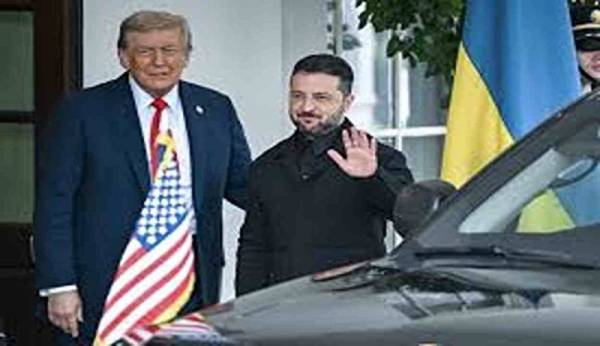
Trump: US President Donald Trump has instructed his negotiating team to pursue a long-term and sustainable agreement aimed at preventing any future recurrence of the Ukraine war. Senior administration officials described recent diplomatic engagements as constructive and forward-looking, emphasizing that the focus is not only on ending hostilities but also on creating a framework that ensures lasting stability in the region. According to officials, the approach reflects a shift toward durable peace rather than temporary ceasefire arrangements.

Background of Recent Diplomatic Engagements
In recent weeks, high-level discussions took place across several international locations, including Davos, Abu Dhabi, and meetings held in Russia. These engagements brought together representatives connected to Ukrainian President Volodymyr Zelensky and Russian President Vladimir Putin. Officials stated that talks concentrated on resolving remaining open questions such as regional security, economic recovery, frozen financial assets, territorial disputes, and broader de-escalation measures.
Emergence of a Trilateral Negotiation Format
One of the most notable outcomes of these discussions has been agreement on a trilateral negotiation structure. Under this format, Ukraine and Russia remain the primary parties, while the United States plays the role of facilitator. Senior officials said reaching consensus on this arrangement required weeks of diplomatic coordination, as both sides wanted assurance that talks had advanced far enough to justify detailed technical discussions.
Trump and Zelensky Meeting in Davos
President Trump met President Zelensky during the Davos meetings, where they reviewed progress achieved over recent months. Officials said this interaction was pivotal, allowing Trump to issue updated guidance to his negotiating team. The conversation reportedly reinforced the US administration’s belief that a lasting agreement is achievable if negotiations remain focused on long-term guarantees rather than short-term political wins.
Abu Dhabi Talks and Discussions in Russia
Following Davos, negotiations continued in Abu Dhabi and later in Russia, where US representatives held an extended discussion lasting several hours with President Putin. US officials characterized these meetings as extremely productive. The Abu Dhabi engagement, in particular, was described as a turning point that marked the transition into a more advanced phase of talks involving military and political participants from all sides.
Focus on De-escalation and Conflict Prevention
During the two-day trilateral sessions, negotiators concentrated heavily on de-escalation strategies. Informal discussions complemented formal meetings, allowing participants to openly exchange concerns and ideas. Officials noted that a key objective was building mutual confidence that once the war ends, it will not restart under similar conditions.
Security, Economy, and Territorial Questions
The talks addressed a wide range of issues, highlighting the complexity of the negotiations. Security arrangements and economic considerations were discussed alongside sensitive territorial questions, including land Russia may retain after the conflict. US officials acknowledged that these topics remain among the most challenging and unresolved, requiring careful balancing of national interests.
Improving Tone Between Ukrainian and Russian Delegations
Administration sources highlighted the positive tone of the meetings, noting that Ukrainian and Russian representatives engaged directly and respectfully for the first time in a long period. This renewed dialogue allowed both sides to articulate their positions clearly, contributing to what officials described as a fluid and productive negotiating environment.
Role of US Envoys and Military Advisors
President Trump’s special envoy Steve Witkoff and senior advisor Jared Kushner led many of the discussions. They met President Zelensky in Switzerland before traveling to Moscow for talks with President Putin. Senior US military leaders, including officials linked to NATO command structures, later joined the process to provide strategic and security-related input.
Post-War Security Guarantees and Energy Issues
A major sticking point remains post-war security guarantees for Ukraine. European nations have proposed a limited peace-monitoring presence, while the US has signaled support through intelligence, surveillance, and logistics rather than deploying ground troops. Economic matters were also addressed, including the future of Ukraine’s Zaporizhzhia nuclear power plant, currently under Russian control. Although no agreement was reached, proposals included shared electricity arrangements, reflecting the broader economic dimension of the negotiations.
Outlook for Future Talks
Senior administration officials confirmed that additional meetings are expected in the coming days, with further discussions planned in Abu Dhabi. These sessions will focus on advancing ceasefire efforts and narrowing differences on unresolved issues. Officials emphasized that the ultimate aim remains a comprehensive agreement capable of reshaping regional stability and preventing renewed conflict.
-
No place for Hindi in TN then, now and forever: Stalin

-
Aryan Khan calls father Shah Rukh Khan’s ‘King’ as ‘BAAP’

-
Border 2 Box Office Day 2: Sunny Deol’s War Epic Storms Past Rs 66 Cr, Sets Republic Day Weekend Ablaze

-
EU Delegation In India For Republic Day, Set To Sign Key Deal In New Delhi

-
Doctor says 'you likely don't need' one supplement