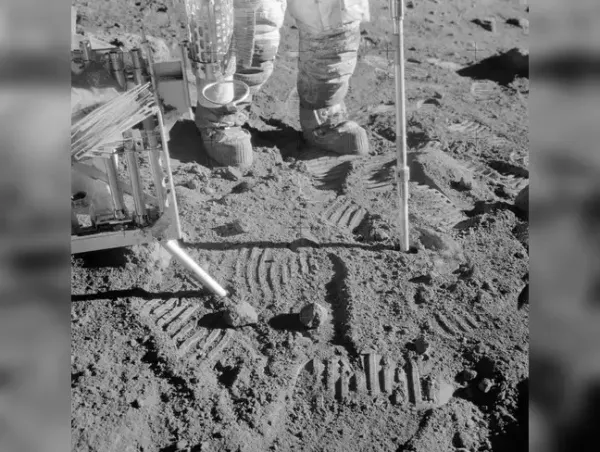
A new NASA study based on Apollo-era lunar soil samples suggests that meteorites were likely not the dominant source of Earth’s water, placing new limits on a long-standing theory about how the planet’s oceans formed. The research, published Tuesday, January 20 in the Proceedings of the National Academy of Sciences, analyzes lunar regolith, the dusty debris covering the Moon’s surface, to reconstruct billions of years of meteorite impacts in the Earth-Moon system.
Scientists have long theorized that water-rich meteorites may have delivered significant amounts of water to Earth during the early stages of the solar system. Unlike Earth, whose geological activity erases much of its ancient history (geologically), the Moon preserves an extensive record of impacts, as the Moon has no rain, wind, plate tectonics, or oceans.
“The lunar regolith is one of the rare places we can still interpret a time-integrated record of what was hitting Earth’s neighborhood for billions of years,” said Tony Gargano, a postdoctoral fellow at NASA’s Johnson Space Center and the Lunar and Planetary Institute.
However, traditional methods of studying lunar soils rely on metal-loving elements, which can be altered or mixed by repeated impacts, complicating efforts to identify the original composition of incoming meteorites.
Also Read: A 400-year-old explosion, one of the biggest humans have ever witnessed, seen over 25 years as NASA shows Kepler Supernova’s uneven expansion
To overcome this limitation, the research team used triple oxygen isotope analysis, a high-precision method that examines oxygen, the most abundant element in rocks, and remains unaffected by impact-related processes.
The analysis showed that at least about 1% of lunar regolith by mass contains material from carbon-rich meteorites that were partially vaporized upon impact. Using known properties of such meteorites, the team calculated how much water they could have carried.
When researchers scaled their findings to account for Earth’s higher impact rate, roughly 20 times that of the Moon, the total amount of water delivered by meteorites over the past four billion years amounted to only a small fraction of Earth’s oceans.
“That makes it difficult to reconcile the hypothesis that late delivery of water-rich meteorites was the dominant source of Earth’s water,” the study concluded.
“Our results don’t say meteorites delivered no water,” said co-author Justin Simon, a planetary scientist at NASA Johnson’s Astromaterials Research and Exploration Science Division. “They say the Moon’s long-term record makes it very hard for late meteorite delivery to be the dominant source of Earth’s oceans.”
While the water contribution on the Moon by meteors is minor on an Earth-ocean scale, it remains meaningful for the Moon. The Moon’s accessible water is concentrated in permanently shadowed regions near its poles among the coldest locations in the solar system and may serve as a key resource for future exploration. NASA plans to return astronauts to the lunar surface under Artemis III and subsequent missions, which are expected to deliver new samples from regions not visited during Apollo.
The current study relied on samples collected near the Moon’s equator on the near side, the landing sites of all six Apollo missions. Though collected more than five decades ago, these materials continue to yield new scientific insights. “The value of the Moon is that it gives us ground truth: real, physical material we can measure in the lab and use to anchor what we infer from orbital data and telescopes,” Gargano concluded.
How Lunar soils offer rare record of early solar system impacts
Scientists have long theorized that water-rich meteorites may have delivered significant amounts of water to Earth during the early stages of the solar system. Unlike Earth, whose geological activity erases much of its ancient history (geologically), the Moon preserves an extensive record of impacts, as the Moon has no rain, wind, plate tectonics, or oceans.
“The lunar regolith is one of the rare places we can still interpret a time-integrated record of what was hitting Earth’s neighborhood for billions of years,” said Tony Gargano, a postdoctoral fellow at NASA’s Johnson Space Center and the Lunar and Planetary Institute.
However, traditional methods of studying lunar soils rely on metal-loving elements, which can be altered or mixed by repeated impacts, complicating efforts to identify the original composition of incoming meteorites.
Also Read: A 400-year-old explosion, one of the biggest humans have ever witnessed, seen over 25 years as NASA shows Kepler Supernova’s uneven expansion
Meteorite contribution in forming Earth’s water
To overcome this limitation, the research team used triple oxygen isotope analysis, a high-precision method that examines oxygen, the most abundant element in rocks, and remains unaffected by impact-related processes.
The analysis showed that at least about 1% of lunar regolith by mass contains material from carbon-rich meteorites that were partially vaporized upon impact. Using known properties of such meteorites, the team calculated how much water they could have carried.
So meteorites don’t deliver any water? Yes, but it was not a dominant factor
When researchers scaled their findings to account for Earth’s higher impact rate, roughly 20 times that of the Moon, the total amount of water delivered by meteorites over the past four billion years amounted to only a small fraction of Earth’s oceans.
“That makes it difficult to reconcile the hypothesis that late delivery of water-rich meteorites was the dominant source of Earth’s water,” the study concluded.
“Our results don’t say meteorites delivered no water,” said co-author Justin Simon, a planetary scientist at NASA Johnson’s Astromaterials Research and Exploration Science Division. “They say the Moon’s long-term record makes it very hard for late meteorite delivery to be the dominant source of Earth’s oceans.”
Implications for lunar water and future exploration
While the water contribution on the Moon by meteors is minor on an Earth-ocean scale, it remains meaningful for the Moon. The Moon’s accessible water is concentrated in permanently shadowed regions near its poles among the coldest locations in the solar system and may serve as a key resource for future exploration. NASA plans to return astronauts to the lunar surface under Artemis III and subsequent missions, which are expected to deliver new samples from regions not visited during Apollo.
The current study relied on samples collected near the Moon’s equator on the near side, the landing sites of all six Apollo missions. Though collected more than five decades ago, these materials continue to yield new scientific insights. “The value of the Moon is that it gives us ground truth: real, physical material we can measure in the lab and use to anchor what we infer from orbital data and telescopes,” Gargano concluded.