After the funding winter, India’s startup ecosystem has settled into what investors increasingly describe as a “new normal”. In 2025, private funding stabilised but still remained restrained, with startups raising about $11 Bn across 936 deals, an 8% decline year-on-year and a fraction of the capital deployed during the peak years of 2021 and 2022.
As startups operate in a more disciplined funding environment – shaped by tighter capital, slower scale-up cycles, and rising public market scrutiny – policy clarity has become increasingly consequential.
Taxation and regulatory certainty now play a larger role in shaping fundraising outcomes, employee compensation structures, and the viability of research-led businesses than they did during the capital-abundant years.
It is against this backdrop that the startup ecosystem is looking at the upcoming Union Budget 2026-27, which finance minister Nirmala Sitharaman will present on February 1 (Sunday).
Rather than sweeping incentives, founders and investors want the finance minister to address unresolved issues around angel tax and provide relief on long-standing demands for a relook at ESOP structure, areas that can influence the ecosystem’s next phase of growth.
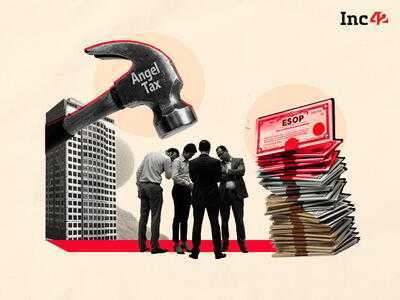
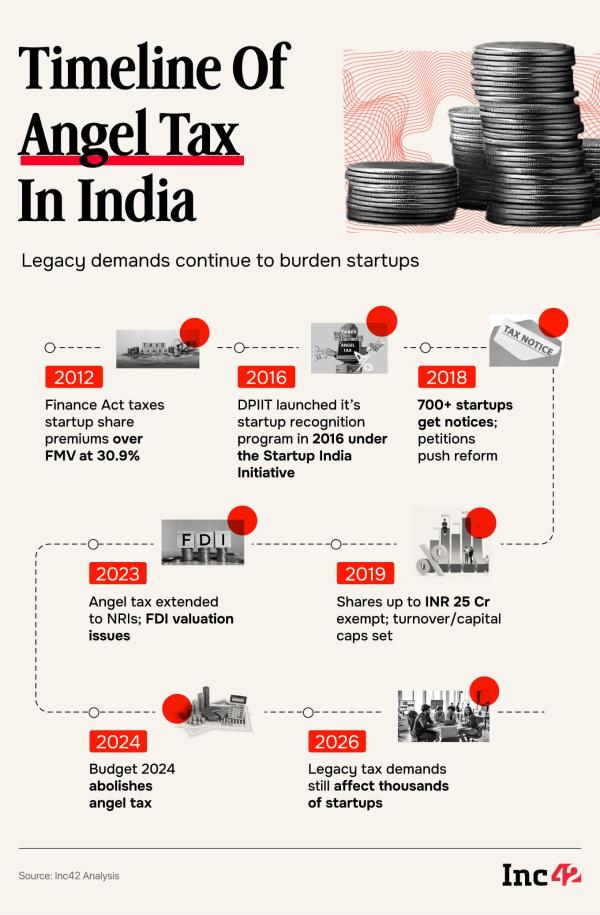
Angel Tax: The Lingering Impact Of A Rolled-Back LawThe Centre abolished the controversial angel tax provisions for startups in July 2024. Introduced to curb money laundering, under section 56(2) of the Income-tax Act,1961, the provision allowed tax authorities to treat capital raised by startups at a premium over fair market value as taxable income. The provision quickly became one of the most feared regulatory hurdles by startup founders.
While the startup ecosystem celebrated the decision to remove angel tax, the ghost of the dreaded provision continues to haunt the world’s third-largest startup ecosystem.
“Since November 1, 2019, there have been no hearings. We’ve submitted all the documentation, yet no action has been taken so far. The department is clueless on what to do,” Pushpinder Singh, founder and CEO of TravelKhana, told Inc42 Media, highlighting the need to address the pending angel tax cases.
According to Singh, the I-T department has already recovered INR 35 Lakh from his startup’s bank account, while simultaneously imposing a penalty of INR 2.3 Cr. The demand remains on the books, even as the angel tax provisions has been abolished.
Singh’s case is not an exception. There were at least 2,743 DPIIT-recognised startups facing scrutiny in 2023. This number is unlikely to have changed much. There are WhatsApp groups of hundreds of founders running startups across sectors, but with one thing in common – uncertainty over what happens to angel tax notice sent by the tax authorities to them. Even IPO-bound OYO was fighting a case against INR 1,140 Cr tax demand under the provision till July last year.
Nikunj Bubna, a Mumbai-based founder who received a tax notice under the provision in December 2017, said his case has remained unresolved for nearly eight years. “The law may no longer exist, but the demand raised in 2017 still stands against my company,” he said.
The unresolved liability continues to impact his startup. Bubna said an income tax refund of around INR 50,000 has been withheld for years, as the demand continues to be treated as legally outstanding. “My own money is stuck because of a tax provision that doesn’t even exist anymore,” he said.
More damaging was the impact on the business. At the time, Bubna was running a customer engagement software startup serving large retail chains, with deployments across around 450 stores, including café chains. In 2017-18, he was in talks to raise nearly INR 2 Cr in funding. That changed overnight once the tax demand notice of INR 50-60 Lakh was received under the angel tax provision.
Investors backed out almost immediately, wary that the penalty could consume a large portion of the incoming capital. Bubna said potential backers were unwilling to proceed unless he gave a personal assurance to shoulder the liability.
As funding conversations collapsed, customers began migrating to other vendors to avoid operational risks. Eventually, the startup shut down. “Not because the product failed, but because the tax demand made the company uninvestable,” he said.
Even after starting a new venture, the overhang remains. Bubna said any capital raise even today by his new startup requires disclosure of the pending tax matter, with the risk that a corporate liability could eventually translate into a personal one. “It hangs over you like a sword,” he added.
Investors want FM Sitharaman to bring an end to this lingering uncertainty. Bluehill Capital’s general partner Sridhar Parthasarathy pointed out that legacy tax liabilities often end up being priced into deals, even if they don’t kill them outright.
He said investors back future growth when infusing capital into a startup, and don’t want to deal with unresolved issues from the past. During due diligence, such cases frequently surface as deal-breakers, and even when promoters offer indemnities, they rarely carry enough financial weight to provide comfort.
The lack of clarity, Parthasarathy added, is what founders struggle with the most. Even when they believe their case is genuine, there is no certainty around how authorities will interpret it, whether appeals will move, or how long resolution might take, leaving startups stuck in regulatory limbo long after the law itself has disappeared.
“If this gets cleaned up in the Budget, it will make life easier for a lot of people and help them finally settle these matters,” said Abhishek Prasad, managing partner at Cornerstone Ventures.
The ESOP DilemmaRecently PhonePe filed its IPO papers, which revealed that cofounders sold shares worth about INR 4,000 Cr to General Atlantic. Founder and CEO Sameer Nigam clarified that the secondary share sale was not for personal liquidity but to meet tax obligations following exercise of vested ESOPs.
Notably, ESOPs in India face a structural tax issue: gains are taxed twice, first as a perquisite at the time of exercise, and then as capital gains when the shares are sold. This creates a cash-flow problem for employees, who often have to pay substantial taxes on shares that are illiquid and cannot be sold immediately.
A 2020 provision allows eligible startup employees to defer perquisite tax until sale, exit, or after five years. However, it applies only to DPIIT-recognised startups which are also certified by the Inter-Ministerial Board (IMB) under Section 80-IAC, and the provision does not remove the dual taxation burden.
Brijesh Damodaran, managing partner at Auxano Capital, pointed out that the deferral provision benefits only a small subset of DPIIT-recognised startups.
With the Indian startup ecosystem growing rapidly, investors believe there is a need to provide relief on double taxation of ESOPs to incentivise founders, innovators and employees to make in India.
As startups remain private for longer and exits become less predictable, the double taxation structure weakens ESOPs as a tool for employee retention and long-term value creation – especially when working at startups is seen as taking significant risk.
“Employees pay tax as if ESOPs are salary, and then pay capital gains when they sell, which can wipe out much of the upside. If you do the math, it can significantly reduce the expected ESOP multiple,” said Prasad.
Further, the complexity of ESOP rules goes beyond taxation. Currently, regulations don’t allow grant of ESOPs to founders after they have taken their startups public. “The law was written primarily for promoter-led companies, where the promoter typically owns 45-50% of the company,” said Siddharth Pai, founding partner at 3one4 Capital.
However, in most startups, founders hold only about 20-25% stake at most, he argued. Pai recommended that the government should allow founders to receive ESOPs in a controlled manner, subject to the consent of non-promoter group shareholders.
Last year, Lenskart cofounder Peyush Bansal sold a 1.2% stake via the offer-for-sale component of the IPO for over INR 820 Cr. Prior to the IPO, he acquired shares from existing investors at INR 52 per share in July. The issue price for the IPO was INR 402. The difference in price for the two transactions drew scrutiny.
Investors said this situation could have been avoided if ESOP allocation for promoters, even before filing IPO papers, was permitted.
Parthasarathy said it should be the board of directors that should determine if founders should get ESOP, not the government.
Citing US’ example, Pai said that executives there are only rewarded if their actions create measurable benefits for shareholders. If shareholders do not gain, the executive receives no payout. This, he said, is a strong alignment of interest.
Investors and founders believe there is a need to relook at the ESOP structure in India to incentivise innovation. The Union Budget presents an opportunity to address these issues. Measures that provide regulatory certainty and empower both founders and employees can unlock a new phase of growth.
Edited by Vinaykumar Rai
The post From Angel Tax To ESOP Stress: What Startups Want From Budget 2026 appeared first on Inc42 Media.
-
Leopard kills toddler, elephant tramples elderly in Uttarakhand

-
R-Day: Mayawati calls for ‘honest evaluation’ of governance
-
Big Concern For India As Washington Sundar Could Miss T20 World Cup 2026
-
Balancing Work, Family And Health: Simple Nutrition Habits For Busy Women

-
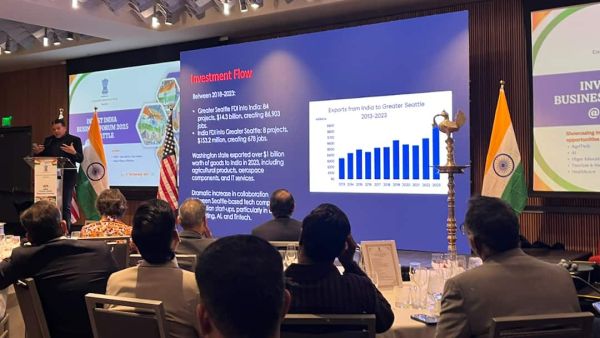
From AI To Ag-Tech: India Courts US Investors At Seattle Business Forum Ahead Of Landmark Trade Mission