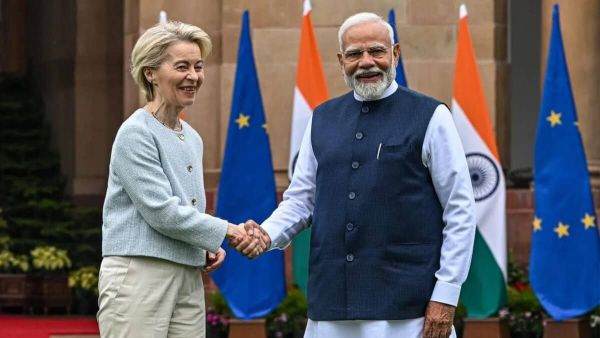
As New Delhi gears up to welcome the top leadership of the European Union as the chief guest for this week’s Republic Day celebrations and the upcoming summit, the signals from Brussels are increasingly positive.
India and the European Union are set to announce the conclusion of a free trade agreement, the firming up of a defence partnership pact, and a framework for the mobility of Indian professionals at the summit talks next week.
A military contingent from the EU, featuring the military staff flag and the flags of the naval operations Atalanta and Aspides, will participate in the Republic Day parade. It will be the EU’s first participation in such an event outside of Europe.

According to Reuters, “Once signed and ratified by the European Parliament—a process that could take at least a year—the agreement could significantly expand bilateral trade and boost Indian exports, notably textiles and jewellery, which have faced US tariffs of up to 50 per cent since late August.”
Currently, negotiations on investment protection and geographical indications (GIs) are being conducted separately, allowing the FTA to focus primarily on goods, services, and trade rules.
EU chief Ursula von der Leyen commented at the World Economic Forum last week, “Immediately after Davos, I will travel to India. There’s still work to be done, but we are on the cusp of a historic trade agreement,” highlighting the momentum in ongoing negotiations.
The India-EU FTA aims to lower or eliminate customs duties in many sectors such as technology, pharmaceuticals, automobiles, textiles, steel, and electrical machinery. Labour-intensive industries such as garments and leather are expected to gain a competitive advantage in EU markets, fostering hope of growth. India’s service exports in telecommunications and transport are expected to grow, fostering optimism about future growth.
Recently, India has signed trade pacts with the UK, Oman, and New Zealand, and has committed to boosting trade with the UAE to over $200 billion by 2032, underscoring confidence in India’s trade trajectory.
This India-EU pact will be the ninth trade deal in four years, reflecting New Delhi’s strategy to secure market access amidst rising global protectionism.
FTA offers the EU an opportunity to diversify supply chains, reduce reliance on China, and engage with India’s burgeoning $4.2 trillion economy. It supports a positive outlook for strengthened economic relations.
The EU will benefit from tariff reductions on high-demand products like wine, automobiles, and chemicals. It will also create new opportunities for EU exports to India. Both sides have agreed to exclude agriculture and dairy products from these reductions. This is to address New Delhi’s concerns about 700 million farmers.
Trade discussions between India and the EU resumed in 2022 after a nine-year hiatus. It has now gained urgency amid escalating global trade tensions. Following US President Donald Trump’s decision in August 2025 to double tariffs on Indian goods to as high as 50 per cent, India has increasingly sought alternative export markets.
The FTA and the deal would lessen dependence on China while tapping into India’s rapidly expanding USD 4.2 trillion economy.
The European Union (EU) is one of India’s main trading partners, along with the United States and China. In 2024/25, total trade between India and the EU exceeded USD 190 billion. During this time, India exported about USD 76 billion in goods and USD 30 billion in services to EU member countries.
In 2024/25, trade between India and the EU was over USD 190 billion. India exports about USD 76 billion worth of goods and around USD 30 billion in services to the EU. The average EU tariff on Indian products is about 3.8 per cent. However, some labour-intensive sectors still face a 10 per cent duty.
Ultimately, the new pact aims to enhance market access by reducing or eliminating customs duties, aligning regulations, and improving regulatory cooperation. It is expected to benefit various sectors, including technology-driven, pharmaceutical, and labour-intensive industries. Service exports from India in telecommunications, transport, and business services are also projected to grow substantially.
This agreement could create a market encompassing around two billion people and represent nearly a quarter of global GDP. It presents European companies with a unique first-mover advantage in one of the fastest-growing regions, fostering an optimistic outlook for future economic interactions.
In recent months, India has successfully negotiated trade agreements with the UK, Oman, and New Zealand. Last week, India and the UAE pledged to elevate their trade relationship to over USD 200 billion by 2032. They agreed on a USD 3 billion LNG purchase deal.
The proposed India-EU trade deal is comprehensive. It covers tariffs, services, investments, digital trade, sustainability standards, and regulatory cooperation to enable India’s access to a key trading partner.
India’s main concerns are the EU’s carbon border levy and high non-tariff barriers, such as regulatory delays and stringent standards. Addressing these issues is essential for a fair and effective deal.
After the pact is completed, Indian markets may soon see an influx of cheaper European cars and wines. Alongside the trade agreement, India and the EU are also expected to formalise a security and defence agreement, marking Europe’s third such pact in Asia, following similar agreements with Japan and South Korea.
After the summit, leaders from both sides will announce the details.
The two sides also expect to sign a security and defence pact – Europe’s third in Asia after deals with South Korea and Japan – along with a mobility agreement covering high-skilled workers and students, according to officials.
The EU is one of the top trading partners alongside the United States and China, with total bilateral trade in goods and services surpassing USD 190 billion in 2024/25. India exported approximately $76 billion in goods and $30 billion in services to the EU’s 27-member states.
In the fiscal year 2024/25, trade in goods and services between the two countries surpassed USD 190 billion. India exported approximately USD 76 billion in goods and USD 30 billion in services to the 27-nation bloc.
While the average EU tariffs on Indian products are relatively low at about 3.8 per cent, certain labour-intensive sectors, such as textiles and garments, still face duties of around 10per cent.
Ultimately, the proposed pact is expected to benefit multiple sectors, including technology-driven, pharmaceutical-based, and labour-intensive sectors. Besides, India’s service exports, with a strong focus on telecommunications, transport, and business services, are likely to grow.
This new agreement offers European companies a first-mover advantage in the fastest-growing regions, thereby cultivating an optimistic outlook for future economic prospects.
There has been progress on issues related to the agriculture sector, as both sides have “marked and mapped each other’s red lines” on it.
As Europe embraces new trade dynamics, differing approaches to world affairs and global political landscapes are prompting enhanced cooperation and mutual benefit in trade relations with India
-
AI talent war heats up: Why India Inc must build 10x organisations, not chase elite hires

-
Your honour, dissent is constitutional
-
'America plus one' still a challenge
-
Infosys caps WFO exemption at five days a quarter after Wipro & TCS tighten WFH norms

-
India-EU mobility pact to boost migration, jobs and student opportunities