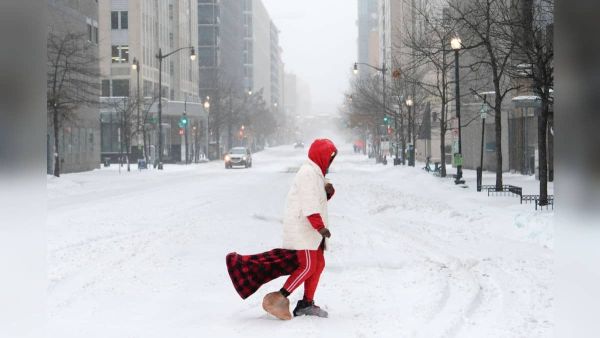
Washington: A powerful U.S. winter storm spread a paralyzing mix of heavy snow, sleet and freezing rain from the Ohio Valley and mid-South to New England on Sunday, compounded by bitter, Arctic cold gripping much of the nation east of the Rockies.
Winter storm warnings were posted for most of the eastern third of the United States covering 118 million people, as the deep freeze strained energy supplies in some areas, and the National Weather Service predicted widespread, prolonged travel disruptions.
The storm is stalled over us and we are already approaching 1ft mark here in N Mississauga! @stormwx1 @IWeatherON @WxOntario1 pic.twitter.com/b5eEouLqSk
— Saadia Alvi (@sadiaalvi) January 25, 2026
An estimated 157 million Americans were warned to bundle up against cold ranging from sub-zero temperatures along the Canadian border to below-freezing as far south as the Gulf of Mexico.
The Arctic blast was accompanied by gusty conditions that sent wind-chill conditions — a measure of how cold it feels based on the rate of heat loss from the body — plunging as low as minus 50 degrees Fahrenheit in the northern Plains.
Deep Snow, Thick Ice
Some of the heaviest snowfall, up to a foot or more since the storm developed on Friday, was measured on Sunday in parts of Colorado, Illinois, Indiana, Missouri, New Jersey, New York and Pennsylvania.
New York Governor Kathy Hochul said she had mobilized National Guard troops in New York City, Long Island and the Hudson Valley to assist with the state's emergency storm response.
Heavy snow and ice from a winter storm left over 1 million US customers without power and canceled over 10,000 flights https://t.co/EtdrUc5t1C pic.twitter.com/PWBJCO5guf
— Reuters (@Reuters) January 26, 2026
The onslaught of snow, ice and winds hit air travel especially hard, with major carriers forced to cancel more than 11,000 U.S. flights scheduled for Sunday, according to an industry tracking service FlightAware.com.
Ronald Reagan National Airport, located in northern Virginia just across the Potomac River from Washington, was effectively closed altogether.
Airports serving other major metropolitan areas, including New York, Philadelphia and Charlotte, North Carolina, had at least 80% of their Sunday flights canceled, FlightAware data showed.
Power outages were widespread across the South, where freezing rain deposited layers of ice up to an inch thick, toppling tree limbs and transmission lines.
More than 1 million homes and businesses in eight states from Texas to the Carolinas were without electricity at the height of the storm on Sunday, according to utility data posted online. Tennessee bore the greatest brunt of energy cuts, accounting for about a third of all the outages.
More than 959,000 electricity customers remained without power as of 7:05 p.m. EST (0005 GMT), according to PowerOutage.us.
Thank you to all of the city workers who have been working around the clock this weekend to keep us safe. No job is too small, no storm is too big. pic.twitter.com/TVuX3pCJIz
— Mayor Zohran Kwame Mamdani (@NYCMayor) January 25, 2026
Federal, State Governments Declare Emergencies
In parts of the mid-Atlantic, heavy snow early in the day gave way to sleet and freezing rain, adding to treacherous driving conditions and making it more difficult for street crews to safely clear road surfaces.
Heavy ice was reported by the weather service to be accumulating across the interior sections of the Eastern seaboard as far south as Atlanta, as the low-pressure system driving the storm moved through the Appalachian Mountains. Calling the storm "historic," President Donald Trump on Saturday approved federal emergency disaster declarations for a dozen states, mostly in the mid-South. Seventeen states and the District of Columbia declared weather emergencies on Saturday.
The Department of Energy on Saturday issued an emergency order authorizing the Electric Reliability Council of Texas to deploy backup generation resources at data centers and other major facilities, aiming to limit blackouts in the state.
On Sunday, the DOE issued an emergency order to authorize grid operator PJM Interconnection to run "specified resources" in the mid-Atlantic region, regardless of limits due to state laws or environmental permits.
While the storm system was expected to drift away from the East Coast into the Atlantic on Monday, more Arctic air was forecast to rush in behind it, prolonging bitter cold, icy conditions over the next few days, the weather service said.
"The situation with this storm is pretty unique, just because it's going to stay cold for a period of time," Homeland Security Secretary Kristi Noem said on the "Fox News Sunday Briefing" program. "This ice that has fallen will keep those (power) lines heavy, even if they haven't gone down immediately."
-
Delhi-NCR sees marginal relief in air quality after moderate rainfall
-
Kodibengre tragedy: Young woman dies during treatment

-
Mary Berry's lemon crunch cake from the 90s is a weekly hit in my family

-
Rannvijay Singha on 'Kohrra 2': Became more comfortable with all the layers I have in my personal life

-
Tragic plane crash in Pune: Maharashtra deputy CM Ajit Pawar among 4 dead