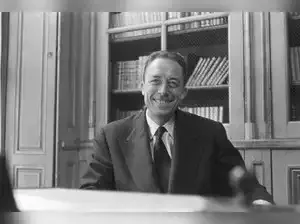
Quote of the day: In times marked by political uncertainty, social conformity and moral compromise, certain ideas return with renewed urgency. Among them is a reflection associated with French writer and philosopher Albert Camus, whose works repeatedly examined how individuals might preserve dignity and autonomy in restrictive or unjust conditions. The idea, often circulated as a modern-day maxim, urges resistance not through violence or slogans, but through the quiet assertion of personal freedom. Decades after Camus’ death, the thought continues to find relevance, particularly among readers confronting systems that limit choice, expression or moral agency.
Shared widely in classrooms, literary discussions and online forums, the quote has resurfaced as a reminder that rebellion need not always be collective or confrontational; it can also be lived quietly, through integrity and refusal to conform.
His philosophy rejected both blind obedience and ideological extremism. Instead, he argued that maintaining personal freedom, intellectual honesty, compassion and moderation was itself an act of defiance in a world inclined toward dogma and coercion.
These early experiences of deprivation and marginalisation shaped Camus’ sensitivity to injustice, while also instilling a deep respect for human dignity and restraint.
The illness forced Camus to confront mortality early, reinforcing themes that would later define his work: the fragility of life, the inevitability of death and the human struggle to find meaning despite these realities.
Though briefly associated with left-wing movements, Camus resisted strict ideological alignment. His commitment remained humanitarian rather than partisan, a stance that later set him apart from contemporaries such as Jean-Paul Sartre. For Camus, moral clarity could not be sacrificed to political expediency.
This was followed by The Myth of Sisyphus, an essay articulating Camus’ philosophy of the “absurd”, the conflict between humanity’s search for meaning and an indifferent universe. Rather than despair, Camus proposed conscious rebellion: continuing to live, choose and act with integrity despite meaninglessness.
In The Rebel, Camus explored the dangers of revolutionary violence, warning that movements claiming absolute truth often reproduced the very oppression they sought to destroy. True rebellion, he argued, must respect human limits and refuse to justify cruelty.
Less than three years later, Camus died in a car accident in France, cutting short a career that had already reshaped modern moral thought.
Quote of the day
Quote of the day by Albert Camus: “The only way to deal with an unfree world is to become so absolutely free that your very existence is an act of rebellion.”Quote of the day today
The Quote of the day today centres on freedom as an ethical stance rather than a political slogan. At a moment when public life is shaped by polarisation and surveillance, Camus’ reflection encourages individuals to examine how personal choices, intellectual, moral and emotional, can themselves become forms of resistance.Shared widely in classrooms, literary discussions and online forums, the quote has resurfaced as a reminder that rebellion need not always be collective or confrontational; it can also be lived quietly, through integrity and refusal to conform.
Quote of the day meaning
The Quote of the day meaning lies in Camus’ lifelong engagement with the tension between individual conscience and oppressive structures. For Camus, freedom was not absolute independence from society but the ability to live truthfully within it, without surrendering one’s moral judgement.His philosophy rejected both blind obedience and ideological extremism. Instead, he argued that maintaining personal freedom, intellectual honesty, compassion and moderation was itself an act of defiance in a world inclined toward dogma and coercion.
Quote of the day by Albert Camus
The Quote of the day by Albert Camus draws directly from themes explored across his essays, novels, and journalism. Born in 1913 in Mondovi, Algeria, then a French colony, Camus grew up amid poverty and political inequality. His father died in World War I when Camus was an infant, leaving his mother, a house cleaner of Spanish descent, to raise the family in a working-class district of Algiers.These early experiences of deprivation and marginalisation shaped Camus’ sensitivity to injustice, while also instilling a deep respect for human dignity and restraint.
Albert Camus: Education and intellectual awakening
Camus’ academic journey was made possible by scholarships and the encouragement of a dedicated schoolteacher, Louis Germain, whom Camus later credited as a formative influence. At the University of Algiers, he studied philosophy while supporting himself through various jobs, his education repeatedly interrupted by bouts of tuberculosis.The illness forced Camus to confront mortality early, reinforcing themes that would later define his work: the fragility of life, the inevitability of death and the human struggle to find meaning despite these realities.
Albert Camus: Journalism, politics and moral independence
Before achieving literary fame, Camus worked as a journalist, notably with Alger-Républicain, where he reported on social injustice and colonial inequality. His investigative pieces on the impoverished Kabylie region highlighted systemic neglect long before the Algerian War erupted.Though briefly associated with left-wing movements, Camus resisted strict ideological alignment. His commitment remained humanitarian rather than partisan, a stance that later set him apart from contemporaries such as Jean-Paul Sartre. For Camus, moral clarity could not be sacrificed to political expediency.
Albert Camus: Literature as resistance
Camus’ breakthrough novel L’Étranger (The Stranger), published in 1942, portrayed a protagonist condemned less for his crime than for his refusal to conform emotionally to societal expectations. The novel became a defining text of 20th-century alienation.This was followed by The Myth of Sisyphus, an essay articulating Camus’ philosophy of the “absurd”, the conflict between humanity’s search for meaning and an indifferent universe. Rather than despair, Camus proposed conscious rebellion: continuing to live, choose and act with integrity despite meaninglessness.
Albert Camus: From absurdity to rebellion
Camus’ later works marked a shift from absurdity to ethical resistance. La Peste (The Plague) depicted ordinary individuals confronting an epidemic, their heroism defined not by success but by perseverance and solidarity. The novel, often read as an allegory of fascism, emphasised moral responsibility over ideological victory.In The Rebel, Camus explored the dangers of revolutionary violence, warning that movements claiming absolute truth often reproduced the very oppression they sought to destroy. True rebellion, he argued, must respect human limits and refuse to justify cruelty.
Albert Camus: Nobel recognition and untimely death
In 1957, at the age of 44, Camus received the Nobel Prize for Literature, cited for illuminating “the problems of the human conscience in our times.” Characteristically modest, he questioned whether he deserved the honour.Less than three years later, Camus died in a car accident in France, cutting short a career that had already reshaped modern moral thought.