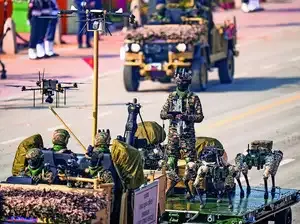
India showcased its cultural heritage celebrating 150 years of the national song Vande Mataram as well as military prowess by displaying a range of unmanned systems at the 77th Republic Day parade in the capital on Monday.
The parade, which stretched on the Kartavya Path from Rashtrapati Bhawan to the National War Memorial, was witnessed by thousands, including the Chief Guests for this year, President of the European Council Antonio Costa and President of the European Commission Ursula von der Leyen.
The theme of the parade this year was the national song, with several renditions of Vande Mataram being played out as tableaus from states and government departments rolled by. The 90 minute parade included a contingent of four flag bearers from the European Union.
On the military front, the focus was firmly on autonomous systems that have been inducted by the armed forces in recent months. On display were several weapons and drones that have been taken into service in the past few months, using emergency procurement powers granted to the armed forces in the aftermath of Operation Sindoor.
The operation, during which terror and military targets were struck with precision in Pakistan, was also depicted on a tableau that captured how the aerial strikes were conducted using Rafale fighter jets and air launched Brahmos missiles. As Monday turned out to be a clear day in the national capital, the flypast, which included several Rafale fighter jets, was carried out in good visibility.
The armed forces displayed a range of robotic dogs, autonomous mules and unmanned ground vehicles that have been inducted to support troops in forward areas as well as for urban warfare. A highlight was the display of several drones that have been inducted into service in recent months for roles ranging from precision strikes to logistics and surveillance.
A key highlight of the parade was the DRDO developed Long Range Anti-Ship Missile. Designed to meet the coastal battery requirements of the Indian Navy, the LR-AShM is a Hypersonic Glide Missile capable of engaging static and moving targets. Firing tests of the missile are currently being undertaken by DRDO.
The army's animal contingent, that included Bactrian Camels, Zanskar Ponies, Black Kites (Raptors) and Indian breed dogs equipped with bullet-resistant jackets, cameras, GPS, radios, and advanced surveillance systems, received a lot of attention at the parade as well.
The parade, which stretched on the Kartavya Path from Rashtrapati Bhawan to the National War Memorial, was witnessed by thousands, including the Chief Guests for this year, President of the European Council Antonio Costa and President of the European Commission Ursula von der Leyen.
The theme of the parade this year was the national song, with several renditions of Vande Mataram being played out as tableaus from states and government departments rolled by. The 90 minute parade included a contingent of four flag bearers from the European Union.
On the military front, the focus was firmly on autonomous systems that have been inducted by the armed forces in recent months. On display were several weapons and drones that have been taken into service in the past few months, using emergency procurement powers granted to the armed forces in the aftermath of Operation Sindoor.
The operation, during which terror and military targets were struck with precision in Pakistan, was also depicted on a tableau that captured how the aerial strikes were conducted using Rafale fighter jets and air launched Brahmos missiles. As Monday turned out to be a clear day in the national capital, the flypast, which included several Rafale fighter jets, was carried out in good visibility.
The armed forces displayed a range of robotic dogs, autonomous mules and unmanned ground vehicles that have been inducted to support troops in forward areas as well as for urban warfare. A highlight was the display of several drones that have been inducted into service in recent months for roles ranging from precision strikes to logistics and surveillance.
A key highlight of the parade was the DRDO developed Long Range Anti-Ship Missile. Designed to meet the coastal battery requirements of the Indian Navy, the LR-AShM is a Hypersonic Glide Missile capable of engaging static and moving targets. Firing tests of the missile are currently being undertaken by DRDO.
The army's animal contingent, that included Bactrian Camels, Zanskar Ponies, Black Kites (Raptors) and Indian breed dogs equipped with bullet-resistant jackets, cameras, GPS, radios, and advanced surveillance systems, received a lot of attention at the parade as well.