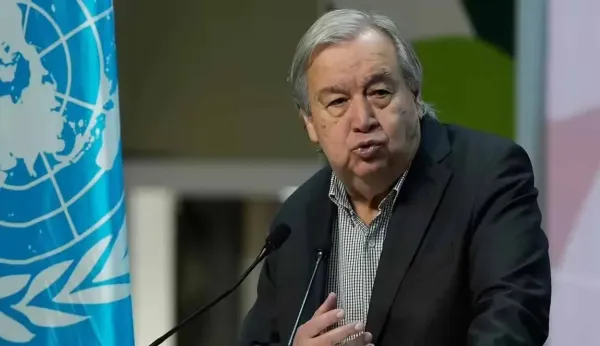
UN Chief: India and United Nations Secretary-General António Guterres have renewed calls for sweeping reforms to the UN Security Council, warning that the body’s current structure is increasingly unable to respond to modern global crises.
Calls for change amid mounting global strain
Speaking at a high-level open debate on reaffirming the international rule of law, India’s Permanent Representative to the United Nations, P. Harish, said the credibility of the world body is being tested as conflicts continue to spread with limited resolution. He argued that the Security Council’s inability to act decisively has exposed serious weaknesses at a time when international cooperation is under pressure.
Harish noted that paralysis and slow decision-making have become persistent problems, undermining confidence in the Council’s role as the primary guardian of global peace and security.
Need for broader and fairer representation
India emphasized that reform must go beyond procedural adjustments and include an expansion of permanent membership. According to Harish, strengthening the Council’s composition is essential if international law is to remain effective in a world that has changed dramatically since the UN’s founding.
He stressed that global governance institutions must adapt to reflect present-day realities, including shifting power balances, population changes, and increasingly complex security threats.
Guterres warns of erosion of rule of law
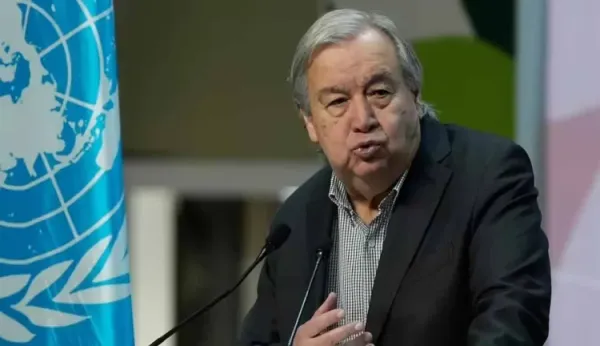
Secretary-General Guterres echoed these concerns, offering a stark assessment of the current international climate. He warned that, in many regions, respect for the rule of law is giving way to brute force and unilateral action.
Guterres underscored that the Security Council remains unique within the UN system. It is the only body whose decisions on peace and security are legally binding on all member states, and the only one authorized under the UN Charter to permit the use of force.
Reform seen as essential to UN relevance
Because of this exclusive mandate, Guterres said reforming the Council is no longer optional. He argued that improving both representation and effectiveness is critical to maintaining the legitimacy of multilateral decision-making.
Without such changes, he cautioned, the gap between the Council’s responsibilities and its ability to act will continue to widen, weakening the entire international system.
Risk of sidelining the United Nations
Harish also raised concerns about a growing trend toward alternative security arrangements outside the UN framework. As confidence in the Security Council wanes, he said, discussions on peace and security are increasingly shifting to smaller, parallel groupings, some of which involve private sector actors.
This movement, he warned, risks marginalizing the United Nations and fragmenting global responses to conflict.
A council rooted in a different era
Reflecting on the UN’s eight decades of existence, Harish pointed out that while the world has undergone profound transformation, the Security Council’s structure has remained largely unchanged. He described it as being anchored in an outdated geopolitical landscape that no longer reflects current realities.
Given evolving power dynamics and the nature of contemporary challenges, he argued that comprehensive reform is urgently needed, covering both permanent and non-permanent membership categories.
New initiatives raise fresh questions
Recent remarks by U.S. President Donald Trump have added another dimension to the debate. He has spoken publicly about creating a new “Board of Peace,” which he suggested could operate alongside, or in some cases independently of, the United Nations.
Although Trump later said the initiative would work in coordination with the UN, his comments were widely interpreted as signaling a reduced role for the world body. Both Guterres and India’s references to ad hoc and parallel arrangements were seen as responses to such initiatives.
Pressure builds for decisive action
As conflicts persist and new power centers emerge, pressure is mounting on UN member states to move beyond longstanding disagreements over reform. For India and the Secretary-General, the message was clear: without meaningful changes to the Security Council, the credibility and effectiveness of the United Nations itself are at risk.
-
Andhra Pradesh: Bus hits median, 29 passengers escape unhurt

-
Canadian PM Mark Carney calls Trump’s tariff threats bluster
-
India, EU sign landmark Free Trade Agreement, says PM Modi
-
Traffic curbs imposed as EU leaders set to visit Delhi’s Rajghat
-
The 50 shoot begins: First 10 captains announced, elimination done