
Karan Aggarwal
Co-founder & CIO, Ametra PMS, SEBI Registered
As India is running a current account deficit, annual currency depreciation of 2%-3% over a long-term is considered healthy as it helps in strengthening Indian exports and NRIs are typically expected to be compensated through better returns in Indian markets vis-à-vis home market. However, sharp annual INR depreciation (of 5% or more) against global currency baskets can trigger sub-optimal returns form Indian equity markets due to panic-stricken FII outflows.
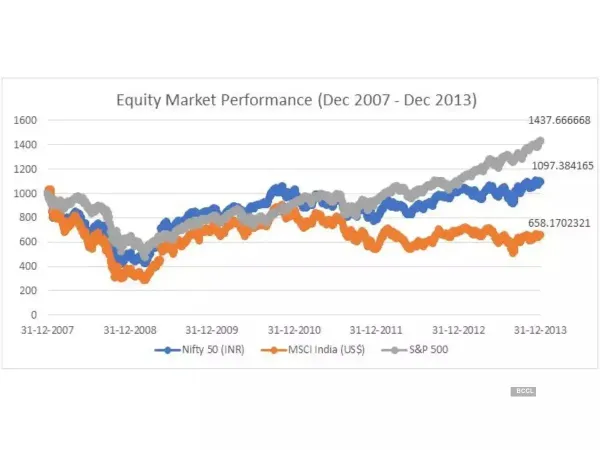
A look at history reveal that INR depreciation has always been a double whammy for investors as sharp INR depreciation against USD often is accompanied by periods of relative underperformance of Indian equities against S&P 500, leading to losses across twin dimensions of equity returns and currency exposure. Last spell of panic-driven INR depreciation took place during Dec 2007 – Dec 2013 (in range of near 43% against USD during 6 years) while US Dollar index in itself was flat during same period, indicating that INR was globally one of the worst-performing currencies in those years with currency performance one the key factors that propelled India’s entry into notorious group labelled as ‘Fragile 5’.
As readers can observe, during the period Dec 2007 – Dec 2013, Nifty 50 underperformed S&P 500 by a decent margin with cumulative returns of merely 10% vis-à-vis 40% for S&P 500. However, if consider returns of US-based NRI, INR depreciation crushed the India portfolio (MSCI India USD) with losses of near 34% during the period. On annualized basis, US-based NRI underperformed S&P 500 by 10%-12% on annualized basis.
(Join our ETNRI WhatsApp channel for all the latest updates)
Though NRIs can hedge against sharp swings in INR through currency derivative contracts but managing currency exposure comes with cost and complications and in case of surprise INR appreciation, it can also create cash flow problems for investors. Another way to manage the currency risk is through a diversified portfolio where 20% exposure is allocated to gold. However, gold is not a perfect hedge to INR as seen during Dec 2011-Dec 2013, when INR depreciated by nearly 30% within 18 months, gold added to problems by going down 20% in INR terms.
Considering available options, it makes sense for NRIs to invest in Indian market only return differential over S&P 500 is large enough to compensate for currency risk. In general, investors tend to rely on smallcap segment when they are looking for higher returns from Indian market. However, historically, smallcap alpha in Indian markets has not been large enough to compensate for currency risk and general underperformance in Indian market. As readers can observe form the chart, India SmallCap (USD) has delivered hardly any outperformance over S&P 500 and has marginally underperformed despite exposing investors to significantly higher downside risk.
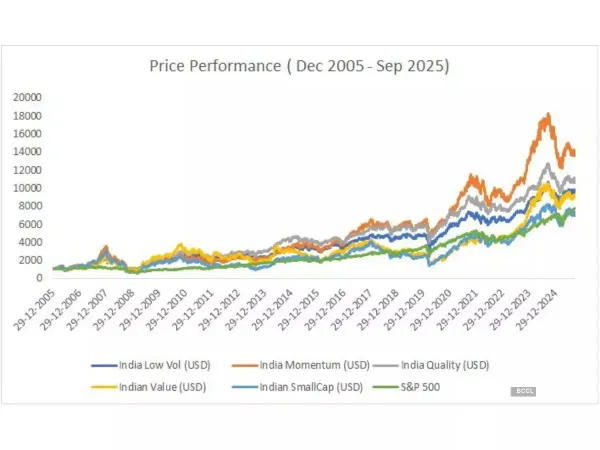
Over the last few years, factor investing has gained prominence in India with mostly largecap and midcap space in India is sliced-and-diced across different factors such as quality, momentum, volatility and value with portfolios concentrated in midcap/largecap stocks scoring high on respective factors. As readers can observe from chart, most of the factors have convincingly beaten S&P 500 during last 20 years and delivered a sizable alpha even after accounting for INR depreciation. Even though all factors have beaten S&P500 by a wide margin, Momentum and Quality coming out as best-performing factors with cumulative returns standing at nearly 2x vis-à-vis S&P 500. Interestingly, factor outperformance is coming with largecap/midcap exposure which indicate significantly lower risk exposure vis-à-vis smallcap, translating to reasonably higher risk-adjusted returns.
Having it would be interesting to see how these factors have done during the bad times where Indian equity markets are struggling and sharp currency depreciation is further compounding the woes for NRIs.
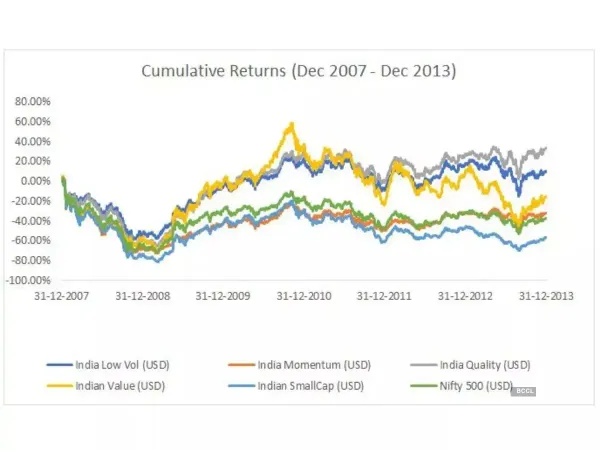
As readers can observe, low-risk factor portfolios such as Low-volatility and quality managed to deliver positive returns to investors (11% and 33%, respectively on cumulative basis) during these tough 6 years where broad Nifty 500 and Indian Small cap benchmark delivered cumulative USD returns of -37% and -57%, respectively.
However, it is noticeable the most successful factor over the period Dec 2005 – Sep 2025, Momentum, failed to deliver for NRIs during turbulent phase of Dec 2007 – Dec 2013 with zero alpha over underwhelming Nifty 500 USD returns. In fact, Momentum was underperforming Nifty 500 by a significant margin for a reasonably large portion in the period which leads to a logical conclusion that momentum factor performance outside this turbulent phase must be exceptional for NRI to come up as best-performing factor in last 20 years.
As readers can deduce form this cross-factor discussion that though factors have delivered outperformance to NRIs over last 20 years, each factor comes with their own unique risk/return profile and their performance across different market conditions can show significant variations. Rather than factor cycle risk, NRI investors are advised to go for a multi-factor approach or even better, a factor rotation approach. As readers can deduce from data that low volatility and quality factors maximize alpha during turbulent times while momentum factor can maximize alpha during bullish phase, factor rotation with right factor exposure inn line with market condition can built further on initial premise of factor alpha for NRI investors.
NRI investors with investable India corpus of up to US$ 100,000 must look at multi-factor approach with diversified India factor-based exposure. There are around 100 index funds/ETFs available in Indian investment landscape, providing investors sufficient options to build an optimal multi-factor portfolio providing exposure to different factors such as Momentum, Low Volatility, Value and Quality. On the other hand, NRIs having corpus larger than US$ 100,000 can approach professionals providing PMS and/or RIA services to explore potential of factor rotation approach which if implemented efficiently, can improve factor outperformance in USD terms by a wide margin.
A look at history reveal that INR depreciation has always been a double whammy for investors as sharp INR depreciation against USD often is accompanied by periods of relative underperformance of Indian equities against S&P 500, leading to losses across twin dimensions of equity returns and currency exposure. Last spell of panic-driven INR depreciation took place during Dec 2007 – Dec 2013 (in range of near 43% against USD during 6 years) while US Dollar index in itself was flat during same period, indicating that INR was globally one of the worst-performing currencies in those years with currency performance one the key factors that propelled India’s entry into notorious group labelled as ‘Fragile 5’.
As readers can observe, during the period Dec 2007 – Dec 2013, Nifty 50 underperformed S&P 500 by a decent margin with cumulative returns of merely 10% vis-à-vis 40% for S&P 500. However, if consider returns of US-based NRI, INR depreciation crushed the India portfolio (MSCI India USD) with losses of near 34% during the period. On annualized basis, US-based NRI underperformed S&P 500 by 10%-12% on annualized basis.
(Join our ETNRI WhatsApp channel for all the latest updates)
Though NRIs can hedge against sharp swings in INR through currency derivative contracts but managing currency exposure comes with cost and complications and in case of surprise INR appreciation, it can also create cash flow problems for investors. Another way to manage the currency risk is through a diversified portfolio where 20% exposure is allocated to gold. However, gold is not a perfect hedge to INR as seen during Dec 2011-Dec 2013, when INR depreciated by nearly 30% within 18 months, gold added to problems by going down 20% in INR terms.
Considering available options, it makes sense for NRIs to invest in Indian market only return differential over S&P 500 is large enough to compensate for currency risk. In general, investors tend to rely on smallcap segment when they are looking for higher returns from Indian market. However, historically, smallcap alpha in Indian markets has not been large enough to compensate for currency risk and general underperformance in Indian market. As readers can observe form the chart, India SmallCap (USD) has delivered hardly any outperformance over S&P 500 and has marginally underperformed despite exposing investors to significantly higher downside risk.
Over the last few years, factor investing has gained prominence in India with mostly largecap and midcap space in India is sliced-and-diced across different factors such as quality, momentum, volatility and value with portfolios concentrated in midcap/largecap stocks scoring high on respective factors. As readers can observe from chart, most of the factors have convincingly beaten S&P 500 during last 20 years and delivered a sizable alpha even after accounting for INR depreciation. Even though all factors have beaten S&P500 by a wide margin, Momentum and Quality coming out as best-performing factors with cumulative returns standing at nearly 2x vis-à-vis S&P 500. Interestingly, factor outperformance is coming with largecap/midcap exposure which indicate significantly lower risk exposure vis-à-vis smallcap, translating to reasonably higher risk-adjusted returns.
Having it would be interesting to see how these factors have done during the bad times where Indian equity markets are struggling and sharp currency depreciation is further compounding the woes for NRIs.
As readers can observe, low-risk factor portfolios such as Low-volatility and quality managed to deliver positive returns to investors (11% and 33%, respectively on cumulative basis) during these tough 6 years where broad Nifty 500 and Indian Small cap benchmark delivered cumulative USD returns of -37% and -57%, respectively.
However, it is noticeable the most successful factor over the period Dec 2005 – Sep 2025, Momentum, failed to deliver for NRIs during turbulent phase of Dec 2007 – Dec 2013 with zero alpha over underwhelming Nifty 500 USD returns. In fact, Momentum was underperforming Nifty 500 by a significant margin for a reasonably large portion in the period which leads to a logical conclusion that momentum factor performance outside this turbulent phase must be exceptional for NRI to come up as best-performing factor in last 20 years.
As readers can deduce form this cross-factor discussion that though factors have delivered outperformance to NRIs over last 20 years, each factor comes with their own unique risk/return profile and their performance across different market conditions can show significant variations. Rather than factor cycle risk, NRI investors are advised to go for a multi-factor approach or even better, a factor rotation approach. As readers can deduce from data that low volatility and quality factors maximize alpha during turbulent times while momentum factor can maximize alpha during bullish phase, factor rotation with right factor exposure inn line with market condition can built further on initial premise of factor alpha for NRI investors.
NRI investors with investable India corpus of up to US$ 100,000 must look at multi-factor approach with diversified India factor-based exposure. There are around 100 index funds/ETFs available in Indian investment landscape, providing investors sufficient options to build an optimal multi-factor portfolio providing exposure to different factors such as Momentum, Low Volatility, Value and Quality. On the other hand, NRIs having corpus larger than US$ 100,000 can approach professionals providing PMS and/or RIA services to explore potential of factor rotation approach which if implemented efficiently, can improve factor outperformance in USD terms by a wide margin.
(Disclaimer: The opinions expressed in this column are that of the writer. The facts and opinions expressed here do not reflect the views of www.economictimes.com.)