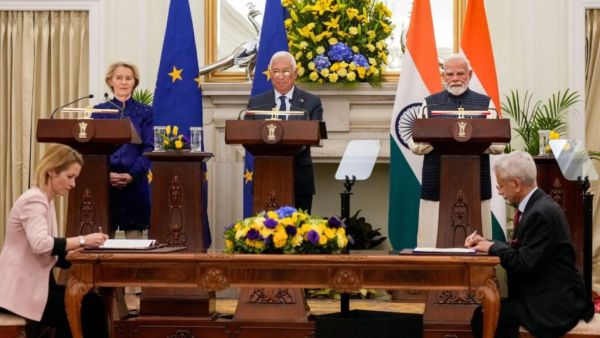
The much-awaited free trade agreement between India and the European Union (EU) has excited businessmen on both sides. All the businessmen of 27 EU countries and India are hopeful that there will be better options for them in the markets of these countries and this will benefit everyone from the businessmen of all the countries to the common people. It is expected that the car will become affordable for Indian customers. At the same time, the European market will prove to be very profitable for Indian textile, chemical and footwear businessmen. There will be no tax on 93 percent of India’s products, while taxes on the remaining products will also be reduced.
This agreement reached after negotiations that lasted for more than two decades has been called the biggest agreement so far. An official said that except vehicles and steel, almost all of India’s goods (more than 93 percent) will get entry into the European Union without any tax. For the remaining 6 percent, Indian exporters will get facilities like duty cuts and quota-based tax discounts (such as for automobiles).
How much relaxation will India give?
With the implementation of this FTA, the European Union will now eliminate import duty on 90 percent of India’s goods on the first day. The agreement is expected to come into force early next year. It has been told that the tax on other items will be abolished in a phased manner in the next 7 years. On this, an official said, ‘In this way the EU is giving concessions to India on 99.5 percent of the total trade.’
On the other hand, India will make such arrangements that in the next 10 years, 93 percent of the goods from the European Union become duty free in India. India will remove duty on only 30 percent of European goods on the first day of implementation of this agreement. Let us tell you that under this deal, India is also giving duty relief and quota based discount to the European Union on 3.7 percent of the trade value. Overall, India is offering duty concessions to the EU at 97.5 percent of the trade value.
The prices of which things will reduce?
The products which will now reach the European market without paying any duty (a type of tax) include Indian textiles, marine products, chemicals, plastics, rubber, leather and footwear. Apart from this, basic metal, gems and jewellery, furniture, toys and sports goods will also get this benefit. At present, duty on products from these sectors ranges from 0 to 26 percent in the European Union. This means that if something goes from India to Europe and its price here is Rs 100, then with 26 percent duty its price would become Rs 126. Now with the end of duty, this item will be available for only Rs 100.
India has also shown generosity for goods coming from EU under this FTA. To this an official said, ‘In our case, India will reduce the import duty to EU to zero in 10 years. The reduction to zero is initially limited. We will cut up to 30 per cent of our trade value when the agreement comes into force but gradually, we will reach zero on products comprising 93 per cent of our total bilateral trade value.’
What will change in the service sector?
In terms of service sector, the European Union has given India one of its best offers ever. It has opened 144 out of 155 sub-sectors for India while India is opening 102 sub-sectors for the European Union. On this the officer has said that apart from this, many things have also been discussed regarding the movement of students. He said, ‘We have also taken some decisions on work visa after studies from the European Union.’
Apart from trade in goods and services, the FTA also includes provisions on digital trade, sanitary and phytosanitary measures, technical barriers to trade and intellectual property rights. There is no chapter on energy, critical minerals and government procurement. Let us tell you that the average duty in the European Union is already low. This is about 3.8 per cent and under the trade deal they will be reduced to 0.1 per cent for India. Some of the sectors where duty is higher include marine products, chemicals, plastics and rubber. On all these, the European Union will eliminate duty for India under this agreement. India’s exports in these sectors totaled $35 billion in the year 2024.
What will happen to the automobile sector?
In the automobile sector, both the parties have talked about quota based concession because the demand of the European Union in this sector is very aggressive. India’s auto sector is largely dominated by small cars (Rs 10 lakh to Rs 25 lakh). European Union companies do not have much interest in this. On this the official said, ‘We have decided that the EU will not export to India those cars which are going to be sold in this country for less than Rs 25 lakh. They can manufacture them here.
On the other hand, above Rs 25 lakh, India’s market is limited but EU has more in it because they make good cars in this section. Currently, India’s import duty on automobiles ranges between 66 percent to 125 percent. Under the new agreement, India will not make any further reduction in duty apart from the fixed quota. India’s quota for electric vehicles will start from the fifth year of this agreement. The duty reduction for EVs will vary from section to section. On this the officer said, ‘In the first year it will be 35 percent in some sections and 30 percent in others. Then it will slowly go down.
What will be the effect on food and drinks?
India will not give any concession on duty in the dairy (including cheese), soya meal and cereals sectors. The European Union is also protecting its sugar, beef, meat and poultry sectors and will not make any concessions in this. India has received quota based concession for ‘table grapes’ (edible grapes) in the European Union. The European Union imports approximately $1.4 billion worth of table grapes annually.
On this the official said, ‘We are getting duty free market for about 100 million dollars i.e. 85,000 tonnes of grapes.’ India will gradually reduce duty over 7 years. The duty on expensive wines will also fall from 150 percent to 20 percent in seven years. On the other hand, there will be no concession for wines less than 2.5 euros. According to a ministry official, the bilateral trade in goods between the two sides currently stands at around $136 billion. It is expected to cross $200 billion within three to four years once the agreement is implemented. Similarly, services trade, which is currently around $80-85 billion, can increase to $125 billion.
-
Infosys’ recruitment drive offering record packages ends tomorrow

-
Insurtech startup Turtlemint files draft papers for Rs 2,000 crore IPO; listing likely by April

-
Meghalaya to host first spice festival in Mumbai to promote high-quality spices

-
Laura Dern honors final promise to Diane Ladd by opening up about her terminal lung disease

-
Camila Morrone's Something Very Bad Is Going To Happen release date, schedule and how to watch: Cast, storyline