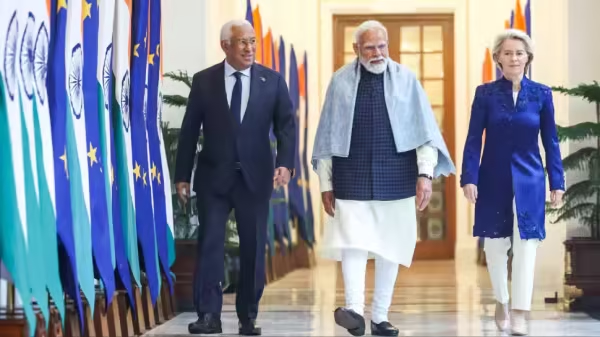
In what has been termed a “tectonic shift” in global trade, India and the European Union (EU) formally announced the completion of Free Trade Agreement (FTA) talks on Tuesday.
At a highly publicized summit held at Hyderabad House, Prime Minister Narendra Modi and European Commission President Ursula von der Leyen announced that the two trading behemoths had completed the “Mother of All Deals,” establishing a free trade area encompassing 2 billion people and a quarter of the world’s GDP.
The historic achievement: Why it was not signed on Tuesday
Add Zee News as a Preferred Source
While the mood was one of jubilation and the presence of the two leaders was a testament to the importance of the agreement, no signing ceremony took place. This was because the agreement has reached the stage of “concluded negotiations,” which is a political achievement rather than a legally binding one.
Before the agreement can be formally “signed” and implemented, the following procedural requirements must be fulfilled:
legal scrubbing: This is a technical examination where the legal teams of both parties verify that the 21+ chapters are harmonized, foolproof, and compliant with the domestic laws of each side. This process is expected to take 5 to 6 months.
translation: The document needs to be translated and authenticated in all 24 official languages of the EU.
Ratification: After the “scrubbing” process, the agreement needs to be ratified by the European Parliament and the Indian Union Cabinet.
It is expected that the signing process will take place towards the end of 2026, and the agreement will come into effect from early 2027.
Major highlights: What’s in the deal?
The historic trade agreement between India and the EU is a huge economic roadmap that will see the European Union’s exports to India double by 2032, offering businesses an incredible annual saving of around €4 billion ($4.35 billion) in customs duties. One of the biggest areas of agreement is in the automotive industry, where the current tariff of 110% will be reduced to just 10% for a certain quota of 250,000 vehicles per year. Similarly, fans of European luxury will enjoy an incredible reduction in tariffs for high-end wines and spirits, which will see the current tariff of 150% reduced to between 20% and 30%.
On the other side of the trade agreement, Indian industries are set to gain an incredible amount of ground with the EU offering duty-free access to the European market for key sectors such as textiles, leather, gems, and marine products. To ensure that the Indian economy remains stable, the trade agreement has carefully left out sensitive agricultural products such as beef, rice, and dairy products, which will not be part of the trade agreement, thus protecting millions of Indian farmers from global competition.
Geopolitical strategy: Hedging against ‘Trump tariffs’
The need to seal the deal comes against the backdrop of a volatile year in international trade. With US President Donald Trump continuing to impose high 50% tariffs on some Indian products and with transatlantic trade tensions running high, both New Delhi and Brussels have taken steps to shield themselves against the “unpredictable” trade policies of the US.
“In an uncertain world, this pact is a shield,” said a top trade analyst. With this deal, India has managed to place itself firmly in the stable alternative category to the US and China, securing its biggest-ever trade breakthrough with any country.
-
More than 490 vacancies to be filled in Bihar, applications open from January 31st

-
State Bank of India Announces Massive Recruitment Drive: Find Out Who Can Apply and How
-
Job Opportunity for Doctors and Scientific Officers: Know the Complete Application Detail

-
Job Opportunity for 12th Pass Candidates: Over 230 Vacancies in this State

-
India Energy Week: Union Minister Hardeep Singh Puri Calls For Sustained Investment