Moody’s Ratings said on Tuesday that India’s conclusion of trade negotiations with the European Union “reflects its continued efforts to selectively diversify trade relationships” and is expected to be credit positive.
“When in effect, the FTA will be credit positive, with lower tariffs and better market access supporting India’s ambition to develop the manufacturing sector, attract foreign investment, and strengthen the export competitiveness of its labor‑intensive goods,” Moody’s said.
Moody’s added that “lower tariffs on EU imports may also help ease costs, although such imports remain a smaller share of India’s overall import bill. European carmakers would gain easier access to the world’s third‑largest car market, allowing them to introduce more premium models under a calibrated liberalization framework: an opportunity for EU brands but adding competition for Indian manufacturers.”
“Ultimately, the broader benefits of the FTA will hinge on progress in complementary areas such as improving business friendliness and streamlining regulations,” Moody’s concluded.
Also read: India-EU FTA to cover 99% of Indian exports, 97% of EU exports, says Piyush Goyal
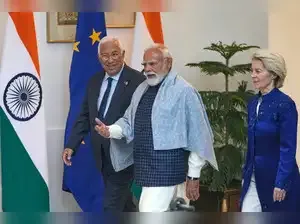
Goyal made the remarks at a joint press conference of the Ministry of Commerce and the Ministry of External Affairs on Tuesday evening, hours after New Delhi and Brussels formally concluded negotiations on what he described as the “mother of all deals”.
The pact brings to an end nearly two decades of on-again, off-again talks between the two economies and marks India’s eighth free trade agreement under Prime Minister Narendra Modi, all of them with developed economies. Collectively, these arrangements now cover trade with 37 advanced nations, underscoring what the government describes as a strategic recalibration of India’s external trade relationships.
India-EU agreement: This sector could be the outright winner
According to the minister, both sides chose to defer or ring-fence politically and economically sensitive issues to ensure progress. “Leaving the sensitive issues aside and coming up with a balance, equitable FTA which is a win-win for all sections of industry—on both sides,” Goyal said.
He underlined the scale of opportunity offered by the European market, noting that the EU imports goods worth about $6.5 trillion and services worth nearly $3 trillion annually, making it one of the world’s largest and most diversified consumption hubs.
Also read: India-EU FTA is a new blueprint for common prosperity, says PM Modi on 'mother of all deals'
“Both sides have ensured that sensitive items are kept out or given enough time for adjustment,” Goyal said.
Automobile liberalisation has been designed around a calibrated, quota-based framework, allowing European manufacturers limited access while preserving space for domestic manufacturing and potential future exports from India.
Goyal described the pact as a milestone for India’s competitiveness and employment prospects. “I congratulate 1.4 billion Indians today,” he said.
Also read: “We did it. We delivered the mother of all deals”: India, EU seal landmark FTA
Labour-intensive sectors, particularly textiles, are expected to be among the biggest beneficiaries. India currently exports around $7 billion worth of textiles to the EU each year, and improved market access could significantly raise that figure. The textile sector alone, Goyal said, has the potential to support 6–7 million jobs.
“There will be a large number of jobs to be created both in India and the European Union,” he said.
The formal signing of the agreement will take place after legal scrubbing, Commerce Secretary Rajesh Agrawal said earlier, after which the deal will move into the ratification process on both sides.
“When in effect, the FTA will be credit positive, with lower tariffs and better market access supporting India’s ambition to develop the manufacturing sector, attract foreign investment, and strengthen the export competitiveness of its labor‑intensive goods,” Moody’s said.
Moody’s added that “lower tariffs on EU imports may also help ease costs, although such imports remain a smaller share of India’s overall import bill. European carmakers would gain easier access to the world’s third‑largest car market, allowing them to introduce more premium models under a calibrated liberalization framework: an opportunity for EU brands but adding competition for Indian manufacturers.”
“Ultimately, the broader benefits of the FTA will hinge on progress in complementary areas such as improving business friendliness and streamlining regulations,” Moody’s concluded.
Also read: India-EU FTA to cover 99% of Indian exports, 97% of EU exports, says Piyush Goyal
A wide-ranging pact covering almost all trade
The India–European Union free trade agreement is set to span nearly the entire breadth of bilateral commerce, with duty concessions extending to almost all traded goods and services. Commerce and Industry Minister Piyush Goyal said on Tuesday that the agreement covers close to 99% of Indian exports to the EU and about 97% of European exports to India, making it one of the most comprehensive trade pacts concluded by either side.Goyal made the remarks at a joint press conference of the Ministry of Commerce and the Ministry of External Affairs on Tuesday evening, hours after New Delhi and Brussels formally concluded negotiations on what he described as the “mother of all deals”.
The pact brings to an end nearly two decades of on-again, off-again talks between the two economies and marks India’s eighth free trade agreement under Prime Minister Narendra Modi, all of them with developed economies. Collectively, these arrangements now cover trade with 37 advanced nations, underscoring what the government describes as a strategic recalibration of India’s external trade relationships.
India-EU agreement: This sector could be the outright winner
Breakthrough after two decades of talks
Calling the agreement a long-awaited breakthrough, Goyal said negotiations had intensified sharply over the past year. “This breakthrough between India and EU comes after 20 years,” he said, adding that the most demanding phase of talks began in 2024.According to the minister, both sides chose to defer or ring-fence politically and economically sensitive issues to ensure progress. “Leaving the sensitive issues aside and coming up with a balance, equitable FTA which is a win-win for all sections of industry—on both sides,” Goyal said.
He underlined the scale of opportunity offered by the European market, noting that the EU imports goods worth about $6.5 trillion and services worth nearly $3 trillion annually, making it one of the world’s largest and most diversified consumption hubs.
Also read: India-EU FTA is a new blueprint for common prosperity, says PM Modi on 'mother of all deals'
Market access with calibrated safeguards
Under the agreement, India will open selected segments of its market, including greater access for automobile components as well as wines and spirits. At the same time, negotiators have sought to shield vulnerable domestic sectors through exclusions or long transition periods.“Both sides have ensured that sensitive items are kept out or given enough time for adjustment,” Goyal said.
Automobile liberalisation has been designed around a calibrated, quota-based framework, allowing European manufacturers limited access while preserving space for domestic manufacturing and potential future exports from India.
Goyal described the pact as a milestone for India’s competitiveness and employment prospects. “I congratulate 1.4 billion Indians today,” he said.
Also read: “We did it. We delivered the mother of all deals”: India, EU seal landmark FTA
Labour-intensive sectors, particularly textiles, are expected to be among the biggest beneficiaries. India currently exports around $7 billion worth of textiles to the EU each year, and improved market access could significantly raise that figure. The textile sector alone, Goyal said, has the potential to support 6–7 million jobs.
“There will be a large number of jobs to be created both in India and the European Union,” he said.
The formal signing of the agreement will take place after legal scrubbing, Commerce Secretary Rajesh Agrawal said earlier, after which the deal will move into the ratification process on both sides.