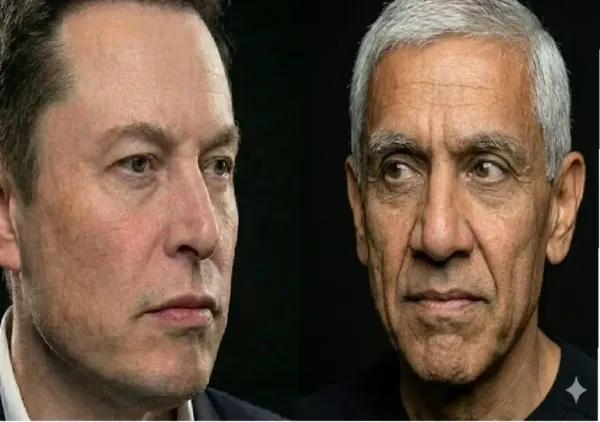
San Francisco: Renowned Indian American billionaire venture capitalist Vinod Khosla has sparked a fresh controversy after publicly urging employees working at companies led by Elon Musk, including Tesla and SpaceX, to resign and consider joining firms backed by his own venture capital portfolio. Khosla’s call was specifically directed at “non-white” employees and what he described as “decent white” staff, whom he suggested may not want to continue working under Musk due to what Khosla alleged were racist and divisive views promoted by the billionaire entrepreneur.
The comments, made in a post on X, have reignited debate around Musk’s public statements on race, immigration and demographics, as well as the broader responsibility of corporate leaders whose social media presence can influence millions globally.
Khosla’s post and allegations against Musk
In his post, Khosla resurfaced a comment made by Musk in September 2025, in which the Tesla and SpaceX chief executive wrote, “White people are a rapidly diminishing minority of the global population.” Khosla described the statement as incendiary and racist, accusing Musk of promoting an ideology centred on race rather than merit.
“@elonmusk doesn’t want MAGA, he wants WAGA or ‘white America great again’ as a ‘racism is great and desirable’ paradigm,” Khosla wrote. He went on to urge “all non-whites in @tesla, @SpaceX, @X etc and all decent whites” to resign from Musk-run companies and “join our portfolio,” even inviting interested professionals to email their LinkedIn profiles to him.
The remarks were widely shared and debated on social media, with screenshots of Khosla’s post circulating across platforms. While some users praised him for calling out what they see as troubling rhetoric from Musk, others accused Khosla of using equally polarising language.
Musk’s comments under renewed scrutiny
Although Khosla referred to an older post, Musk’s more recent comments on immigration and demographics have continued to attract criticism. Earlier this month, Musk faced backlash after reacting with a “100” emoji to a post claiming that white men could face existential danger if they became a minority. The emoji, often used online to signal strong agreement, was interpreted by critics as an endorsement of the sentiment.
Immigration has become a recurring theme in Musk’s online commentary in recent months. He has repeatedly argued that large-scale migration could destabilise societies, framing his concerns around public safety, economic strain and social cohesion. Musk has insisted that his views are not rooted in race, but critics argue that the language he uses often overlaps with talking points popular among nationalist and far-right groups.
International backlash to Musk’s rhetoric
Musk’s statements have not been limited to the United States. In the United Kingdom, he drew sharp criticism from political leaders after appearing via video at an anti-immigration rally. During the event, Musk warned protesters that “violence is coming” and urged them to “fight back or die,” remarks that were condemned across the political spectrum.
UK Prime Minister Keir Starmer described Musk’s language as “dangerous and inflammatory,” though the British government stopped short of imposing any sanctions on him. The episode intensified debate about the influence of global business leaders on domestic political discourse.
In Japan, Musk also courted controversy after voicing support for an anti-immigration protest associated with the rise of a nationalist “Japanese First” party. Responding positively to footage of demonstrators demanding the deportation of illegal immigrants, Musk was accused of amplifying nationalist rhetoric in another country’s political landscape.
Musk’s defence against accusations of racism
Responding to repeated accusations of racism, Musk has maintained that he opposes discrimination against all groups. In several posts, he has argued that he is “equally opposed” to laws that target people based on race, whether they discriminate against Black people, white people or any other racial group.
“I am extremely opposed to anti-Black laws, but equally opposed to the laws against White people or other races too. There should be a fair and even playing field,” Musk wrote, asserting that his views are rooted in equality under the law rather than racial hierarchy.
Supporters of Musk often point to these statements as evidence that his positions are being misrepresented, while critics argue that his selective amplification of certain narratives tells a different story.
Mixed reactions to Khosla’s call
Khosla’s appeal to employees of Musk-run companies has drawn a mixed response. Some commentators said his remarks highlighted the immense power Musk holds over public discourse and the importance of holding influential figures accountable for their words. Others, however, argued that Khosla’s framing was itself racially charged and risked deepening existing divisions.
Several X users questioned whether urging people to quit their jobs based on the political views of a company’s founder was practical or fair, especially for employees who may not share those views but depend on their jobs for livelihood. Critics also noted that Khosla’s call could further polarise discussions around race and identity in the technology sector.
Conclusion
The exchange between Vinod Khosla and Elon Musk underscores how debates around race, immigration and identity have increasingly spilled into corporate and professional spaces. As tech leaders continue to wield enormous influence beyond their companies, their words are scrutinised not just as personal opinions but as signals that can shape workplace culture and public debate. Whether Khosla’s call leads to any tangible movement of talent remains to be seen, but the episode highlights the growing intersection of politics, identity and power in the global technology industry.
-
Going to the toilet more often is tell-tale sign you might have 'fatal' illness

-
Going to the toilet more often is tell-tale sign you might have 'fatal' illness
-
'New fraud': SC questions minority claim by upper-caste candidates after converting to Buddhism
-
'New fraud': SC questions minority claim by upper-caste candidates after converting to Buddhism
-
PMQs chaos erupts as Lindsay Hoyle forced to intervene over Lee Anderson question