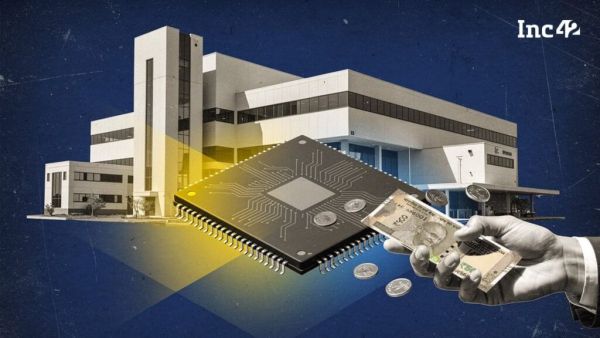
Tata Electronics’ upcoming Dholera fab will enable Indian semiconductor startups to conduct prototype chip tape-outs domestically at 28–90 nm nodes
India’s semiconductor push is beginning to translate into on-ground progress, with Micron’s $2.75 Bn ATMP facility in Gujarat’s Sanand expected to start commercial production by February
Meanwhile, VC funding in Indian semiconductor startups rose to about $50 Mn in 2025, yet remains modest due to long timelines, capital intensity and limited near-term commercial validation
Adding to the regulatory push to further build the prowess of India’s semiconductor industry, Union minister for electronics and IT Ashwini Vaishnaw announced that Tata Electronics’ upcoming semiconductor fabrication plant in Dholera will aid Indian semiconductor startups to build prototype chips. Once operational, the support from the plant will add on to the assistance already provided via the state-run Semiconductor Laboratory (SCL) in Mohali.
During his interaction with semiconductor chip design companies operating under the Semicon India Programme, the Minister informed that the upcoming facility will be used for chip “tape-outs”, the stage where a chip’s final design is sent to a fabrication unit to produce early samples for testing and validation.
At present, most Indian startups rely on overseas fabs like Taiwan’s TSMC and US-based GlobalFoundries for tape-outs. The export of the fabrication process raises costs, increases turnaround time and limits startups’ ability to improve their designs.
The Dholera plant will support chip designs in the 28-90 nm range. In comparison, SCL Mohali currently operates at the 180 nm node, which restricts startups from working on relatively newer and more commercially relevant designs. Vaishnaw said that together, the two facilities would cover a large share of the chips used in global electronics applications.
The minister was speaking after meeting 24 chip design startups selected under the government’s Design Linked Incentive (DLI) scheme. Of these, 14 startups have raised around INR 430 Cr in venture funding, as per the government.
Currently, SCL Mohali supports tape-outs for startups and academic institutions, mainly through shared wafer runs. However, the facility’s older technology has been a bottleneck. To address this, the government has announced a plan to modernise SCL Mohali over three years with an investment of INR 4,500 Cr.
Under the next phase of the DLI scheme, the government plans to expand support to more fabless semiconductor startups. The focus will be on six chip categories: compute systems, radio frequency, networking, power management, sensors and memory.
The news comes at a time when India’s semiconductor push is beginning to move from policy intent to early execution. A key milestone on this front is US-based Micron Technology’s India facility in Gujarat’s Sanand, which is expected to begin commercial semiconductor production by the end of February.
Micron’s project involves a total investment of up to $2.75 Bn under the India Semiconductor Mission (ISM), including fiscal incentives from the Centre and the Gujarat government. Construction began in mid-2023, with around 60% of Phase-1 work completed by late 2024.
Tata Projects is executing the build, and the facility is expected to be handed over to Micron by December 2025, after which the company will share its operational and production timelines.
Venture Capital Still In Wait-And-Watch Mode
Despite the growing policy momentum, venture capital participation in India’s semiconductor ecosystem continues to remain cautious. In 2025, Indian semiconductor startups raised roughly $50 Mn, a 79% jump from $28 Mn raised by such startups in 2024.
While this reflects an upward trend in VC interest, funding levels remain modest compared to other deeptech or software segments.
Industry observers attribute this gap to multiple structural factors. Semiconductor manufacturing is capital-intensive and execution-heavy, making it better suited to large, established companies rather than venture-backed startups.
As a result, many of the government’s biggest incentives, including those under ISM and PLI, are flowing towards large electronics and semiconductor players, with startups benefiting only indirectly.
That said, investor interest is slowly shifting towards less capital-intensive segments of the semiconductor stack. Areas such as chip design, RISC-V-based architectures, AI accelerators, edge computing chips and specialised ASICs are increasingly seen as more aligned with venture economics.
-
10 Ways To Know In You are Being Too Available for Your Partner

-
Tiny but filthy rich country without an airport is Europe's 'least visited'

-
This Former New Zealand Star Will Now Play for Scotland at T20 World Cup 2026

-
Kanye West Apologises For His Anti-Semitic Remarks And Here's What He Said

-
"I am calling it off": Arijit Singh announces he is not going to take "any new assignments" as playback vocalist