At the Australian National University in the capital city of Canberra, an international student from China said the cost of food came as an unwelcome shock to her.
“I ate instant noodles or fast food until I found work,” she told ABCspeaking on condition of anonymity.
Hesitant to ask her family for support, she took on jobs alongside her studies, working up to the maximum 48 hours per fortnight allowed under Australia’s student visa rules.
But balancing work and study soon took a toll, leaving her under immense stress.
“I couldn’t really sleep well and (…) I was very anxious about many things,” she said.
Situations like hers are not rare as financial strain hits international students across the country.
Some 30.7% of them regularly skip meals because of grocery costs while nearly one in four said they cannot afford fresh fruit and vegetables, according to the 2024 State of Student Healthcare Report released by insurance firm Allianz Partners Australia last March.
Housing insecurity is also a growing concern. Sean Stimson, a senior solicitor at the Redfern Legal Centre’s International Student Legal Service, noted late last May that homelessness among international students had risen over the preceding 18 months due to steep rent increases.
The situation was bad enough that Erin Longbottom, nurse unit manager of the homeless health service at St Vincent’s Hospital in Sydney, described international students as the emerging “hidden face of homelessness.”
Research published in 2024 by the Student Accommodation Council found that international students are at a disadvantage in the private rental market.
They “have no previous rental history living in Australia, and they usually do not have jobs or income statements when they are applying for leases,” the report noted, according to SBS News.
Although students must demonstrate access to A$30,000 (US$20,700) to obtain a visa, Stimson said those funds can be depleted quickly amid rising living costs.
|
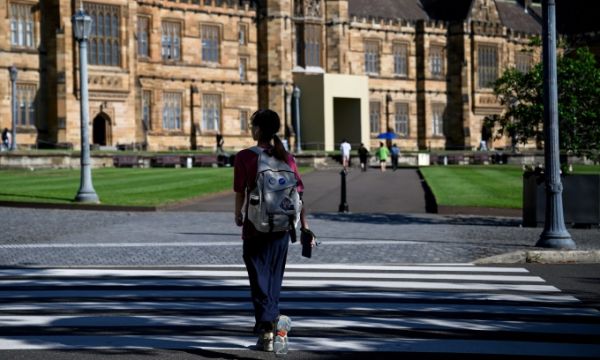
Students are seen at the University of Sydney, Camperdown campus, in Sydney, New South Wales, Friday, March 14, 2025. Photo by AAPIMAGE via Reuters |
Beyond housing and food, tuition fees are also more expensive. Dr. Abul Rizvi, an expert on immigration, said fees for international students have been rising “much faster than inflation” in recent years.
“That’s particularly the case for the higher-tier universities and the more extensive courses such as medicine,” he told The Sydney Morning Herald.
More than 583 courses charge international students over $250,000, with 445 of those offered by Group of Eight universities, which comprises the country’s leading research-intensive universities. In some cases, the total cost of a degree can exceed A$850,000.
These students are paying up to eight times more in fees than their domestic counterparts, according to government data obtained by the International Students Representative Council of Australia, a national peak body representing and advocating for international students.
Earning enough through part-time jobs to cover tuition is simply not realistic given academic demands and other living expenses, said Ariye Sunilkumar Monee, an international student from India.
She is pursuing a master’s degree in professional electrical engineering at the University of Sydney, one of the Group of Eight schools, after completing her undergraduate studies at home. For international students, the three-year postgraduate program carries a price tag of $180,035.87 in 2025.
To manage the fees, Sunilkumar Monee has to rely on an education loan. “I am not (…) making my parents struggle to pay my fees.”
Financial stress weighs on students
The Allianz report also found that more than 61% of surveyed international students said daily expenses were far higher than they had anticipated, with accommodation costs being the most commonly underestimated, followed by healthcare, dining out, travel home and groceries.
Only 18.2% said they felt financially secure while 40.2% fell into financial stress or hardship, with many relying on credit, family assistance or support from welfare organizations to cope. Most concerning, some 28.1% said they had considered dropping out because of financial stress.
Alan Morris, a professor focusing on urban and housing studies at the University of Technology Sydney who previously co-authored a report on international students, said: “There is a lot of suffering out there amongst international students, an enormous amount of stress and anxiety as they try to not only deal with their academic studies, but also try and survive financially.”
They tend to deprioritize their studies because they are so focused on surviving financially, he noted.
More work hours may not be the solution
According to Rizvi, Australia’s relatively generous work rules for international students are often cited as part of its global appeal.
“The more generous the work rights, the more you (can) offset the higher cost,” he said.
However, experts caution that raising the work hour limit is unlikely to solve the cost-of-living pressures facing international students.
Phil Honeywood, chief executive of the International Education Association of Australia, warned that it could come at the expense of their academic results.
Morris likewise said some students who juggle two or three jobs often experience a dramatic drop in academic performance.
Instead, Morris suggests, Australia could draw lessons from the innovative housing model in Canada that pairs international students with older residents.
“In exchange for cheaper rents, the student helps the elder person in terms of washing up, taking the dustbins out, maybe watches TV a couple of nights a week with them,” he explained. “It’s a win-win situation.”
At the same time, many international students are adapting on their own to cope with rising costs and make the most of their situation.
Queenie Kwan Yee Siu, a researcher at the Australian National University who studies the Hong Kong diaspora, said students were using the cost-of-living squeeze as an opportunity to develop practical skills, such as learning to cook or drive, to save money.
“That’s still very attractive to international students,” she said.
Despite the hardship, many of them still deem studying in Australia worthwhile. Sunilkumar Monee said the cost is “too much, but still, it’s worth it.”
-
10 Ways To Know In You are Being Too Available for Your Partner

-
Tiny but filthy rich country without an airport is Europe's 'least visited'

-
This Former New Zealand Star Will Now Play for Scotland at T20 World Cup 2026

-
Kanye West Apologises For His Anti-Semitic Remarks And Here's What He Said

-
"I am calling it off": Arijit Singh announces he is not going to take "any new assignments" as playback vocalist