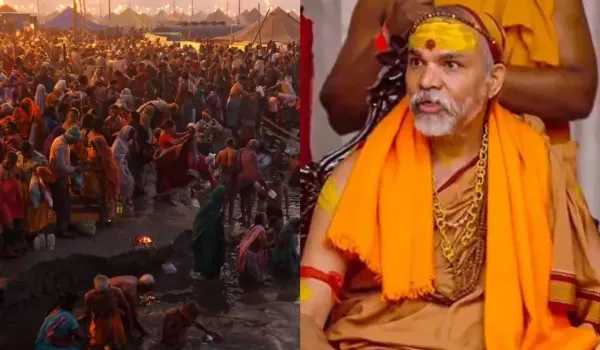
Prayagraj : After nearly ten days of public protest and strained exchanges with local authorities, Shankaracharya Swami Avimukteshwaranand Saraswati departed Prayagraj on Wednesday without performing the customary ritual bath at the Sangam during the Magh Mela. The seer left for Kashi in a vanity van, visibly unsettled by the events that unfolded during his stay.
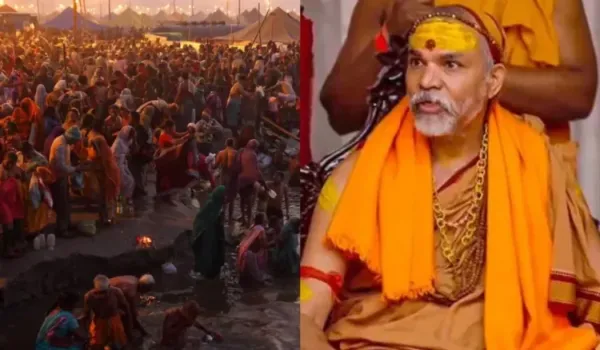
Before his departure, he briefly addressed his followers, conveying a sense of personal anguish. He said leaving the city without entering the sacred waters was something he had never expected in his lifetime. Prayagraj, he noted, has long symbolized faith, harmony, and spiritual reassurance for millions, including himself. What transpired this year, however, left him emotionally shaken and unable to continue his religious observances there.
Emotional Departure From a Sacred City
The Shankaracharya described his decision as deeply painful, emphasizing that his presence at Prayagraj was rooted in devotion rather than confrontation. He explained that a particular incident during the auspicious period had profoundly disturbed him, affecting not only his spiritual state but also his trust in fairness and compassion. According to him, the experience raised broader concerns about how religious sentiments are handled during major spiritual gatherings.
He added that the emotional toll of the episode made it impossible for him to find solace, even in rituals that normally offer peace and closure. For him, the sanctity of the act could not be separated from the state of mind in which it was performed.
Offer by Authorities Declined
A day before his exit, officials from the Magh Mela administration reportedly reached out with a conciliatory proposal. The plan involved escorting him to the Sangam in a palanquin, accompanied by senior officers, ensuring ceremonial respect during the holy dip. Despite the gesture, the Shankaracharya declined.
Explaining his refusal, he stated that ritual acts lose their meaning when performed amid unresolved grief and resentment. In his view, respect offered after the damage had been done could not restore inner calm or address the larger issue that had led to the standoff.
Worship Conducted Before Leaving
Prior to setting out for Kashi, the seer completed prayers and traditional rites outside his camp. Observers noted that the rituals were carried out quietly, without public ceremony. Shortly afterward, he began his journey, bringing an abrupt end to his participation in the ongoing Magh Mela.
His early departure marked a rare moment in the event’s history, as senior religious figures typically conclude their stay with a ceremonial bath at the confluence of the rivers.
How the Dispute Began
The controversy traces back to Mauni Amavasya on January 18, one of the most significant bathing dates of the Magh Mela. On that day, authorities halted the Shankaracharya’s palanquin while it was en route to the Sangam. Officials cited an unusually heavy influx of devotees and expressed concerns over crowd safety, requesting that he proceed on foot instead.
The request triggered protests from his followers, who objected to what they perceived as a lack of due respect. Tensions escalated, and reports later emerged of scuffles between disciples and mela police personnel.
Sit-In Protest and Administrative Notices
In response, the Shankaracharya began a sit-in protest outside his camp, refusing to enter it for ten days. During this period, the administration issued formal notices asking him to submit documentation confirming his status as a Shankaracharya. He responded to these notices through official channels, but the exchange further strained relations.
Supporters argued that the demand itself was inappropriate, while authorities maintained it was a procedural requirement amid the unfolding dispute.
Political Remarks Add to Tensions
The situation intensified after a public speech by Chief Minister Yogi Adityanath in Haryana, where he warned against figures he described as harming the image of Sanatan dharma. The remarks were widely interpreted as a reference to the Shankaracharya, though no names were mentioned.
In response, Avimukteshwaranand made sharp counter-statements, drawing comparisons involving historical and mythological figures. These exchanges transformed an administrative disagreement into a broader political and religious confrontation, deepening divisions and drawing national attention.
-
Suspected KFD death reported in Thirthahalli, first this year
-
Maharashtra Deputy Chief Minister Eknath Shinde Mourns the Loss of Ajit Pawar in Tragic Plane Crash
-
Falcon Risers Hyderabad Clinches Victory with Vicky Bhoir's Hat-Trick in ISPL Season 3
-
Maharashtra in shock as Dy CM Ajit Pawar passes away; Leaders recall fearless 'Dada'
-
Good Morning Britain halts show to issue urgent warning just minutes into show