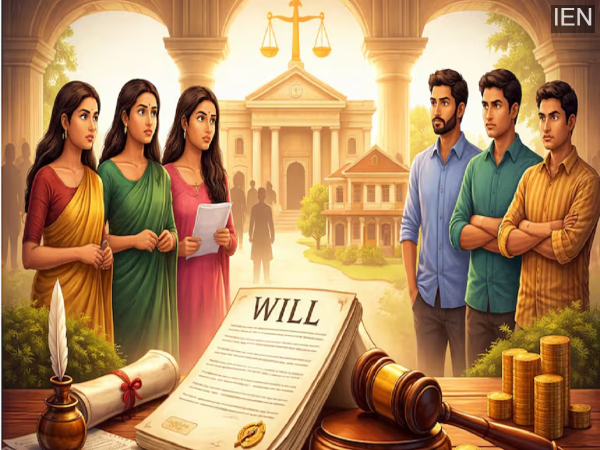
Property disputes within families are among the most common legal conflicts in India, especially when parents leave behind a will that is not registered. Questions often arise about whether such a will is legally valid, whether daughters still have equal rights, and how property should be divided among sons and daughters. Indian law provides clear answers to these concerns, particularly after the Hindu Succession (Amendment) Act, 2005.
A recent case highlights these issues. After a father passed away in 2022, a dispute emerged between his sons and daughters over the division of his property. Although he had prepared a will during his lifetime, it was never registered. In 2024, the daughters approached the court, claiming equal rights under the law. A key factor in this case was that the property had been purchased by the father using his own earnings and was not inherited ancestral property.
Is the Property Ancestral or Self-Acquired?
According to legal experts, property purchased after 1956 using an individual’s own income is treated as self-acquired property, not ancestral property. Under Hindu law, ancestral property is inherited across generations and belongs to the Hindu Undivided Family (HUF).
In this case, since the father bought the property with his own earnings, it is considered his personal asset. This distinction is important because the owner of self-acquired property has full legal authority to decide how it should be distributed through a will.
Is an Unregistered Will Legally Valid?
One of the most common misconceptions is that a will must be registered to be legally valid. Indian law does not make registration mandatory. A will is considered valid if:
-
It is written voluntarily,
-
It is signed by the person making the will (testator),
-
It is witnessed by at least two individuals,
-
It can be proven that it was not created under pressure, fraud, or coercion.
Therefore, a will cannot be rejected solely because it is unregistered. Courts focus more on authenticity and intent rather than registration status.
Do Daughters Lose Their Rights if There Is a Will?
Under the Hindu Succession (Amendment) Act, 2005, daughters enjoy equal rights as sons in family property. If a will clearly mentions the share given to daughters, they are legally entitled to that portion.
Even when a will exists, daughters cannot be automatically excluded unless the will specifically states otherwise. The law ensures that daughters are not denied their rightful inheritance simply because of gender.
What Happens If There Is No Will?
If a person dies without leaving a will, the situation is known as intestate succession. In such cases, property is divided equally among all Class I legal heirs. These typically include:
-
All sons and daughters,
-
The surviving spouse,
-
The mother of the deceased (if alive).
Each heir receives an equal share, regardless of gender.
What if the Will Covers Only Part of the Property?
Sometimes, a will mentions only certain assets and leaves out others. This is called a partial will. In such cases:
-
The property mentioned in the will is distributed according to its instructions,
-
Any property not mentioned in the will is divided equally among all legal heirs under intestate succession rules.
This mixed approach ensures fairness while respecting the wishes of the deceased.
Key Legal Principles in Property Division
From legal interpretations and court rulings, several points become clear:
-
An unregistered will can still be legally valid,
-
Daughters have equal inheritance rights as sons,
-
Self-acquired property can be distributed as per the will,
-
Property not included in the will must be shared equally among heirs,
-
Courts prioritize proof of authenticity over formal registration.
Why a Clear Will Matters
Legal experts strongly recommend preparing a well-drafted and clear will to avoid disputes among family members. When families have multiple heirs, unclear or incomplete wills often lead to long legal battles, emotional stress, and financial loss.
A properly written will should clearly list all assets and specify how they are to be divided. This prevents confusion and ensures that the wishes of the property owner are honored without prolonged court cases.
Conclusion
In India, an unregistered will is not automatically invalid, and daughters retain equal rights in property inheritance under the law. Whether property is ancestral or self-acquired plays a crucial role in determining how it is divided. Courts evaluate each case based on the authenticity of the will and the legal status of the property.
To avoid family conflicts and legal complications, it is essential for individuals to create a clear and comprehensive will during their lifetime. Doing so not only protects the interests of heirs but also preserves harmony within families and ensures smooth transfer of property.
-
Martin Lewis speaks about 'particularly good' bank account for couples

-
Punjab's health insurance scheme impractical, publicity-driven: BJP
-
Himachal secures first place for average response time in distress, says CM Sukhu
-
Nitish Kumar launches, inaugurates projects worth Rs 136 crore in Darbhanga
-
Tragic Warehouse Fire in Kolkata Claims Lives and Sparks Rescue Efforts