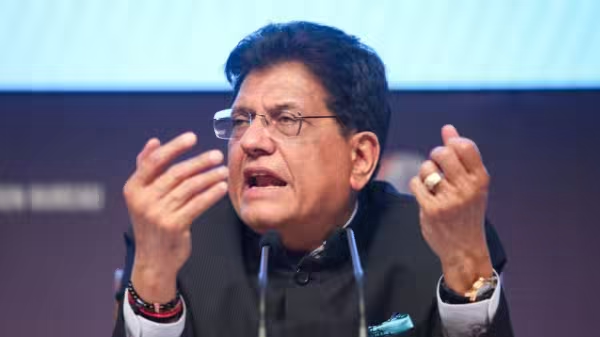
New Delhi: Union Commerce and Industry Minister Piyush Goyal on Wednesday strongly defended the India-European Union free trade agreement, pushing back against Congress criticism and asserting that the pact is a mutually beneficial arrangement that will drive economic growth and create new opportunities for Indian businesses and citizens.
The Congress had earlier questioned the Modi government’s handling of the negotiations after the deal was announced, raising objections over key provisions of the agreement.
Among the concerns flagged by the party was the lack of exemption for Indian aluminum and steel exporters from the European Union’s Carbon Border Adjustment Mechanism, along with criticism of tariff reductions or relief on over 96 per cent of EU exports to India.
Add Zee News as a Preferred Source
Congress General Secretary Jairam Ramesh also pointed to the EU’s strict health and product safety standards, which will continue to apply to Indian exports even after the agreement takes effect. He further highlighted issues to refined fuels, one of India’s largest export categories to the EU.
Responding to these remarks, Goyal took to social media and said it was ironic that those who failed to take decisions while in power were now questioning decisive action. He said such criticism reflected a disconnect from economic realities.
The Union Minister said the country had paid a heavy price in the past for missed opportunities, resulting in losses in jobs, income and growth, and added that voters have repeatedly rejected such indecision.
In a post on He urged leaders to open doors for opportunity rather than act as obstacles to prosperity.
Taking aim at Ramesh’s description of the pact as “hugely hyped,” Goyal said it was puzzling that a deal being hailed globally as the “mother of all trade agreements” was being dismissed so lightly.
He pointed to the combined GDP of $25 trillion, total trade of $11 trillion, a common market of 2 billion people, and $33 billion worth of India’s labour-intensive exports gaining immediate access, arguing that the two economies are largely complementary.
Reiterating that the agreement safeguards India’s interests, Goyal stressed that it was not a zero-sum arrangement. “It is a win-win deal that will accelerate growth and unlock wide-ranging opportunities for Indian enterprises and people,” he said.
Addressing concerns around the Carbon Border Adjustment Mechanism, the minister said India has actively engaged with the EU to protect domestic exporters in sectors such as steel and aluminium, and workable solutions have been identified.
He said sensitive issues were being handled through dialogue and mutual trust rather than rigid or confrontational approaches.
Goyal added that the pact reflects a long-term strategic partnership built on respect and cooperation, strengthening global trade linkages.
Referring to the automobile sector, he said the agreement’s phased and quota-based approach, including a delayed rollout for electric vehicles, is aimed at supporting the Make in India initiative.
He explained that relaxed norms for completely knocked down imports would encourage European automakers to establish assembly units in India, gradually shifting from imports to local assembly and eventually full localisation.
This transition, he said, would bring advanced manufacturing processes, higher quality standards and cutting-edge research and development into India, while expanding consumer choice and improving safety and technology standards.
The India-EU trade agreement was announced earlier this week in New Delhi and has been described by leaders on both sides as the largest trade pact in India’s history. European Commission President Ursula von der Leyen termed it the “mother of all deals,” saying it creates a free-trade zone of 2 billion people with benefits for both sides.
The pact links two of the world’s largest economies at a time marked by global trade tensions and geopolitical uncertainty.
(With inputs from IANS)
-
Hyderabad police invokes PD Act against rowdy sheeter for third time
-
Little children chant ‘Jai Shri Ram’ in front of mosque in Bihar

-
Failing To Keep Up With Your Fitness Routine? Try Out Reset Diet To Detox

-
Which Clubs Could Challenge Real Madrid In Champions League Playoff Stage After Missing Direct Spot In Round Of 16
-
Invincible No More, Bayern Munich Aim To Make Amends Against Hamburg In Bundesliga