Highlights
- Trial and pilot programs for drone last-mile delivery are expanding worldwide.
- Healthcare and emergency logistics are currently the most successful real-world drone use cases.
- Regulation and urban airspace safety remain major barriers for mass adoption.
- Public concerns around privacy, noise, and trust are key obstacles to acceptance.
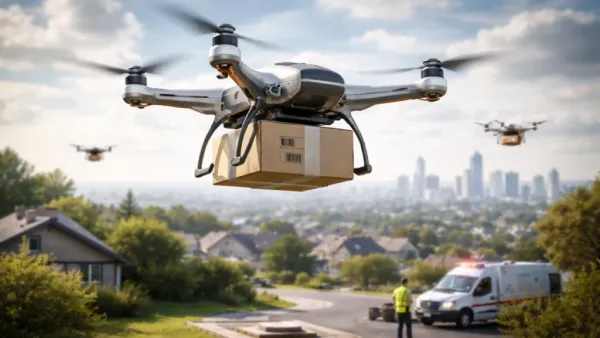
The last-mile delivery was always the most expensive and complicated part of logistics. The continuous growth of e-commerce, food delivery, and on-demand services prompts companies to seek ways to transport goods over short distances that are faster, cleaner, and more efficient. Drones for delivery have become one of the most widely debated solutions that aim to evade traffic jams, reduce delivery times, and cut carbon emissions.
Over the last ten years, the Autonomous Delivery Drones have traveled from being only experimental ideas to performing real-world pilot projects in several countries. Although the technology has matured a lot, the large-scale deployment is still uneven. The global drone delivery scene today is characterized not only by innovation but also by regulatory caution, public concerns, and practical limitations.
The Working Mechanics of Autonomous Delivery Drones
The autonomous delivery drone system consists of advanced hardware and software integrated systems. These usually consist of GPS navigation, computer vision, obstacle detection sensors, cameras on board, and autonomous flying algorithms. Those devices operate together and enable the drones to plan their routes, avoid obstacles, and drop the packages with little human assistance.
The majority of delivery drones are made to be able to transport small payloads, which are, in most cases, under five kilograms, and the distance they can fly is also quite limited. More often, they follow the flight paths that have been approved beforehand and are monitored using cloud-based systems that also provide the coordination and safety overrides. A human operator usually monitors several drones at the same time, but only intervenes if there is an issue.
Nevertheless, although they have autonomy, the delivery drones of today can still not be considered as fully independent systems. They are, in fact, operating in very tightly controlled environments, which is a reflection of the cautious approach that both regulators and companies have taken toward aerial automation.
Global Deployment: Where Drone Delivery Is Working
Drone delivery has gained the most popularity in certain use cases characterized by high-value, rather than general consumer delivery. The healthcare logistics have been the best example of it.
Drones are used in remote or hard-to-reach areas to transport:
- Vaccines and medical supplies
- Blood samples and laboratory materials
- Emergency medicines during natural disasters
These applications give priority to speed and accessibility rather than cost, which makes the use of drones especially valuable in places where traditional transport is slow or unreliable.

In addition to the healthcare sector, very few pilot programs in total have been conducted that involved the use of drones for food, groceries, and small consumer goods delivery in suburban and rural areas. These trials show that the technology is feasible, but they often remain limited in size and duration.
Urban vs Rural Deployment Challenges
The effectiveness of deployment differs a lot between urban and rural areas. In rural places, drones can fly freely because of less congested airspace, fewer obstacles, and a low population. Hence, the safety risks and regulatory complexity are also reduced, which in turn makes rural deployments more attractive.
Urban settings, on the contrary, pose significant hurdles. The presence of heavy infrastructure, the movement of a large number of people, and the intricacy of the aerial space all add to the collision and accident risk. The noise and light pollution associated with drones further make it difficult for the public to accept the idea of drones in the air.

Thus, companies are putting their emphasis on the suburbs and outskirts of cities as the best zones for drone operations, where the latter would meet fewer restrictions while being able to service the populated areas at the same time.
Barriers to Legislation and Control of Airspace
The regulation is the most significant obstacle of all to the acceptance of drone delivery on a large scale. The airspace in the majority of countries is controlled strictly, and the aviation authorities demand that safety standards be met before approving the use of autonomous aircraft in that area.
Some of the most important regulatory issues are as follows:
- Manned aircraft collision avoidance
- Requirement for a visual line-of-sight
- Pilot and operator certification
- Setting up emergency fail-safe mechanisms
The majority of countries have laws that only permit delivery drones to operate in limited areas designated for beyond-visual-line-of-sight activities, which thereby dictate the altitude and manner of their travel. There is a gradual development of regulatory frameworks, but the process is slow because of the risks that are considered.
The drone delivery market will take a cautious and slow approach to expansion until global standards become more aligned and uniform.
Issues of Privacy and Surveillance, and Trust of the Public
Public perception, apart from regulation, is a major factor determining the future of delivery drones. The issues of privacy and surveillance, more so, are always raised in the case of urban settings.
Drones for deliveries usually depend on the use of cameras and sensors as their guide for safe navigation. These technologies are meant for the purpose of obstacle detection, but they also contribute to the fears of unintended data gathering. Some community members may resist the technology, as they fear being inadvertently recorded when their consent was never given.
One major issue that needs to be tackled is noise pollution. Plus, a drone, no matter how small, is going to be emitting a buzzing noise that continuously disturbs the surroundings, and in the case of big areas, the excitement can get out of hand.
Furthermore, the public is lacking trust due to no clear policies being propagated on data protection, flight frequency, and community involvement.
In the end, it seems that deliveries by drone would be less harmful to the environment than using other means of transportation, at least when it comes to e-commerce deliveries, which has been the case so far, with the environmental pros and cons always depending on the mass and method of the electric drone. Thus, if drones are to be credited with taking the place of trucks in the delivery of goods, then the emission level would be close to nothing since electric drones would produce less carbon than a fuel-driven truck for short distances.
As it turns out, the existing benefit-to-cost ratio may not be that great if drones simply interfere with the current delivery channels rather than taking over completely. On the other hand, the proper costly execution and the regulated trial that goes beyond just being the company’s input retail is the requirement of a sustainably convenient operation.

Due to this, from the business side, drone delivery is still an expensive service. The hardware costs, maintenance, regulatory compliance, and insurance are all part of the operational expenses. Drones may lead to a decrease in labor costs, but they also present new technical and infrastructural requirements.
Right now, delivery by drone is most suitable for:
- When speed is of utmost importance
- Where it is hard to get to the place
- Delivery personnel are at risk, or delivery takes a long time
- In the case of common city deliveries, human couriers and old vehicles are still the most flexible and cost-effective option
The Role of Human Oversight
Even if the autonomy is emphasised, humans are still very much a part of the drone delivery operations. The remote pilots, system monitors, and maintenance teams are the ones ensuring that all operations are done in a safe way and according to the rules.
Instead of replacing jobs from the beginning to the end, drone delivery is most probably going to change the labour roles, thus bringing in the demand for technical operators, maintenance specialists, and airspace coordinators.
This hybrid system is an indication of the wider reality of automation — tech is here to uplift human systems rather than wiping them out completely.
Future Outlook: Cautious Progress, Not Overnight Change
Autonomous delivery drones do represent a really nice image when it comes to the future of logistics, but they are not a one-size-fits-all solution. The very success of these drones will be dependent not only on the technological capability but also on the context, regulatory measures, and public acceptance.
Jason Blackeye/Unsplash
Gradually, in the near future, drone deliveries are expected to get larger at a slow pace through specific use cases like healthcare, disaster response, and remote location logistics. The overall adoption of drones for consumer delivery will take a long time as it will require significant advancement in regulation, infrastructure, and consumer trust.
Conclusion
Delivering drones proved that it is possible to have autonomous logistics for the last mile. What is still not clear is how widely and responsibly the technology can be adopted. Drones are brilliant in particular cases, but still face a lot of barriers in crowded cities and restricted airspaces.
The path of robot delivery in the future will not be determined by speed only, but by the balance between innovation and safety, effectiveness and privacy, aspirations and regulations. While the trade-offs are being explored and managed by the authorities, corporations, and localities, the use of delivery drones will probably be limited to a specific sector, yet still be recognized as an influential tool in global logistics.
-
More than 490 vacancies to be filled in Bihar, applications open from January 31st

-
State Bank of India Announces Massive Recruitment Drive: Find Out Who Can Apply and How

-
Job Opportunity for Doctors and Scientific Officers: Know the Complete Application Detail

-
Job Opportunity for 12th Pass Candidates: Over 230 Vacancies in this State

-
India Energy Week: Union Minister Hardeep Singh Puri Calls For Sustained Investment