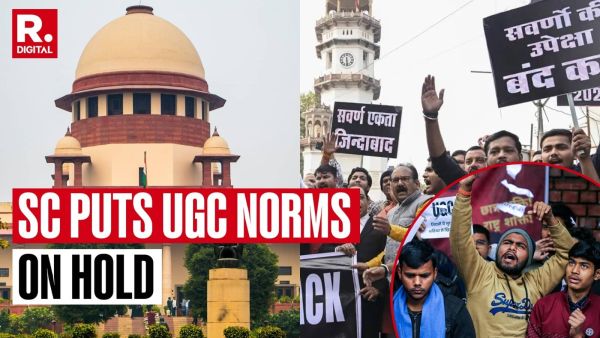
New Delhi: The Supreme Court on Thursday stayed the University Grants Commission’s (UGC) Promotion of Equity in Higher Education Institutions Regulations, 2026, observing that several provisions were prima facie vague, capable of misuse and could have far-reaching consequences if allowed to operate in their present form.
A Bench headed by Chief Justice Surya Kant ordered that the regulations shall remain in abeyance until the Centre redrafts them, directing that the 2012 UGC regulations continue to operate in the interim. The court invoked its powers under Article 142 of the Constitution to ensure that the existing grievance redressal mechanism for students from marginalised communities is not dismantled.
“If we don’t intervene, it will divide the society,” the Chief Justice said, adding that the court could not allow safeguards built over the years to be diluted. “Are we going backwards from whatever we have gained in terms of achieving a casteless society?” the Bench asked during the hearing.
‘We cannot go further backward…if we don’t intervene, it will divide the society’: CJI comes down heavily on UGC, new 2026 norms put on hold until Centre redrafts it
— Republic (@republic) January 29, 2026
Tune in to LIVE TV for fastest #BREAKING alerts - https://t.co/0EuxFx84n0 pic.twitter.com/hNkX3c4gfQ
The new UGC regulations, notified on January 13, were challenged by various petitioners as being arbitrary, exclusionary, discriminatory and in violation of the Constitution as well as the University Grants Commission Act, 1956.
The top court was hearing a batch of petitions challenging the new UGC regulations aimed at preventing caste-based discrimination in universities and colleges. The petitioners contended that the 2026 framework was arbitrary, exclusionary and violated Article 14 of the Constitution, which guarantees equality before law, as well as the University Grants Commission Act, 1956.
The court noted that the language of the regulations was “completely vague” and required remodulation. “Prima facie, the provisions are capable of misuse,” the Bench observed, stressing that experts would need to rework the wording to ensure clarity and prevent exploitation.
At the same time, the Chief Justice made it clear that the court’s concern lay in protecting existing remedies for historically disadvantaged groups. “Victims cannot be left remediless,” CJI Kant said, clarifying that the court was not examining complaints relating to general category students at this stage. “Our concern is that the redressal system for members of the reserved communities should remain in force,” the SC said.
Accordingly, the court directed that the 2012 UGC regulations, which mandate institutional mechanisms to address complaints of caste-based discrimination, will continue until the new rules are redrafted and reconsidered.
"We want free, equitable and inclusive atmosphere in educational institutions. Unity of India must be reflected in our educational institutions. We are simply examining it on threshold of constitutionality and legality," the apex court said.
The Supreme Court also issued notice to the Union Government, with the Solicitor General accepting notice on its behalf. The matter has been posted for further hearing on March 19, and the petitions have been tagged with an earlier plea pending since 2019 that challenges the constitutional validity of the 2012 regulations themselves.
The Controversy
The UGC Equity Regulations, 2026, notified earlier this month, were intended to strengthen safeguards against caste discrimination in higher education institutions by mandating equity committees, helplines and monitoring mechanisms. However, they quickly sparked nationwide protests and political debate.
The new norms mandate every college and university to set up a special body called an Equal Opportunity Centre (EOC) on campus. The UGC has asked institutions to set up special committees, helplines and monitoring teams to handle complaints, especially from SC, ST and OBC students.
Critics argued that while the regulations expanded the definition of discrimination to explicitly include Other Backward Classes (OBCs), they did not provide equivalent, explicit protections to general category students. Allegations of “reverse discrimination” were raised, with petitioners claiming the framework violated the constitutional guarantee of equality.
Another major point of contention was the definition of caste-based discrimination itself, which critics said was overly broad and vague, increasing the risk of misuse. The absence of penalties for false or malicious complaints was also cited as a serious flaw.
Student protests were reported in Delhi University, Lucknow and other campuses, while political reactions followed across party lines. Even as the Union Government defended the intent behind the regulations, the Supreme Court’s intervention has now halted their implementation.
-
Operation Sindoor, AR Rehman's 'Jai Ho' spice up Beating Retreat experience

-
New weather map shows UK hit with huge 530-mile blanket of snow as far south as Sussex

-
Explained: Google Chrome's Auto Browse and how Gemini browses the web for you

-
Clothing brand with 20 UK high street stores opens in famous city shopping centre

-
Opposition targets DMK govt over women's safety after Nandanam college assault