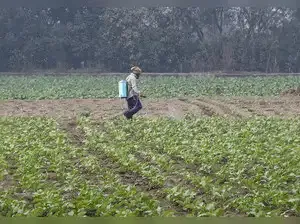
The gap between production value and export performance underscores the vast untapped potential for expanding agricultural trade, according to the Economic Survey 2026, released on Thursday. The volatility in domestic prices and output has often led trade policy of the country to be used for short-term goals, such as curbing inflation through product-specific measures like ad hoc export bans or minimum export prices.
According to the WTO’s World Trade Statistics, the country’s share in global agricultural exports has increased only modestly from 1.1% in 2000 to 2.2% in 2024.24. “This disparity between production value and export performance highlights the significant untapped potential for expanding trade in agricultural products,” says the Economic Survey.
For context, between FY20 and FY25, India’s merchandise exports grew with a compounded average growth rate (CAGR) of 6.9%. In comparison, agricultural exports increased from $34.5 billion to $51.1 billion, registering a CAGR of 8.2%. During the same period, the share of agricultural exports in the country’s merchandise exports has varied between 11% and 14%. However, between FY23 and FY25, the country’s agriculture exports have stagnated, while the global export of agricultural products rose from $2.3 trillion in CY 2022 to $2.4 trillion in CY 2024. India is the world’s second-largest agricultural producer by value.
India could reach $100 billion in combined agricultural, marine, and food exports within four years, the Survey notes. However, exports remain constrained by food security concerns, infrastructure gaps, processing capacity and regulations. Price and output volatility has also led to short-term trade interventions such as export bans and minimum export prices, which disrupt supply chains, create uncertainty, and risk permanent loss of export markets, it says.
While such steps may briefly stabilise prices, they risk long-term reputational damage, especially as India is seen as a supplier of high-quality farm produce, the Survey notes. Instead, price stability can be ensured through targeted domestic measures such as PDS subsidies, buffer stock management, open market sales, action under the Essential Commodities Act, and use of the Price Stabilisation Fund, it says.
“It is possible to stabilise domestic availability and prices while enabling farmers to tap global markets for better incomes. By maintaining a delicate balance between fulfilling domestic demand and harnessing its export potential, India’s remarkable achievements in agricultural production can translate into export-led growth, enabling the country to achieve its goal of $100 billion in agricultural exports. Exports also make farmers more productive and competitive by fostering knowledge accumulation and market feedback,” Survey notes.
According to the WTO’s World Trade Statistics, the country’s share in global agricultural exports has increased only modestly from 1.1% in 2000 to 2.2% in 2024.24. “This disparity between production value and export performance highlights the significant untapped potential for expanding trade in agricultural products,” says the Economic Survey.
For context, between FY20 and FY25, India’s merchandise exports grew with a compounded average growth rate (CAGR) of 6.9%. In comparison, agricultural exports increased from $34.5 billion to $51.1 billion, registering a CAGR of 8.2%. During the same period, the share of agricultural exports in the country’s merchandise exports has varied between 11% and 14%. However, between FY23 and FY25, the country’s agriculture exports have stagnated, while the global export of agricultural products rose from $2.3 trillion in CY 2022 to $2.4 trillion in CY 2024. India is the world’s second-largest agricultural producer by value.
India could reach $100 billion in combined agricultural, marine, and food exports within four years, the Survey notes. However, exports remain constrained by food security concerns, infrastructure gaps, processing capacity and regulations. Price and output volatility has also led to short-term trade interventions such as export bans and minimum export prices, which disrupt supply chains, create uncertainty, and risk permanent loss of export markets, it says.
While such steps may briefly stabilise prices, they risk long-term reputational damage, especially as India is seen as a supplier of high-quality farm produce, the Survey notes. Instead, price stability can be ensured through targeted domestic measures such as PDS subsidies, buffer stock management, open market sales, action under the Essential Commodities Act, and use of the Price Stabilisation Fund, it says.
“It is possible to stabilise domestic availability and prices while enabling farmers to tap global markets for better incomes. By maintaining a delicate balance between fulfilling domestic demand and harnessing its export potential, India’s remarkable achievements in agricultural production can translate into export-led growth, enabling the country to achieve its goal of $100 billion in agricultural exports. Exports also make farmers more productive and competitive by fostering knowledge accumulation and market feedback,” Survey notes.