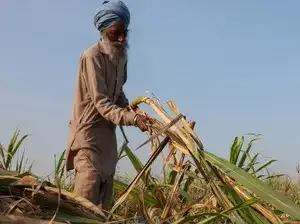
New Delhi: The government should encourage voluntary crop diversification rather than altering minimum support prices (MSP) or weakening procurement, according to the Economic Survey.
The survey noted that India remains structurally dependent on imports of edible oils, pulses and some feedstocks, creating an opportunity to better align farm support with changing consumption patterns, environmental sustainability and national self-reliance while preserving the food security architecture.
"Rather than altering MSP or weakening procurement, a calibrated strategy may use savings from improved stock management to support voluntary crop diversification," the Survey said on Thursday.
Farmers can be offered financially attractive alternatives to rice and wheat acreage, particularly in regions where procurement volumes are high but farm profitability remains modest and agro-ecological conditions favour other crops.
The initial phase can focus on the eastern and central regions, where rainfall patterns, soil conditions, and market access make pulses, oilseeds, and maize economically viable. Regions critical for national food security can be incorporated later, once the approach has been tested.
LINKING AGRONOMY AND MARKETS
Crop choices would be guided by agro-climatic suitability and market demand. In eastern India, maize, pulses, and oilseeds fit existing cropping systems. In central regions, oilseeds such as gram and soybeans suit prevailing rainfall and soil conditions.
These crops support national priorities: edible oils and pulses reduce import dependence, while maize and oilseeds contribute to ethanol, livestock, and bioenergy value chains.
INCOME PROTECTION
Per-quintal or per-acre incentives can offset yield differences and transitional costs. Experience from several states shows that modest bonuses can make alternative crops financially attractive, particularly when combined with lower input costs for water, fertiliser and energy.
"These incentives can be financed from fiscal savings created by reducing excess stocks and carrying costs, making the approach fiscally neutral while remaining farmer-centric," the survey said.
CENTRE-STATE PARTNERSHIP
State-level diversification missions would be implemented through the Centre-State partnership.
The Centre's contribution would come from procurement, storage, and interest savings, while states would fund their share from reduced input subsidies and existing incentive frameworks. Transitional financing could be provided, conditional on verified acreage shifts.
MARKET DEVELOPMENT
Over time, public intervention can evolve from physical procurement towards enabling markets for a wider range of crops. The government can increasingly rely on price-deficiency payments, bonuses and assured offtake mechanisms to stabilise farmer incomes while encouraging private investment.
Fiscal savings should be reinvested in post-harvest infrastructure -- oilseed processing, pulse milling, maize drying and ethanol linkages -- leveraging public-private partnerships and the Agri-Infrastructure Fund.
SAFEGUARDS
Food security remains protected through automatic adjustments in procurement volumes and buffer norms. WTO compatibility can be maintained by structuring diversification support as area-based, decoupled payments linked to sustainability goals.
"Utilising efficiencies in the existing procurement system to finance voluntary, agronomy-led diversification provides a practical pathway to increase farmer incomes, alleviate fiscal pressures, and enhance long-term food and nutritional security," the Survey said.
The survey noted that India remains structurally dependent on imports of edible oils, pulses and some feedstocks, creating an opportunity to better align farm support with changing consumption patterns, environmental sustainability and national self-reliance while preserving the food security architecture.
"Rather than altering MSP or weakening procurement, a calibrated strategy may use savings from improved stock management to support voluntary crop diversification," the Survey said on Thursday.
Farmers can be offered financially attractive alternatives to rice and wheat acreage, particularly in regions where procurement volumes are high but farm profitability remains modest and agro-ecological conditions favour other crops.
The initial phase can focus on the eastern and central regions, where rainfall patterns, soil conditions, and market access make pulses, oilseeds, and maize economically viable. Regions critical for national food security can be incorporated later, once the approach has been tested.
LINKING AGRONOMY AND MARKETS
Crop choices would be guided by agro-climatic suitability and market demand. In eastern India, maize, pulses, and oilseeds fit existing cropping systems. In central regions, oilseeds such as gram and soybeans suit prevailing rainfall and soil conditions.
These crops support national priorities: edible oils and pulses reduce import dependence, while maize and oilseeds contribute to ethanol, livestock, and bioenergy value chains.
INCOME PROTECTION
Per-quintal or per-acre incentives can offset yield differences and transitional costs. Experience from several states shows that modest bonuses can make alternative crops financially attractive, particularly when combined with lower input costs for water, fertiliser and energy.
"These incentives can be financed from fiscal savings created by reducing excess stocks and carrying costs, making the approach fiscally neutral while remaining farmer-centric," the survey said.
CENTRE-STATE PARTNERSHIP
State-level diversification missions would be implemented through the Centre-State partnership.
The Centre's contribution would come from procurement, storage, and interest savings, while states would fund their share from reduced input subsidies and existing incentive frameworks. Transitional financing could be provided, conditional on verified acreage shifts.
MARKET DEVELOPMENT
Over time, public intervention can evolve from physical procurement towards enabling markets for a wider range of crops. The government can increasingly rely on price-deficiency payments, bonuses and assured offtake mechanisms to stabilise farmer incomes while encouraging private investment.
Fiscal savings should be reinvested in post-harvest infrastructure -- oilseed processing, pulse milling, maize drying and ethanol linkages -- leveraging public-private partnerships and the Agri-Infrastructure Fund.
SAFEGUARDS
Food security remains protected through automatic adjustments in procurement volumes and buffer norms. WTO compatibility can be maintained by structuring diversification support as area-based, decoupled payments linked to sustainability goals.
"Utilising efficiencies in the existing procurement system to finance voluntary, agronomy-led diversification provides a practical pathway to increase farmer incomes, alleviate fiscal pressures, and enhance long-term food and nutritional security," the Survey said.