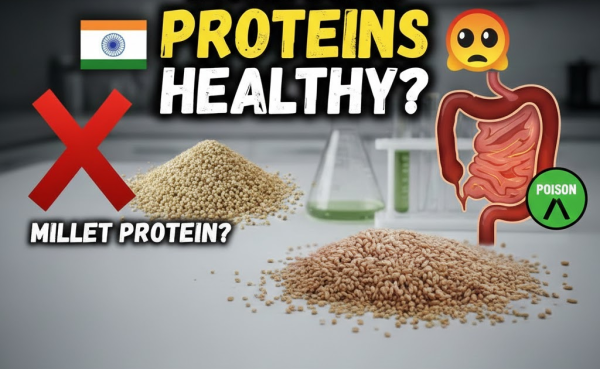
“I started eating millets for health, but now I’m always bloated.” I hear this daily. Most people treat millets like white rice—they wash it and boil it. But millets are ancient seeds, and they have a defense mechanism that your stomach isn’t prepared for.
1. The “Mineral Thief”: Phytic Acid
Millets contain Phytic Acid, which acts as a storage for phosphorus. However, for humans, it is an anti-nutrient.
The Evidence (NIH/PubMed): Research archived in the National Library of Medicine (PMID: 32745195) confirms that phytic acid forms insoluble complexes with Calcium, Magnesium, Iron, and Zinc.
The Impact: When you eat unsoaked millets, the phytic acid “steals” the minerals from your food and carries them out of your body. You aren’t just losing the nutrients in the millet; you’re losing the nutrients in your whole meal.
2. Intestinal Irritation: The Lectin Factor
Lectins are proteins that bind to carbohydrates. They are the plant’s natural pesticide.
The Evidence (PubMed): Studies on PubMed (PMID: 25599185) show that certain plant lectins can cause “Intestinal Permeability” (Leaky Gut). They bind to the lining of your digestive tract, causing an inflammatory response.
The Result: This is the direct cause of the gas, sharp stomach pains, and brain fog some people feel after eating poorly prepared grains.
3. The Solution: Why 8 Hours is the Magic Number
Soaking isn’t just about softening the grain; it’s about chemical transformation.
Phytase Activation: Soaking triggers an enzyme called Phytase. According to NIH research, this enzyme breaks down the phytic acid, releasing the bound minerals and making them bioavailable.
Lectin Reduction: Water immersion significantly reduces the concentration of active lectins, making the grain safe for the gut lining.
Why We Don’t Need Lectins
While proteins are generally seen as the “building blocks” of life, not all proteins are created equal. Lectins are a specific type of protein used by plants as a defense mechanism to ward off pests. Unlike the essential proteins your body needs for muscle repair, lectins are “carbohydrate-binding” proteins that are highly resistant to human digestive enzymes.
When consumed through unsoaked millets, these “sticky” proteins bind to the delicate lining of your gut (villi), causing inflammation, gas, and a condition known as “leaky gut.” According to NIH/PubMed research, they also act as anti-nutrients by blocking the absorption of minerals. Therefore, by soaking millets, we “deactivate” these harmful proteins to unlock the beneficial amino acids inside the grain.
1. Not all Proteins are “Building Blocks”
Proteins are not just for building muscles. In nature proteins are also used for “Defense Mechanism”.
The Reality: Lectins are called “Anti-Nutrients” because their function is not to nourish the body, but to protect the seeds from insects and microbes.
The Science (NIH Reference): According to research by the National Institutes of Health (NIH), lectins are “carbohydrate-binding proteins.” These are “sticky” and stick to the walls of our gut cells.
2. The “Sticky” Problem (Why we remove them)
Hume proteins require amino acids, but lectins cannot be digested in our body.
Gut Damage: When lectins enter our stomach via unsoaked millets, they block the gut lining (villi). This is called “Agglutination” in science—where cells clump together.
Nutrient Blockage: These are the “proteins” that block other good nutrients (like Zinc and Iron). Therefore, we get less benefit and more harm (inflammation and gas) from lectins.
3. Can we survive without them?
Yes, of course! We do not place lectins in the category of “Essential Protein”. The amino acids that our body needs are obtained from the proteins found in millet. Lectins are only there to “protect” the grain, not to protect our body.
-
Parliament Allocates 18 Hours for Discussion on President's Address During Budget Session
-
Healthy quick kids' tiffin recipes under 20 minutes that make mornings easier
-
From Grassroots to RS 100 Crore Ambitions: Startup Singam Season 2 Roars to Life
-
Paysharp Strengthens Payment Offerings with RBI PA-P Licence Approval
-
3EA Global Launching 'Nothing' and 'Zinga' Beverage Brands in India