
Listen to this article in summarized format
Loading...
××
Subscribe to

Unlock AI Briefing and Premium Content
Subscribe NowWhat's Included
- Exclusive Stories
- Daily ePaper Access
- Smart Market Tools
- Curated Investment Ideas
- Ad-lite Experience
Subscription

Creative Licence
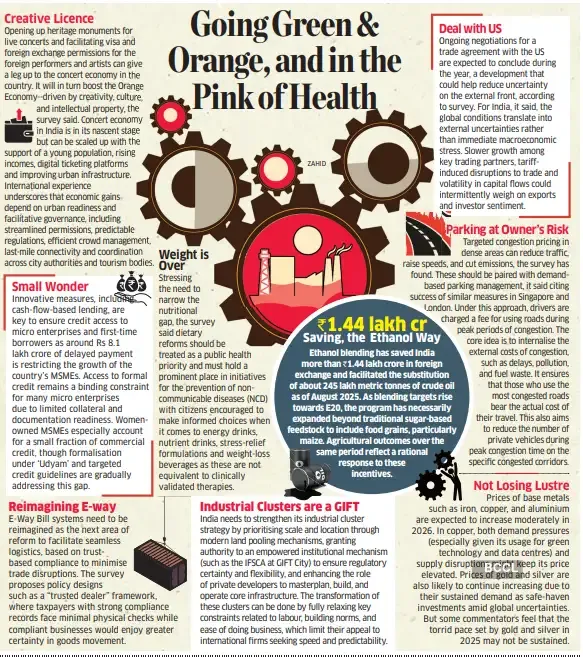
Opening up heritage monuments for live concerts and facilitating visa and foreign exchange permissions for the foreign performers and artists can give a leg up to the concert economy in the country. It will in turn boost the Orange Economy--driven by creativity, culture, and intellectual property, the survey said. Concert economy in India is in its nascent stage but can be scaled up with the support of a young population, rising incomes, digital ticketing platforms and improving urban infrastructure. International experience underscores that economic gains depend on urban readiness and facilitative governance, including streamlined permissions, predictable regulations, efficient crowd management, last-mile connectivity and coordination across city authorities and tourism bodies.
Small Wonder
Innovative measures, including cash-flow-based lending, are key to ensure credit access to micro enterprises and first-time borrowers as around Rs 8.1 lakh crore of delayed payment is restricting the growth of the country’s MSMEs. Access to formal credit remains a binding constraint for many micro enterprises due to limited collateral and documentation readiness. Women-owned MSMEs especially account for a small fraction of commercial credit, though formalisation under ‘Udyam’ and targeted credit guidelines are gradually addressing this gap.
Reimagining E-way
E-Way Bill systems need to be reimagined as the next area of reform to facilitate seamless logistics, based on trust-based compliance to minimise trade disruptions. The survey proposes policy designs such as a “trusted dealer” framework, where taxpayers with strong compliance records face minimal physical checks while compliant businesses would enjoy greater certainty in goods movement.
Weight is Over
Stressing the need to narrow the nutritional gap, the survey said dietary reforms should be treated as a public health priority and must hold a prominent place in initiatives for the prevention of noncommunicable diseases (NCD) with citizens encouraged to make informed choices when it comes to energy drinks, nutrient drinks, stress-relief formulations and weight-loss beverages as these are not equivalent to clinically validated therapies.
Industrial Clusters are a GIFT
India needs to strengthen its industrial cluster strategy by prioritising scale and location through modern land pooling mechanisms, granting authority to an empowered institutional mechanism (such as the IFSCA at GIFT City) to ensure regulatory certainty and flexibility, and enhancing the role of private developers to masterplan, build, and operate core infrastructure. The transformation of these clusters can be done by fully relaxing key constraints related to labour, building norms, and ease of doing business, which limit their appeal to international reforms seeking speed and predictability.
Not Losing Lustre
Prices of base metals such as iron, copper, and aluminium are expected to increase moderately in 2026. In copper, both demand pressures (especially given its usage for green technology and data centres) and supply disruptions might keep its price elevated. Prices of gold and silver are also likely to continue increasing due to their sustained demand as safe-haven investments amid global uncertainties. But some commentators feel that the torrid pace set by gold and silver in 2025 may not be sustained.
Parking at Owner’s Risk
Targeted congestion pricing in dense areas can reduce traffic, raise speeds, and cut emissions, the survey has found. These should be paired with demand-based parking management, it said citing success of similar measures in Singapore and London. Under this approach, drivers are charged a fee for using roads during peak periods of congestion. The core idea is to internalise the external costs of congestion, such as delays, pollution, and fuel waste. It ensures that those who use the most congested roads bear the actual cost of their travel. This also aims to reduce the number of private vehicles during peak congestion time on the specific congested corridors.
Deal with US
Ongoing negotiations for a trade agreement with the US are expected to conclude during the year, a development that could help reduce uncertainty on the external front, according to survey. For India, it said, the global conditions translate into external uncertainties rather than immediate macroeconomic stress. Slower growth among key trading partners, tariff-induced disruptions to trade and volatility in capital flows could intermittently weigh on exports and investor sentiment.
Opening up heritage monuments for live concerts and facilitating visa and foreign exchange permissions for the foreign performers and artists can give a leg up to the concert economy in the country. It will in turn boost the Orange Economy--driven by creativity, culture, and intellectual property, the survey said. Concert economy in India is in its nascent stage but can be scaled up with the support of a young population, rising incomes, digital ticketing platforms and improving urban infrastructure. International experience underscores that economic gains depend on urban readiness and facilitative governance, including streamlined permissions, predictable regulations, efficient crowd management, last-mile connectivity and coordination across city authorities and tourism bodies.
Small Wonder
Innovative measures, including cash-flow-based lending, are key to ensure credit access to micro enterprises and first-time borrowers as around Rs 8.1 lakh crore of delayed payment is restricting the growth of the country’s MSMEs. Access to formal credit remains a binding constraint for many micro enterprises due to limited collateral and documentation readiness. Women-owned MSMEs especially account for a small fraction of commercial credit, though formalisation under ‘Udyam’ and targeted credit guidelines are gradually addressing this gap.
Reimagining E-way
E-Way Bill systems need to be reimagined as the next area of reform to facilitate seamless logistics, based on trust-based compliance to minimise trade disruptions. The survey proposes policy designs such as a “trusted dealer” framework, where taxpayers with strong compliance records face minimal physical checks while compliant businesses would enjoy greater certainty in goods movement.
Weight is Over
Stressing the need to narrow the nutritional gap, the survey said dietary reforms should be treated as a public health priority and must hold a prominent place in initiatives for the prevention of noncommunicable diseases (NCD) with citizens encouraged to make informed choices when it comes to energy drinks, nutrient drinks, stress-relief formulations and weight-loss beverages as these are not equivalent to clinically validated therapies.
Industrial Clusters are a GIFT
India needs to strengthen its industrial cluster strategy by prioritising scale and location through modern land pooling mechanisms, granting authority to an empowered institutional mechanism (such as the IFSCA at GIFT City) to ensure regulatory certainty and flexibility, and enhancing the role of private developers to masterplan, build, and operate core infrastructure. The transformation of these clusters can be done by fully relaxing key constraints related to labour, building norms, and ease of doing business, which limit their appeal to international reforms seeking speed and predictability.
Not Losing Lustre
Prices of base metals such as iron, copper, and aluminium are expected to increase moderately in 2026. In copper, both demand pressures (especially given its usage for green technology and data centres) and supply disruptions might keep its price elevated. Prices of gold and silver are also likely to continue increasing due to their sustained demand as safe-haven investments amid global uncertainties. But some commentators feel that the torrid pace set by gold and silver in 2025 may not be sustained.
Parking at Owner’s Risk
Targeted congestion pricing in dense areas can reduce traffic, raise speeds, and cut emissions, the survey has found. These should be paired with demand-based parking management, it said citing success of similar measures in Singapore and London. Under this approach, drivers are charged a fee for using roads during peak periods of congestion. The core idea is to internalise the external costs of congestion, such as delays, pollution, and fuel waste. It ensures that those who use the most congested roads bear the actual cost of their travel. This also aims to reduce the number of private vehicles during peak congestion time on the specific congested corridors.
Deal with US
Ongoing negotiations for a trade agreement with the US are expected to conclude during the year, a development that could help reduce uncertainty on the external front, according to survey. For India, it said, the global conditions translate into external uncertainties rather than immediate macroeconomic stress. Slower growth among key trading partners, tariff-induced disruptions to trade and volatility in capital flows could intermittently weigh on exports and investor sentiment.