
Promoting climate-resilient technologies, empowering farmer producer organisations, strengthening cooperatives, and improving markets and logistics are among measures that the Economic Survey suggested as the way forward for India's agriculture sector. It listed small landholdings, climate risks, productivity gaps and weak market integration as challenges weighing on farm incomes.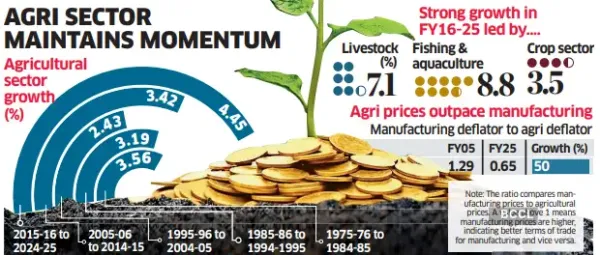
More private sector participation in areas such as food processing, cold chain logistics and the development of high-value agricultural products will be crucial to increasing competitiveness in both domestic and export markets, the survey said.
Strengthening access to assured water supply, focussing on research and development, bringing about reforms in fertiliser usage and promoting crop diversification are important, it said.
The survey recommended a modest increase in the retail price of urea, together with an equivalent direct transfer of subsidy to farmers' bank accounts. This will help curb overuse of urea and incentivise farmers to shift towards balanced fertilisation, soil testing, nano-urea, liquid fertilisers and organic alternatives, it said.
Subsidies have made urea one of the cheapest fertilisers, which is why farmers tend to overuse it. Urea consumption in the current financial year is expected to reach an all-time high of about 40 million tonnes, the survey said. Fertiliser subsidy, meanwhile, is likely to cross ₹1.91 lakh crore in FY26, exceeding the budget estimate of ₹1.67 lakh crore, according to industry projections.
Trade policies employed for managing domestic inflation such as ad hoc export bans or the imposition of minimum export prices disrupt export supply chains, create market uncertainty and cause foreign buyers to switch to other sources, the survey said.
More private sector participation in areas such as food processing, cold chain logistics and the development of high-value agricultural products will be crucial to increasing competitiveness in both domestic and export markets, the survey said.
Strengthening access to assured water supply, focussing on research and development, bringing about reforms in fertiliser usage and promoting crop diversification are important, it said.
The survey recommended a modest increase in the retail price of urea, together with an equivalent direct transfer of subsidy to farmers' bank accounts. This will help curb overuse of urea and incentivise farmers to shift towards balanced fertilisation, soil testing, nano-urea, liquid fertilisers and organic alternatives, it said.
Subsidies have made urea one of the cheapest fertilisers, which is why farmers tend to overuse it. Urea consumption in the current financial year is expected to reach an all-time high of about 40 million tonnes, the survey said. Fertiliser subsidy, meanwhile, is likely to cross ₹1.91 lakh crore in FY26, exceeding the budget estimate of ₹1.67 lakh crore, according to industry projections.
Trade policies employed for managing domestic inflation such as ad hoc export bans or the imposition of minimum export prices disrupt export supply chains, create market uncertainty and cause foreign buyers to switch to other sources, the survey said.