Artemis program NASA’s modern space mission is, J by to human again moon on to take off and there long time till to stay Technical capacity to develop plan is.this in the program SLS rocket, orion crew module and modern landing system by Chandrana south pole on research will be done.
Now half a century later, mankind has once again looked towards the moon. “We are going to the moon again” is no longer just sentimental talk, but a clear scientific and strategic plan. NASA’s Artemis Plan. The Apollo era had set foot on the Moon, while the Artemis era has resolved to stay on the Moon. Under the Artemis plan, mankind will again land on the Moon, stay there for a long time, conduct scientific research and, based on this experience, move forward towards Mars. These three stages, Artemis I, II and III, are taking humanity slowly but steadily into deep space. Landing at the South Pole, discovery of water ice, Lunar Gateway, and international collaboration. All this makes this scheme not just a mission, but a vision.
The Artemis plan is ultimately based on the “Moon to Mars” idea. The Moon is the first step towards Mars. The technology, human endurance and planning skills learned on the Moon will take mankind much further in the future. If one has to go directly from Earth to Mars, the astronauts would have to carry with them a large amount of water, food and other necessities. To carry this, a lot of fuel has to be made to make rockets and spacecraft to escape from the Earth’s gravity. Most accidents occur during the rocket launching phase itself. Instead, if only the astronauts are taken from the Earth to the Moon and the rest of the requirements are prepared on the Moon and the cosmic pleasure is sent to Mars, then due to the low gravitational force of the Moon, very little power would have to be used. Many such benefits are due to the theory of “Mars via Moon”.
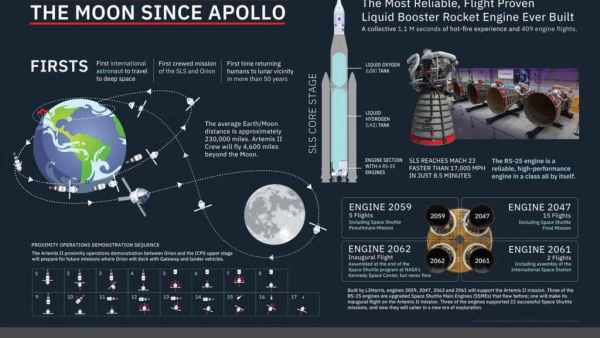
The main launch vehicle of the Artemis program is the Space Launch System (SLS). SLS is the most powerful rocket in the world currently in operation. Its overall height is approximately 98 meters (322 feet) and it produces more than 39,000 kilonewtons of thrust at launch. The SLS core stage is 65 meters high and contains two large propellant tanks filled with liquid hydrogen and liquid oxygen. This core stage is powered by four RS-25 engines, which were previously used in the Space Shuttle program, but now operate at much higher thrust and efficiency. Two solid rocket boosters attached to the core stage provide the rocket’s main takeoff power for the first two minutes. These boosters provide approximately 75 percent of the total launch thrust. After booster separation, the core stage and upper stage send the Orion spacecraft out of Earth’s orbit on its way to the Moon.
Another important part of the Artemis program is the Orion Crew Module. Orion is a deep space vehicle designed for humans, which can operate in high radiation conditions far from Earth. It has life support systems for four astronauts, including oxygen supply, carbon dioxide removal system, temperature control and water recovery system. Orion’s heat shield is the largest and strongest heat shield ever built, which can withstand temperatures of approximately 2,800 degrees Celsius when returning to Earth.
The European Service Module attached to Orion provides electrical, propulsion and thermal control to the vehicle. This module generates electricity through solar panels and is used by the main engine for navigation. In the Artemis II mission, the Orion spacecraft will fly on a “free-return trajectory,” in which the Moon’s gravity will naturally return the spacecraft to Earth even if the engines fail.
The Artemis III mission will use the Human Landing System (HLS) for lunar landing. This system will be launched completely from the Earth, reach the lunar orbit and dock with Orion. After this, two astronauts will land in the south pole area of the moon through the lander. This area is scientifically important because evidence of water ice has been found in the ravines that are in permanent shade. This ice can be useful in future for making drinking water, oxygen and rocket fuel.
An important technical part of the Artemis program is the Lunar Gateway. Gateway will be a small space station rotating in the elliptical orbit of the Moon. It will be equipped with power and propulsion elements, habitat module and docking ports. The Gateway will serve as a transit point for the lunar landing, a scientific laboratory, and a training center for future Mars missions.
The Artemis program is also developing new technologies to address radiation safety, the effects of prolonged exposure to zero gravity on the human body, and working with lunar dust (lunar regolith). Lunar dust is extremely fine and charged, posing a challenge to instruments and astronauts.
NASA’s Artemis 2 mission has a total of four astronauts who will go on a 10-day journey around the Moon. Of these four, three passengers are from NASA (American Space Agency) and one passenger is from the Canadian Space Agency (CSA). Reed Wiseman served as commander in chief, meaning he is the head of the travel team. Reed Wiseman has already done missions on the Space Station (ISS) and has deep space experiences. Victor Glover is the pilot in this mission and has been in space for a long time. Victor Glover is one of the great astronauts and he will control the Orion spacecraft as the pilot. Christina Koch is a mission specialist and also an experienced NASA engineer. Christina Koch has already spent a long time in space and broken records on the ISS. Jeremy Henson is a Mission Specialist with the Canadian Space Agency (CSA). Hansen would go on his first trip into space and go around the Moon for the first time.
-
Clinical New Zealand secure consolation 50-run win over India in 4th T20I

-
Venezuela’s acting president signs law privatising state-owned oil sector

-
Indian national indicted in Canada–US human smuggling case

-
What happened to Virat Kohli’s Instagram account?

-
Meri Zindagi Hai Tu last episode date: Writer confirms details