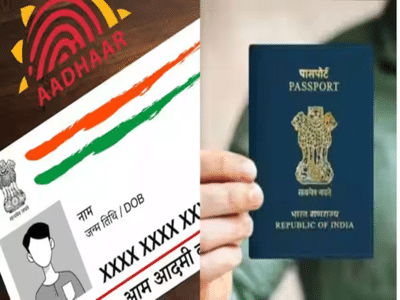
The Aadhaar card has become the most widely used document in India. Because of this, many people consider it proof of citizenship. But is Aadhaar truly equivalent to a passport? The answer is no. The legal force behind the two, the verification process, and the government's responsibility differ significantly.
Aadhaar is an identity number, but it is not a proof of citizenship; rather, it is a document related to residence and identity. The Aadhaar card itself clearly states that it is not proof of citizenship, date of birth, or address.
Passport: Not Just Identity, But a Legal Declaration
A passport is not just an ID card. It is an official document issued by the Government of India that certifies that the holder is an Indian citizen. This is why passports are internationally recognized. There is no disclaimer stating that it is not proof of citizenship, because the passport's very existence depends on it.
Foreigners can get Aadhaar, but not passports.
This is the biggest difference. Any foreign citizen who has lived in India for 182 days can be eligible for Aadhaar. But that person does not become eligible for an Indian passport. A passport can only be issued to a non-citizen if the central government deems it necessary in the public interest, and this is a completely exceptional situation.
Differences between passports and Aadhaar in matters of citizenship
The Aadhaar card and the Aadhaar Act repeatedly clarify that Aadhaar is not proof of citizenship. This is clearly stated on the card itself. In contrast, passports do not contain any such note or warning. The passport itself is a sovereign document, issued by the President of India.
Difference in the severity of verification
There is no police verification for Aadhaar. The enrollment agency takes your biometric and basic information, and the card is issued. However, police verification is mandatory for passports. This includes address verification, identity verification, and record verification, greatly reducing the chance of mistaken identity.
Issuership also matters
Aadhaar is issued by UIDAI. For Aadhaar, anyone who has passed the 10th grade and has basic computer knowledge can become an enrollment agent by opening a Common Service Center. A passport is issued with the signature of the Regional Passport Officer, who is an IAS or IFS officer and a representative of the Government of India.
Digital vs. Physical Responsibility
Aadhaar is completely digital. E-Aadhaar can be downloaded, and multiple copies can be made. This is not the case with passports; passports are a physical booklet with strict rules for security, validity, and use.
As of January 2026, more than 1.43 billion Aadhaar cards have been issued in India, while the total number of passports is around 140 million. This difference shows that Aadhaar is a comprehensive identity system, while passports are a limited but extremely powerful document.
Why can't the two be equal?
Aadhaar aims to facilitate access to services such as subsidies, banking, or identification. A passport, on the other hand, aims to certify citizenship and represent the country's sovereignty. Therefore, equating Aadhaar with a passport is not only technically incorrect but also legally misleading.
Aadhaar is necessary and useful, but limited. Fewer people have passports, but their power is far greater. Conflating or equating the two is a widespread misconception among the public.
Disclaimer: This content has been sourced and edited from TV9. While we have made modifications for clarity and presentation, the original content belongs to its respective authors and website. We do not claim ownership of the content.
-
Cockroach talks with Janata Party government, discussion will be held at a neutral place. Government Agrees To Talks With Cjp At Neutral Venue Demand Remains
-
Ranbir Kapoor Net Worth: All About Ramayana Star’s Rs 345 Crore Fortune – Properties, Cars And More

-
Amaal Mallik’s SERIOUS Allegations Against Tanishk Bagchi: Stole Saiyaara Song; Badmouths Bhushan Kumar, YRF And More

-
Mammootty Shares Support For Student Protests, States ‘Youth Are The True Treasure Of Our Nation’

-
After 5th Drunk Driving Charge, Prosecutors Seek Harsher Sentence For Welcome To Waikiki Actor Son Seung-Won