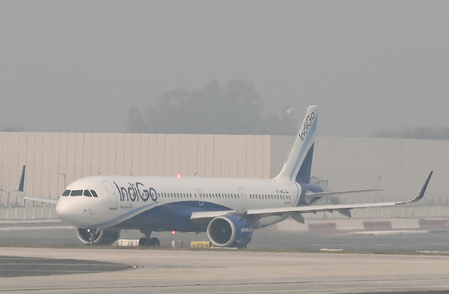
The Delhi High Court on Friday questioned the Directorate General of Civil Aviation (DGCA) over its decision to grant an “indefinite” relaxation to airlines on new norms governing weekly rest and leave for pilots, raising concerns about fatigue and passenger safety.
Issuing notice on a public interest litigation (PIL), a bench led by Chief Justice D K Upadhyaya and Justice Tejas Karia asked the aviation regulator to explain the rationale behind its move to withdraw a key provision of the new flight duty regulations, which stipulated that weekly rest could not be substituted with leave.
The court directed both the DGCA and IndiGo to file their responses to the petition within two weeks.
The controversy stems from the implementation of revised Flight Duty Time Limitations (FDTL), which came into effect on 1 November 2025. On 5 December, the DGCA issued an exemption allowing flexibility in the application of the norms, a move that followed widespread flight disruptions at IndiGo earlier that month. The airline had cancelled hundreds of flights, citing insufficient pilot availability to comply with the new rules.
Counsel for the DGCA told the court that the regulator had been monitoring the impact of the FDTL norms and decided to withdraw the provision after conducting audits and receiving representations from airlines. These representations, she said, highlighted issues arising from pilots combining weekly rest days with leave.
She clarified that even after the exemption, weekly rest for pilots remained mandatory under the Civil Aviation Requirements (CAR), while leave arrangements continued to be governed by individual contracts between pilots and airlines. The DGCA also pointed out that a separate, time-bound relaxation from night duty norms had been granted to IndiGo until 10 February.
'Meagre' fine: Pilots’ body flays DGCA over Rs 22.20-cr penalty on IndiGoHowever, the court questioned why the withdrawal of the rule preventing substitution of weekly rest with leave was left open-ended, while the relaxation on night duty was limited to a specific period.
“If both relaxations were granted due to operational disruption, why is one time-bound and the other indefinite?” the bench asked, noting that the withdrawal applied to all airlines, not just IndiGo.
The court reiterated its earlier observation that concerns over public safety arising from non-implementation of fatigue management regulations could not be ignored.
The petitioners — Sabari Roy Lenka, Aman Monga and Kiran Singh — have alleged that the DGCA’s relaxation of fatigue rules was granted illegally and selectively, favouring IndiGo. They contended that the move was prima facie mala fide and violated international aviation safety obligations.
According to the plea, the DGCA is required under International Civil Aviation Organisation standards to uniformly enforce fatigue regulations, prevent unsafe rostering practices, ensure adequate staffing and suspend non-compliant flight schedules. The petition alleges that the regulator has consistently failed to uphold these responsibilities.
The matter is scheduled to be heard next in April.
With PTI inputs
-
Ration Card Update: Credit ₹5,000 Directly to Beneficiaries' Bank Accounts

-
Enhance Your Home's Energy with Wind Chimes: A Vastu Guide

-
"European auto manufacturers see India as profitable business, FTA to create more jobs": Piyush Goyal
-
Red Chief Brand Welcomes Bollywood Star Ayushmann Khurrana as Its New Brand Ambassador

-
Kuwait-Delhi IndiGo flight makes emergency landing in Ahmedabad after bomb threat