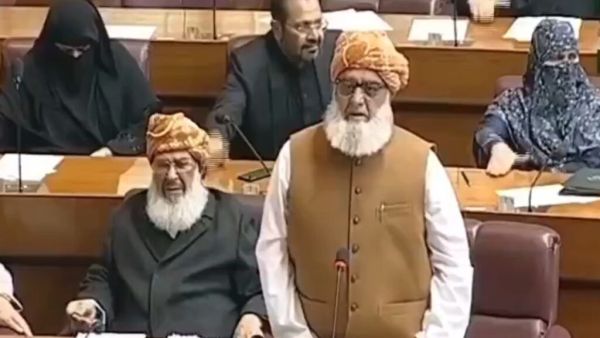
There was silence in the Parliament of Pakistan when a cleric announced not against the law but directly breaking the law. The country’s most powerful religious leader, Maulana Fazlur Rehman, has openly rejected new laws prohibiting child marriage and domestic violence, saying he will not obey them – but willfully break them.
According to the report of News 18, Maulana made such a statement by personally participating in the marriages of minor children and promoting them, which shook the politics, courts and society of Pakistan.
On which laws was Maulana angry?
Maulana Fazlur Rehman has expressed objection to two important laws. The first is the Child Marriage Restraint Bill 2025 and the second is the Domestic Violence (Prevention and Protection) Act 2026. The objective of both these laws is to ban the marriage of minors in Pakistan and to protect women and children from domestic violence. But Maulana Fazlur Rehman clearly said in Parliament that he does not accept these amendments and calls them “un-Islamic”.
Provocative statement in Parliament
Addressing the National Assembly, Maulana Fazlur Rehman said, “I do not believe in these laws. If they are implemented, I will myself violate them.” He further said that he will not only participate in the marriages of 10, 12, 15 and 16 year old children but will also encourage them, so that he can show the government that he does not believe in these laws. On hearing this statement, there was an uproar in the Parliament and many MPs from the opposition parties protested strongly.
How was the domestic violence law passed in Parliament?
This controversy deepened when Parliament passed the Domestic Violence (Prevention and Protection) Act 2026. This bill was introduced by Pakistan Peoples Party (PPP) MP Sharmila Farooqui. However, MPs from Jamiat Ulema-e-Islam (Fazal) strongly opposed it and raised slogans in the House. The new law criminalizes physical violence, mental torture and emotional abuse.
What will be the definition of domestic violence?
Under this law the following acts will now be considered crimes:
- Threatening wife with divorce or remarriage
- forced to live with someone else without consent
- Mentally abusing wife, children or family member
- Intimidation, bullying or emotional torture
The definition of “child” has also been fixed in this law – every person below the age of 18 years will be considered a child, whether he is a boy or a girl. That is, through this law the minimum age for marriage has been fixed at 18 years.
What is Maulana’s argument?
Maulana Fazlur Rehman says that both these laws are against the Constitution and conflict with Islamic principles. Parliament does not have the right to make laws in such matters. He demanded that these laws be sent to the Council of Islamic Ideology (CII) so that they can be reviewed from a religious point of view. He claims that Parliament should not interfere in religious matters.
Questions were also raised on the government
According to government sources, Maulana’s statement has exposed the weakness of the state. Senior officials say that openly threatening to break the law, challenging child protection laws and the government’s silence on it weakens the rule of law in the country. Concern was also expressed that if influential clerics refuse to obey the laws, it will become more difficult for ordinary citizens to follow the law.
Women’s rights vs religious politics
Human rights organizations say that this soft attitude of the government shows that in Pakistan, more importance is still being given to religious politics than women’s rights, children’s safety and constitutional law. According to critics, this attitude is going to further divide the society and give strength to fundamentalist forces.
The debate rages again
After the statement of Maulana Fazlur Rehman, the debate has once again intensified in Pakistan whether religious leaders are above the law? Does Parliament not have the right to make laws for social reform? Can there be compromise on the safety of women and children? This dispute has become a symbol not only of law but of the conflict of power, religion and rights.
The laws against child marriage and domestic violence are an attempt to take Pakistan towards a modern legal system, but the open opposition of leaders like Maulana Fazlur Rehman shows that this path will not be easy. This controversy can decide the political and social direction of Pakistan in the future.
-
Ramiz Raja Shamelessly Defends Usman Tariq’s 'Chucking' Bowling Action On Live TV
-
Union Budget 2026: FM Nirmala Sitharaman Announces 'Khelo India Mission' To Transform Sports Sector Over Next Decade
-
Budget 2026: Indian Semiconductor Mission 2.0 Announced, Chemical Parks To Be Built For Mining Of 'Rare Earth Magnets'
-
Budget 2026: PLI Scheme May Be Extended, AI Push Likely, Smartphone Prices May Rise
-
Union Budget 2026: Experts Welcome Rs 1.39 Lakh Crore Education Allocation, Call It Growth-Oriented