
Listen to this article in summarized format
Loading...
××
Subscribe to

Unlock AI Briefing and Premium Content
Subscribe NowWhat's Included
- Exclusive Stories
- Daily ePaper Access
- Smart Market Tools
- Curated Investment Ideas
- Ad-lite Experience
Subscription

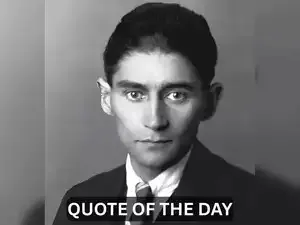
Quote of the Day: Some quotations feel timeless because they speak less about a specific era and more about an inner human truth. Franz Kafka’s reflections often belong to this rare category. His words emerge from a deeply personal, introspective mind, yet they resonate across generations, cultures, and emotional states. Kafka wrote during a period of anxiety, transition, and intellectual ferment in Europe, but his observations about beauty, youth, and perception continue to feel uncannily modern.
A Quote of the Day matters because it slows us down. In a world saturated with noise, a single well-chosen line can offer clarity, comfort, or quiet provocation. It invites reflection rather than reaction. Kafka’s thoughts, in particular, tend to unsettle and awaken at the same time, asking readers to reconsider how they see themselves and the world around them. His words do not offer easy optimism, but they reward attention with insight.
The Quote of the Day today by Franz Kafka reads: “Youth is happy because it has the capacity to see beauty. Anyone who keeps the ability to see beauty never grows old.”
Franz Kafka was born on July 3, 1883, in Prague, then part of the Austro-Hungarian Empire. He was a writer whose work would later become some of the most influential literature of the 20th century, though much of it gained recognition only after his death. Kafka is best known for his novels and short stories that explore alienation, anxiety, guilt, and the often-absurd nature of modern life. His writing career unfolded quietly alongside his professional life, and he never experienced widespread fame during his lifetime, as per information sourced from Britannica
Kafka’s literary legacy rests not on volume but on intensity. His works challenged traditional storytelling, favoring unsettling symbolism and psychological depth over clear resolutions. Though he struggled with self-doubt and illness, Kafka produced writing that continues to shape how literature addresses identity, power, and inner conflict. Today, his name has become synonymous with situations that feel surreal, oppressive, or emotionally disorienting, a testament to the enduring relevance of his vision.
Kafka’s writing was deeply inward-looking. Rather than grand historical narratives, he focused on the private fears, moral dilemmas, and quiet despair of individuals navigating incomprehensible systems. His stories often portray characters trapped in circumstances they cannot fully understand, reflecting a sense of existential unease that many readers recognize in their own lives, as per information sourced from Britannica
Despite the darkness often associated with his work, Kafka was acutely sensitive to moments of beauty and clarity. His reflections suggest that perception itself is a form of freedom. To see beauty, in his view, was not about ignoring suffering but about retaining a capacity for wonder even in its presence. This tension between despair and sensitivity defines much of his writing.
The meaning of Kafka’s Quote of the Day lies in its quiet redefinition of youth. Rather than linking youth to age, strength, or social status, Kafka ties it to perception. Youth, in this sense, is a way of seeing. It is the ability to notice beauty, whether in people, ideas, or fleeting moments, even when life feels difficult or absurd.
Kafka suggests that aging is not merely physical but perceptual. When people lose their ability to see beauty, they grow old in spirit, regardless of years lived. Conversely, anyone who preserves curiosity, sensitivity, and openness remains young. The quote gently challenges the assumption that time inevitably dulls perception. Instead, it frames attentiveness as a lifelong choice, fragile but renewable, as per information sourced from Britannica
In a broader sense, the quote also resists cynicism. Kafka does not deny suffering, but he implies that beauty and meaning coexist with it. Holding onto that awareness becomes an act of quiet resistance against despair.
Kafka’s work consistently questioned how language, identity, and meaning intersect. He was deeply aware of the limitations of expression and often wrote about the struggle to communicate inner truths. His reflections reveal a mind both rigorous and vulnerable, always searching for authenticity in a world that felt increasingly fragmented.
His writing suggests that understanding oneself is never complete and often uncomfortable. Yet it is precisely this discomfort that opens the door to insight. Kafka believed that art should disturb complacency, forcing readers to confront what lies beneath habit and certainty.
Beyond the Quote of the Day, Kafka’s writings offer many lines that continue to provoke thought and introspection:
“Don't bend; don't water it down; don't try to make it logical; don't edit your own soul according to the fashion. Rather, follow your most intense obsessions mercilessly.”
“A book must be the axe for the frozen sea within us.”
“I am a cage, in search of a bird.”
“Many a book is like a key to unknown chambers within the castle of one’s own self.”
“I am free and that is why I am lost.”
“I write differently from what I speak, I speak differently from what I think, I think differently from the way I ought to think, and so it all proceeds into deepest darkness.”
“The meaning of life is that it stops.”
“A First Sign of the Beginning of Understanding is the Wish to Die.”
“All language is but a poor translation.”
“I have spent all my life resisting the desire to end it.”
As a Quote of the Day, Kafka’s words about youth and beauty remind us that aging is not simply something that happens to us; it is something shaped by how we choose to see the world. More than a century after his lifetime, Franz Kafka’s insights continue to speak to the fragile, searching, and deeply human desire to find meaning amid uncertainty.
A Quote of the Day matters because it slows us down. In a world saturated with noise, a single well-chosen line can offer clarity, comfort, or quiet provocation. It invites reflection rather than reaction. Kafka’s thoughts, in particular, tend to unsettle and awaken at the same time, asking readers to reconsider how they see themselves and the world around them. His words do not offer easy optimism, but they reward attention with insight.
Quote of the Day Today January 30
The Quote of the Day today by Franz Kafka reads: “Youth is happy because it has the capacity to see beauty. Anyone who keeps the ability to see beauty never grows old.”
Franz Kafka was born on July 3, 1883, in Prague, then part of the Austro-Hungarian Empire. He was a writer whose work would later become some of the most influential literature of the 20th century, though much of it gained recognition only after his death. Kafka is best known for his novels and short stories that explore alienation, anxiety, guilt, and the often-absurd nature of modern life. His writing career unfolded quietly alongside his professional life, and he never experienced widespread fame during his lifetime, as per information sourced from Britannica
Kafka’s literary legacy rests not on volume but on intensity. His works challenged traditional storytelling, favoring unsettling symbolism and psychological depth over clear resolutions. Though he struggled with self-doubt and illness, Kafka produced writing that continues to shape how literature addresses identity, power, and inner conflict. Today, his name has become synonymous with situations that feel surreal, oppressive, or emotionally disorienting, a testament to the enduring relevance of his vision.
Franz Kafka and the Inner World of the Individual
Kafka’s writing was deeply inward-looking. Rather than grand historical narratives, he focused on the private fears, moral dilemmas, and quiet despair of individuals navigating incomprehensible systems. His stories often portray characters trapped in circumstances they cannot fully understand, reflecting a sense of existential unease that many readers recognize in their own lives, as per information sourced from Britannica
Despite the darkness often associated with his work, Kafka was acutely sensitive to moments of beauty and clarity. His reflections suggest that perception itself is a form of freedom. To see beauty, in his view, was not about ignoring suffering but about retaining a capacity for wonder even in its presence. This tension between despair and sensitivity defines much of his writing.
Meaning of the Quote of the Day
The meaning of Kafka’s Quote of the Day lies in its quiet redefinition of youth. Rather than linking youth to age, strength, or social status, Kafka ties it to perception. Youth, in this sense, is a way of seeing. It is the ability to notice beauty, whether in people, ideas, or fleeting moments, even when life feels difficult or absurd.
Kafka suggests that aging is not merely physical but perceptual. When people lose their ability to see beauty, they grow old in spirit, regardless of years lived. Conversely, anyone who preserves curiosity, sensitivity, and openness remains young. The quote gently challenges the assumption that time inevitably dulls perception. Instead, it frames attentiveness as a lifelong choice, fragile but renewable, as per information sourced from Britannica
In a broader sense, the quote also resists cynicism. Kafka does not deny suffering, but he implies that beauty and meaning coexist with it. Holding onto that awareness becomes an act of quiet resistance against despair.
Kafka’s Enduring Reflections on Life and Art
Kafka’s work consistently questioned how language, identity, and meaning intersect. He was deeply aware of the limitations of expression and often wrote about the struggle to communicate inner truths. His reflections reveal a mind both rigorous and vulnerable, always searching for authenticity in a world that felt increasingly fragmented.
His writing suggests that understanding oneself is never complete and often uncomfortable. Yet it is precisely this discomfort that opens the door to insight. Kafka believed that art should disturb complacency, forcing readers to confront what lies beneath habit and certainty.
Iconic Quotes by Franz Kafka
Beyond the Quote of the Day, Kafka’s writings offer many lines that continue to provoke thought and introspection:
“Don't bend; don't water it down; don't try to make it logical; don't edit your own soul according to the fashion. Rather, follow your most intense obsessions mercilessly.”
“A book must be the axe for the frozen sea within us.”
“I am a cage, in search of a bird.”
“Many a book is like a key to unknown chambers within the castle of one’s own self.”
“I am free and that is why I am lost.”
“I write differently from what I speak, I speak differently from what I think, I think differently from the way I ought to think, and so it all proceeds into deepest darkness.”
“The meaning of life is that it stops.”
“A First Sign of the Beginning of Understanding is the Wish to Die.”
“All language is but a poor translation.”
“I have spent all my life resisting the desire to end it.”
As a Quote of the Day, Kafka’s words about youth and beauty remind us that aging is not simply something that happens to us; it is something shaped by how we choose to see the world. More than a century after his lifetime, Franz Kafka’s insights continue to speak to the fragile, searching, and deeply human desire to find meaning amid uncertainty.