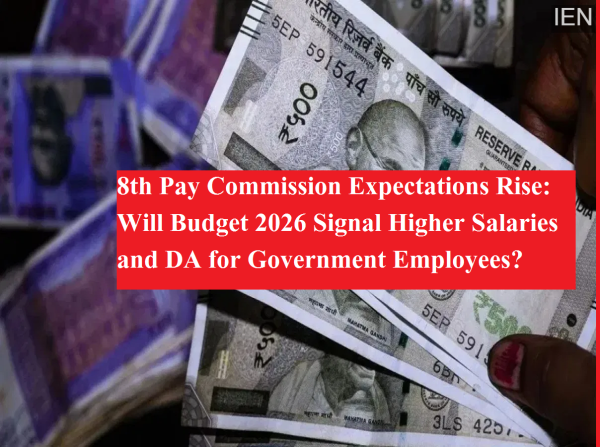
As the Union Budget approaches, millions of government employees and pensioners across the country are eagerly watching for any indication of changes in salaries, allowances, and pensions. This year, expectations are especially high because the 8th Pay Commission was constituted a few months ago. Naturally, questions are being raised: Will Budget 2026 provide a roadmap for salary hikes? Will there be any announcement related to Dearness Allowance (DA) or pension revisions? Or will employees need to wait longer for real benefits?
With over one crore central government employees and pensioners directly affected, even a small hint in the Finance Minister’s speech can shape future expectations and financial planning.
Why the 8th Pay Commission Is in Focus
Every time a new pay commission is formed, it becomes a topic of intense discussion among employees and economists alike. The 8th Pay Commission was set up around three months ago and has been given approximately 18 months to prepare and submit its recommendations. This means that a new salary and pension structure is unlikely to be implemented immediately.
Experts believe that even during the financial year 2027, employees may not see the direct benefits of the commission’s recommendations. However, the upcoming Budget 2026–27 could offer early signals about the government’s intent and preparedness.
Nearly 1.1 crore central government employees and pensioners are expected to closely follow the budget speech to see whether any funds are earmarked for future pay revisions. If the government allocates money in advance, it may suggest faster implementation of the commission’s proposals.
Budget and the Future Salary Structure
The Union Budget for FY 2026–27 will be presented on February 1. Since the 8th Pay Commission has only recently begun its work, its final report is still some distance away. However, the budget can reveal whether the government is preparing financially for a new pay structure.
If a specific provision is made for future salary and pension increases, it would indicate that the government is serious about implementing the recommendations at an earlier stage. Such a move could also push the commission to speed up consultations with employee unions and stakeholders.
On the other hand, if no allocation is made, it may signal that employees should be prepared for a longer wait before any actual revision in salaries and pensions takes place.
Impact on the Government’s Finances
Implementing a new pay commission always places a heavy burden on the government treasury. When the 7th Pay Commission was introduced in 2017, it increased government expenditure by nearly ₹1.02 lakh crore. At that time, a fitment factor of 2.57 was applied to revise basic pay and pensions.
However, the actual increase did not appear as high as expected because Dearness Allowance (DA) and Dearness Relief (DR) were reset to zero under the new structure. These allowances are recalculated as a percentage of basic pay and then raised every six months to offset inflation.
This time, the scenario could be different.
Why the Next Increase Could Be Larger
Even if the fitment factor under the 8th Pay Commission is slightly lower than before, employees may still receive a noticeable rise in overall pay. One reason is that the current DA and DR levels are significantly lower compared to the final phase of the 7th Pay Commission.
At present, DA and DR stand at around 58 percent, which is much lower than what was seen during earlier transitions. This creates room for a stronger upward revision when the new pay structure is introduced.
Another important factor is the growing number of employees and pensioners. With more people now covered under government payrolls and pension systems, the total cost to the exchequer is expected to be higher.
According to estimates by brokerage firm Kotak Institutional Equities, the financial impact of implementing the 8th Pay Commission could range between ₹2.4 lakh crore and ₹3.2 lakh crore.
What Employees Should Watch in Budget 2026
For now, all attention is on whether the government provides any hints in the upcoming budget. Key indicators include:
-
Allocation of funds for future salary and pension revisions
-
Any mention of the 8th Pay Commission in the budget speech
-
Signals about managing the fiscal impact of pay hikes
-
References to DA adjustments or employee welfare measures
If these elements appear in the budget, it could suggest that the process will move faster than expected.
The Road Ahead
At present, most signs point toward patience being necessary. Employees and pensioners will likely have to wait for the Pay Commission’s final report before any concrete changes are announced. Still, Budget 2026 may act as the first step in outlining the government’s strategy for future salary reforms.
In conclusion, the rising expectations around the 8th Pay Commission reflect the importance of salary and pension decisions for millions of families. While immediate benefits may not arrive soon, the upcoming budget could provide a crucial glimpse into how and when these changes might take shape. For now, government employees and pensioners will be watching closely for any signal that their long-awaited pay revision journey has officially begun.
-
Hyderabad to Kakinada: A 48-hour travel guide to Coastal Andhra

-
US envoys to Israel barred early Gaza ‘apocalyptic wasteland’ warnings

-
Sunetra Pawar takes oath as Maharashtra’s first woman Dy Chief Minister
-
Mullah se azaadi doonga: UP gau rakshak gets bail in hate speech case

-
Watch: Wedding celebrations begin in Allu Arjun’s family