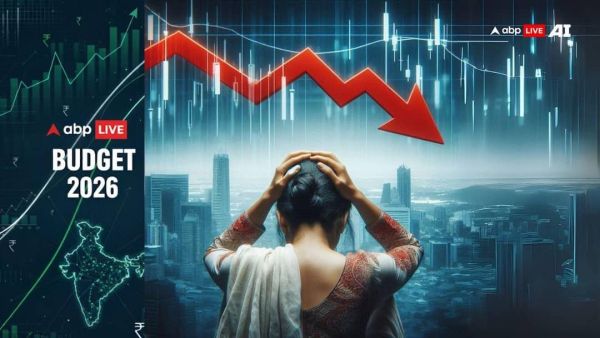
What began as an eagerly awaited Budget Day on Dalal Street quickly turned into a bruising session for investors. Within minutes of Finance Minister Nirmala Sitharaman presenting the Union Budget 2026-27, equity markets tumbled sharply, wiping out thousands of crores in investor wealth and triggering widespread selling across sectors.
The BSE Sensex crashed more than 2,300 points after the Budget speech. As of 12:30 PM, the Sensex tested 80,700, crashing close to 1,600 points, while the Nifty inched closer to 24,800, taking a hit of more than 500 points. The sharp decline marked one of the most volatile Budget reactions in recent years.
At the centre of the market turmoil was a key tax announcement: a hike in the Securities Transaction Tax (STT) on futures and options trading.
The Trigger: STT Hike on Futures and Options
Finance Minister Nirmala Sitharaman on Sunday, February 1, proposed to raise Securities transaction tax (STT) on both futures and options.
The Securities Transaction Tax on Futures has been raised to 0.05 per cent from 0.02 per cent earlier, and for options has been raised to 0.15 per cent from the previous 0.1 per cent.
While the move may appear marginal on paper, derivatives traders view even small cost increases as significant, especially in high-frequency or large-volume trades. The derivatives segment accounts for a substantial portion of daily turnover on Indian exchanges, making it highly sensitive to transaction-based levies.
As the announcement sank in, traders rushed to reassess positions, leading to aggressive unwinding in index heavyweights and derivative-linked counters.
What Exactly Is STT And Why Does It Matter?
Securities transaction tax (STT) is a tax imposed on the value of securities transactions on recognised stock exchanges in the country. It applies to trades in equity mutual funds, equities, futures and options. STT is collected when the transaction occurs, regardless of the investor making a profit or loss.
In simple terms, every time an investor buys or sells an equity, derivative contract or mutual fund, they are required to pay a charge on the transaction. Unlike the capital gains tax, which depends on profits, STT applies irrespective of whether a trader makes money or not.
STT was introduced in India on October 1, 2004. It was meant to replace the long-term capital gains (LTCG) tax, curb evasion in equity and derivatives trades and simplify tax collection.
However, the Union Budget 2018 reintroduced LTCG on listed equities, while STT remained in place, effectively creating a dual-layer tax environment for equity investors.
Why Traders Are Worried
Investor concerns have increased ever since a sharp rise in STT was announced in the previous Budget.
The tax on the sale of options was increased from 0.0625 per cent to 0.1 per cent of the option premium. Meanwhile, futures trades now receive 0.02 per cent of traded value, which is up from 0.0125 per cent.
The latest hike compounds that pressure. Brokerages and asset managers argue that the cumulative impact of higher STT and elevated capital gains tax dampens the appeal of equity-linked products, particularly for active traders and derivatives participants.
In the previous Budget, LTCG tax rose to 12.5 per cent from 10 per cent, while short-term capital gains (STCG) increased to 20 per cent from 15 per cent. For investors who rely on short-term trading strategies, this combination significantly increases overall transaction costs.
An investor is required to pay LTCG tax when they hold equities of a firm for over a year. Any holding period less than 12 months receives STGC tax.
With both transaction taxes and capital gains taxes rising over successive Budgets, market participants fear that trading volumes, particularly in futures and options, could moderate over time.
Why Markets Reacted So Sharply
Budget Day volatility is not unusual, but the intensity of the reaction reflects deeper anxieties in the market.
Derivatives trading forms a crucial backbone of India’s equity ecosystem, contributing a large share of daily turnover. Higher STT directly increases the cost of hedging, speculation and arbitrage strategies. For institutions, proprietary traders and retail derivatives players alike, margins become tighter when transaction levies climb.
The immediate market reaction suggested that participants were pricing in lower profitability for brokerage firms, reduced derivatives activity and potential pressure on trading volumes.
The sell-off was broad-based, with heavyweight stocks dragging benchmarks lower. The Sensex’s fall of more than 2,300 points at one stage underscored the depth of investor disappointment.
A Bigger Question: Is Equity Becoming Less Attractive?
The cumulative tax burden has revived an old debate on the cost of equity investing in India. When STT was introduced in 2004, it was meant to simplify tax administration and replace LTCG. Today, both taxes co-exist, alongside higher short-term capital gains levies.
Market intermediaries argue that the combined impact could deter high-frequency trading and short-term participation, potentially affecting liquidity in certain segments.
For long-term investors, the impact may be less dramatic. However, the Budget 2026 announcement clearly signals that transaction costs in the equity derivatives segment are rising, and markets reacted swiftly.
What Experts Have To Say About STT Hike?
Market veterans and tax experts were quick to weigh in on the implications of the STT hike, offering a more nuanced perspective on the government’s intent.
Archit Gupta, Founder and CEO of ClearTax, described the move as a deliberate policy signal aimed at moderating excessive short-term trading rather than maximising revenue. He noted that the increase represents a 150 per cent rise on futures and a 50 per cent rise on options, and said the government appears to be nudging investors towards longer-term capital formation.
Gupta pointed out that STT collections remained flat at around Rs 45,000 crore from FY2425 to FY2625, against a Rs 78,000 crore target. However, he emphasised that investor behaviour has evolved rather than declined. With over 21 crore demat accounts and record SIP inflows of Rs 31,000 crore+ in 2025, retail participation remains strong but is increasingly shifting from frequent trading to systematic, long-term investing. According to him, the broader policy direction suggests a preference for steady capital formation over dependence on short-term transaction revenue.
Shripal Shah, MD & CEO of Kotak Securities, said the steep increase in STT on futures and options, particularly coming on top of last year’s hike, is likely to raise impact costs for traders, hedgers and arbitrageurs. He cautioned that derivative activity could cool, leading to a moderation in volumes. Shah suggested that the government’s intent appears to be volume moderation rather than revenue maximisation, since any incremental tax gains could be offset if derivative volumes decline.
Prasenjit Paul, Equity Research Analyst at Paul Asset & Fund Manager at 129 Wealth Fund, said the market’s sharp intraday sell-off reflects immediate concerns over higher transaction costs and the revised tax treatment for buybacks. He noted that these changes alter the near-term economics for active traders as well as companies that rely on buybacks as a capital-return strategy.
However, Paul added that the broader fiscal architecture of the Budget remains structurally sound. He highlighted the 4.3 per cent fiscal deficit target for FY27 and a record Rs 12.2 lakh crore capital expenditure allocation, which he believes supports the long-term investment cycle. While short-term volatility is inevitable, he said earnings visibility for infrastructure, capital goods and manufacturing-linked sectors continues to improve.
Paul also underscored that the fiscal framework signals credibility, with a clear consolidation path, a declining debt-to-GDP trajectory, and measures such as infrastructure risk guarantees and asset monetisation designed to crowd in private capital. In his view, while near-term market sentiment may adjust to higher transaction costs, the medium-term investment and earnings cycle remains well supported.
What Happens Next?
In the near term, volatility is likely to persist as traders adjust positions and reassess strategies. Whether the sell-off deepens or stabilises will depend on broader cues, including global market sentiment, domestic earnings trends and policy follow-through.
For now, however, Dalal Street has delivered its verdict. Budget 2026 may have aimed to strengthen tax collections, but the hike in STT has triggered an immediate and sharp correction, turning what began as a policy speech into a painful trading session for investors.
-
Airtel: This Airtel recharge plan is best for couples; find out how much it costs and what benefits it offers..

-
Check these documents before buying a house, or you could get scammed

-
Start investing with just Rs. 210 and get a pension of Rs. 5000 every month! Learn the important details.

-
FD Update: Which bank offers the highest interest rate on fixed deposits? Note down the names of the top 5..

-
PM Kisan Yojana: The month of February has begun, when can the 22nd installment be expected? Find out..
