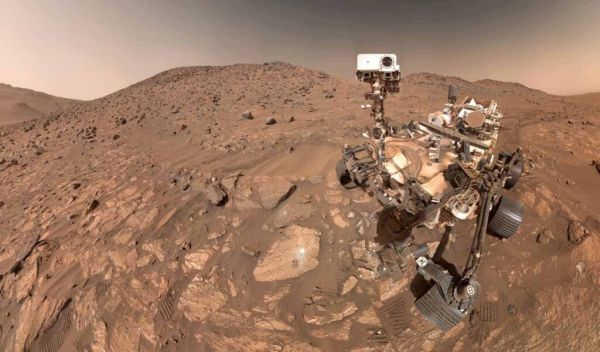
NASA’s Perseverance rover has successfully completed its first Mars drives planned entirely by artificial intelligence, marking a major step in autonomous space exploration and showcasing how generative AI can safely navigate complex extraterrestrial terrain.
Updated On – 1 February 2026, 10:58 AM
New Delhi: The six-wheeled Perseverance rover has completed the first drives on Mars that were planned by artificial intelligence (AI), NASA said.
Conducted on December 8 and 10, 2025, the demonstration used generative AI to create waypoints for Perseverance. The complex decision-making task is typically performed manually by the mission’s human rover planners at the US space agency’s Jet Propulsion Laboratory in Southern California.
“This demonstration shows how far our capabilities have advanced and broadens how we will explore other worlds,” said NASA Administrator Jared Isaacman.
“Autonomous technologies like this can help missions to operate more efficiently, respond to challenging terrain, and increase science return as distance from Earth grows. It’s a strong example of teams applying new technology carefully and responsibly in real operations,” he added.
The rover — about the size of a car and carrying seven scientific instruments — has been exploring Mars, studying its geology and atmosphere, as well as collecting samples since 2021.
During the demonstration, the team leveraged a type of generative AI called vision-language models to analyse existing data from the surface mission dataset.
The AI used the same imagery and data that human planners rely on to generate waypoints — fixed locations where the rover takes up a new set of instructions — so that Perseverance could safely navigate the challenging Martian terrain.
The initiative was led out of JPL’s Rover Operations Center (ROC) in collaboration with Anthropic, using the company’s Claude AI models.
The team for the six-wheeled scientist used a vision-capable AI to create a safe route over the Red Planet’s surface without the input of human route planners.
NASA noted that on December 8, with generative AI waypoints in its memory, Perseverance drove 689 feet (210 metres). Two days later, it drove 807 feet (246 metres).
-
Union Budget 2026 live updates: Capex target raised to Rs 12.2L crore

-
Union Budget 2026 Update: The budget will be presented today, what surprises will Nirmala Sitharaman's budget speech hold?.
-
FM Sitharaman in Budget 2026 proposes interventions in six areas to sustain economic growth

-
Budget 2026: Odisha, Kerala, Andhra, Tamil Nadu to have dedicated rare earth corridors

-
Union Budget 2026-27: Sitharaman unveils initiative for high-quality sports manufacturing