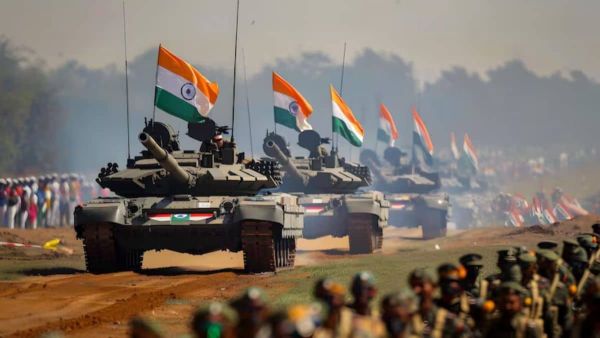
New Delhi: Finance Minister Nirmala Sitharaman on Sunday announced a sharp increase in defence spending, allocating Rs 7.8 lakh crore to the Ministry of Defence for 2026-27, marking a nearly 15 per cent rise from Rs 6.81 lakh crore in the previous year and underscoring the government’s renewed focus on military preparedness, modernisation and indigenisation.
The allocation, pegged at Rs 7.85 lakh crore in official Ministry of Defence communication, accounting for 14.68 per cent of the Union Budget, is the highest among all ministries and reflects India’s evolving security imperatives amid persistent threats along its western and northern borders from Pakistan and China.
Defence leads with the highest allocation at Rs 7.85 lakh crore, accounting for 14.68% of the Union Budget-strengthening preparedness, driving innovation, and reinforcing India’s national security.#ViksitBharatBudget pic.twitter.com/tL9rpbeDqG
— Ministry of Defence, Government of India (@SpokespersonMoD) February 1, 2026
Interestingly, despite the scale of the increase, Sitharaman did not announce any standalone defence policy reforms during her Budget speech, choosing instead to reinforce the sector through higher fiscal support and targeted duty exemptions.
Rs 2.19 Lakh Crore For Modernisation
A major highlight of the Budget is the Rs 2.19 lakh crore capital outlay for defence modernisation, registering a sharp 21.84 per cent jump over the previous year. The enhanced allocation comes in the backdrop of heightened security challenges and post-Operation Sindoor operational requirements, with a renewed emphasis on strengthening capabilities across the Army, Navy and Air Force.
This year, a provision of Rs 2.19 lakh crore has been made for the overall capital expenditure of our Armed Forces. A key highlight of this budget is the strong focus on the modernisation of all three services, which shows an increase of nearly 24 percent over the previous… pic.twitter.com/5cRD9wgZ18
— Ministry of Defence, Government of India (@SpokespersonMoD) February 1, 2026
The Defence Ministry is expected to accelerate several big-ticket acquisitions, including contracts for Rafale fighter jets, submarines and unmanned aerial vehicles (UAVs), alongside investments in emerging domains such as surveillance, cyber and electronic warfare.
Break-Up Reflects Strategic Priorities
A detailed break-up of allocations shows Defence Services (Revenue) being allotted Rs 3,65,478.98 crore, a rise of 17.24 per cent, reflecting higher operational and manpower-related expenditure. The Defence Pensions Bill has also increased to Rs 1,71,338.22 crore, underscoring the fiscal commitment towards veterans and retirees.
In contrast, the defence civil budget has seen a marginal reduction as compared to last year, signalling sharper prioritisation of frontline and operational requirements.
#BudgetWithArnab | “We now have a new element in defence expenditure – emergency procurement which has become larger this year. Hopefully this will turn into a fast-track procurement process”: Bharat Forge Chairman Baba Kalyani shares more industry takeaways from Union… pic.twitter.com/WyUV6uNgRH
— Republic (@republic) February 1, 2026
Boost For Defence Aviation, MRO Ecosystem
To strengthen the defence aviation ecosystem and reduce dependence on imports, Sitharaman announced a series of customs duty exemptions. The Budget proposes to exempt basic customs duty on components and parts required for the manufacture of civilian, training and other aircraft.
Raw materials imported for the manufacture of aircraft parts used in maintenance, repair and overhaul (MRO) by defence units, including public sector undertakings under the Ministry of Defence, will also be exempted.
“It is proposed to exempt basic customs duty on raw materials imported for the manufacture of parts of aircraft to be used in maintenance, repair or overhaul requirements by units in the defence sector,” the Finance Minister said.
#BudgetWithArnab | In a decisive step toward a technologically advanced and self-reliant future, Defence leads with highest allocation at Rs 7.85 lakh crore, accounting for 14.68% of Union #StabilityBudget 2026 - strengthening preparedness, driving innovation, and reinforcing… pic.twitter.com/sb3c7R9mfP
— Republic (@republic) February 1, 2026
The measures are expected to lower costs, improve turnaround times and strengthen India’s domestic MRO and defence manufacturing base. “These steps will support domestic manufacturing and enhance self-reliance in defence aviation,” Sitharaman added.
Broader Strategic Vision
According to official posts shared by the Ministry of Defence on X, the Defence Budget 2026-27 aligns with the government’s Viksit Bharat@2047 vision, with a strong focus on technological innovation, modernisation and streamlined procurement for optimal utilisation of resources.
The allocation also continues a clear upward trajectory in defence spending over the past five years, reflecting the Centre’s intent to future-proof India’s armed forces while strengthening indigenous production under the Atmanirbhar Bharat framework.
Other Tariff Measures
Separately, in response to higher US tariffs, Sitharaman proposed reducing the tariff rate on all dutiable goods imported for personal use from 20 per cent to 10 per cent.
To support exports, particularly the seafood sector impacted by US tariffs, the Finance Minister also proposed increasing the limit for duty-free imports of specified inputs used for seafood processing from 1 per cent to 3 per cent of the FOB value of the previous year’s export turnover.
-
Andrew has just shamed the Royal Family and Britain - there's only one thing left to do
-
Dhurandhar's Netflix Release Confirms A Wild Rumour About Ranveer Singh; Check It Out

-
GB News issues breaking news alert - and it's major blow to Keir Starmer

-
What happened at Grammy Awards 2026 - Trump fury, naked celebs and Ozzy Osbourne tears

-
SC orders Centre to set up tribunal for Pennaiyar river dispute