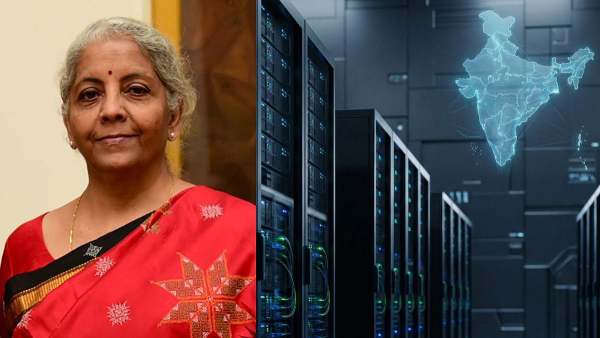
Finance Minister Nirmala Sitharaman on Sunday announced a proposal to extend the exemption on basic customs duty for imports of goods required for nuclear power projects until 2035, as India accelerates efforts to expand its atomic energy capacity to 100 GW by 2047.
During the Winter Session of Parliament, the government passed the Sustainable Harnessing and Advancement of Nuclear Energy for Transforming India (SHANTI) law, paving the way for private sector participation in the traditionally tightly regulated civil nuclear sector.
“I propose to extend the existing basic customs duty exemption on imports of goods required for Nuclear Power Projects till the year 2035 and expand it for all nuclear plants irrespective of their capacity,” Sitharaman said in her Budget speech.
The Finance Minister also outlined plans to support mineral-rich states—Odisha, Kerala, Andhra Pradesh, and Tamil Nadu—in setting up dedicated Rare Earth Corridors aimed at boosting mining, processing, research, and manufacturing capabilities.
In the Union Budget, the Finance Ministry allocated Rs 24,123.92 crore to the Department of Atomic Energy, with Rs 9,966.41 crore earmarked for capital expenditure.
“The proposal to establish dedicated Rare Earth Corridors across mineral-rich states is a timely step towards securing critical materials, strengthening domestic value chains, and reducing strategic dependencies,” said Dr Pawan Goenka, Chairman of the Steering Committee on Advancing Local Value-Add and Exports (SCALE).
He added that targeted customs duty exemptions designed to support domestic manufacturing and supply-chain integration would help build a more competitive and resilient economy, enabling businesses to invest with greater confidence and long-term visibility.
As of 2025, India operates 24 nuclear reactors with a combined installed capacity of about 8,780 MW. Although nuclear energy currently contributes around three per cent to the country’s overall energy mix, the government views it as a key source of low-carbon baseload power.
India has set ambitious targets to scale nuclear capacity to 22 GW by 2032 and up to 100 GW by 2047, with a strong emphasis on the development of small modular reactors.
[With PTI inputs]
Budget 2026 Live
Your 2-minute guide to becoming a Budget pro
Check what gets cheaper and costlier in Budget this year
How far has India come since the last money manual
Budget 2026 Highlights: Here's the fine print
“I propose to extend the existing basic customs duty exemption on imports of goods required for Nuclear Power Projects till the year 2035 and expand it for all nuclear plants irrespective of their capacity,” Sitharaman said in her Budget speech.
The Finance Minister also outlined plans to support mineral-rich states—Odisha, Kerala, Andhra Pradesh, and Tamil Nadu—in setting up dedicated Rare Earth Corridors aimed at boosting mining, processing, research, and manufacturing capabilities.
In the Union Budget, the Finance Ministry allocated Rs 24,123.92 crore to the Department of Atomic Energy, with Rs 9,966.41 crore earmarked for capital expenditure.
“The proposal to establish dedicated Rare Earth Corridors across mineral-rich states is a timely step towards securing critical materials, strengthening domestic value chains, and reducing strategic dependencies,” said Dr Pawan Goenka, Chairman of the Steering Committee on Advancing Local Value-Add and Exports (SCALE).
He added that targeted customs duty exemptions designed to support domestic manufacturing and supply-chain integration would help build a more competitive and resilient economy, enabling businesses to invest with greater confidence and long-term visibility.
As of 2025, India operates 24 nuclear reactors with a combined installed capacity of about 8,780 MW. Although nuclear energy currently contributes around three per cent to the country’s overall energy mix, the government views it as a key source of low-carbon baseload power.
India has set ambitious targets to scale nuclear capacity to 22 GW by 2032 and up to 100 GW by 2047, with a strong emphasis on the development of small modular reactors.
[With PTI inputs]