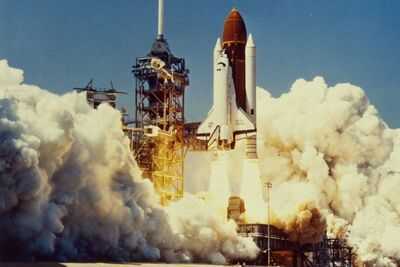
On the morning of January 28, 1986, millions of people across the globe sat glued to their TVs, excited to watch the Space Shuttle Challenger prepared for lift-off.
At first, everything went according to plan. Challenger shot into the sky, with Commander Francis Scobee calmly confirming his instructions from mission control with the words, “go throttle up”. It sounded like another routine mission was unfolding. Until it didn't. Just three seconds later, came the final transmission from inside the cockpit.
Pilot Michael Smith uttered only two words, but they showed him to be a man who realised something was very, very wrong. - “uh oh”. Moments later, the shuttle was engulfed in fire and tore apart in the sky just 73 seconds after launch, killing all seven astronauts on board.
- Couple's incredible find left by previous owners after lifting kitchen floor
- 'My dad murdered my mum on my 2nd birthday then told twisted lie for 18 years'
From the ground, it looked like an enormous explosion, a violent fireball that appeared to instantly destroy the spacecraft. For decades, that was the version many people believed: that the crew were killed immediately.
But years later, deeply unsettling details emerged that painted a far more disturbing picture.
Challenger did not explode in the traditional sense. A failure in a booster designed to seal fuel leaks caused scorching gases to escape, weakening the external fuel tank. As the shuttle climbed, the structure failed, triggering a massive fireball that ripped the vehicle apart.
Crucially, the crew compartment did not disintegrate straight away.

Instead, it is believed to have broken free pretty much intact, continuing to rise for around 25 seconds before beginning its long fall into the Atlantic Ocean.
Investigators later revealed that several of the astronauts’ personal air packs had been switched on, a process that could only be done manually.
That discovery raised the horrifying possibility that at least some of the crew were alive and conscious after the initial breakup, fully aware that they were falling helplessly back to Earth.
NASA maintained that a sudden loss of cabin pressure may have caused the astronauts to lose consciousness quickly. But experts noted that the physical evidence inside the crew module did not fully support that explanation, leaving the exact final moments unclear.
What is certain is that the impact with the ocean was unsurvivable.
The crew compartment slammed into the sea at immense speed, bringing the nightmare to a brutal end.
The remains of the astronauts were later recovered from the ocean floor, though details of their final moments were never publicly disclosed.
-
Arsenal confirm injured star faces surgery as lengthy absence awaits amid deadline day plan

-
Uttarakhand CM lauds renaming of Adampur airport as 'Shri Guru Ravidass Maharaj Ji Airport'

-
'Masterpiece' F1 film on legendary racing rivalry now streaming on BBC iPlayer

-
Arsenal see attacker transfer bid rejected as separate last-minute deal explored

-
BRS' RS Praveen Kumar defends KCR amid SIT questioning in illegal phone-tapping case