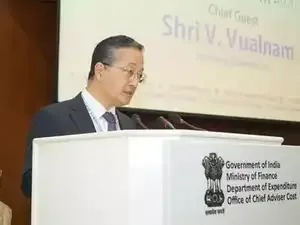
New Delhi: The government will continue to prioritise infrastructure creation through higher capital expenditure even as it operates with tight fiscal headroom and navigates persistent global economic uncertainty, expenditure secretary V Vualnam said Monday, signalling continuity in public investment-led growth strategy. In an interaction with ET after the budget, he dismissed concerns raised by states over the 16th Finance Commission's recommendation to discontinue post-devolution revenue deficit grants.
He maintained that such grants were always intended to "taper off" over time and states would need to "undertake course correction" on expenditure to tame revenue deficits. He said the Centre has already enhanced the budget under the Scheme for Special Assistance to States for Capital Investment, a key instrument to encourage state-level capex.
The budget enhanced the fiscal 2027 outlay for the scheme to ₹1.85 lakh crore from the revised estimate of ₹1.44 lakh crore this financial year.
The secretary said the Centre would continue to work on rationalisation of its expenditure, especially on the subsidy side, and that this is time for states to push the expenditure reform as suggested by the Finance Commission in its report.
"Spending on infrastructure creation remains a priority and is a key element of government policy," he said, adding that the Centre increased the capex for the coming financial year after assessing requirements across infrastructure sectors, which would have a multiplier effect on the economy.
When asked whether the pace of capex growth could taper in the coming years amid rising commitments, including those linked to the Eighth Pay Commission and future Finance Commission recommendations, the secretary said allocations would be reviewed later.
"These are early days and what will be the requirement in the years in the future is something we will assess," he said, adding: "Whether the same level is required or whether it needs to scale up or scale down, we will see."
Addressing concerns that states and departments are unable to spend funds on time, the secretary said utilisation had improved significantly and only a few big schemes had seen a slowdown this year. "The spending was slow because they were reviewing scheme components or implementation at the grassroots level," he said. "Otherwise, most schemes are moving well." The 16th Finance Commission in its report recommended doing away with revenue deficit grant and sector-specific or state-specific grants, signalling its view that most states have scope to improve revenues and rationalise expenditure. It retained states' share in the divisible tax pool at 41% for the five-year period beginning April 1, 2026.
Budget 2026
Critics' choice rather than crowd-pleaser, Aiyar says
Sitharaman's Paisa Vasool Budget banks on what money can do for you best
Budget's clear signal to global investors: India means business
Budget 2026 Highlights: Here's the fine print
The budget enhanced the fiscal 2027 outlay for the scheme to ₹1.85 lakh crore from the revised estimate of ₹1.44 lakh crore this financial year.
The secretary said the Centre would continue to work on rationalisation of its expenditure, especially on the subsidy side, and that this is time for states to push the expenditure reform as suggested by the Finance Commission in its report.
"Spending on infrastructure creation remains a priority and is a key element of government policy," he said, adding that the Centre increased the capex for the coming financial year after assessing requirements across infrastructure sectors, which would have a multiplier effect on the economy.
When asked whether the pace of capex growth could taper in the coming years amid rising commitments, including those linked to the Eighth Pay Commission and future Finance Commission recommendations, the secretary said allocations would be reviewed later.
"These are early days and what will be the requirement in the years in the future is something we will assess," he said, adding: "Whether the same level is required or whether it needs to scale up or scale down, we will see."
Addressing concerns that states and departments are unable to spend funds on time, the secretary said utilisation had improved significantly and only a few big schemes had seen a slowdown this year. "The spending was slow because they were reviewing scheme components or implementation at the grassroots level," he said. "Otherwise, most schemes are moving well." The 16th Finance Commission in its report recommended doing away with revenue deficit grant and sector-specific or state-specific grants, signalling its view that most states have scope to improve revenues and rationalise expenditure. It retained states' share in the divisible tax pool at 41% for the five-year period beginning April 1, 2026.