

Listen to this article in summarized format
Loading...
××
Subscribe to

Unlock AI Briefing and Premium Content
Subscribe NowWhat's Included
- Exclusive Stories
- Daily ePaper Access
- Smart Market Tools
- Curated Investment Ideas
- Ad-lite Experience
Subscription

The tax holiday announced for data centres in the budget is expected to increase demand for large industrial land parcels, accelerate data centre leasing and campus development, and draw long-term foreign capital into India’s industrial and commercial real estate markets, particularly in power-rich peripheral urban locations.
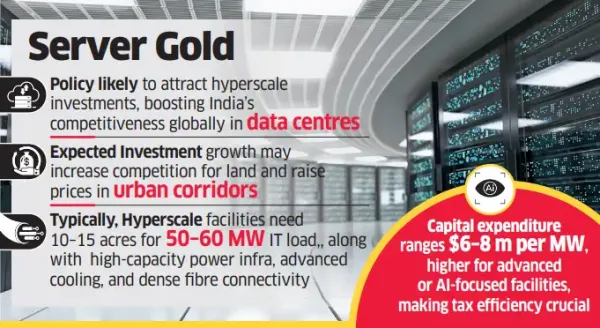
As part of its push to position India as a global data, cloud and AI hub, the government has announced long-term tax incentives, including tax holidays and related fiscal support, for data centres and cloud infrastructure providers. The incentives are also likely to help attract hyperscale investments, anchoring on-shore digital infrastructure and strengthening India’s competitiveness against established data centre markets in Asia-Pacific and Europe.
“India’s rapid digital adoption is driving unprecedented demand for AI-ready data centres. Securing land and power for new campuses will be critical for the growth and the proposed tax holiday will draw sustained investment into the sector, enabling scalable growth of hyperscale infrastructure nationwide,” said Pratap Mane, President & Country Head - India, Colt DCS.
Additionally, according to him, the 15% safe harbour for related-party data centre services simplifies operations for global players and improves cost efficiency. Microsoft India, Amazon Data Services India, Cold DCS, STT Global Data Centres, NTT Global Data Centres, and Blackstone’s data centre platform are among key entities that have acquired land parcels to set up data centres.
“The announcement of a tax holiday till 2047 for foreign cloud service providers will significantly accelerate data-centre growth in India by attracting global hyperscalers, deepening long-term investment in the segment, boosting capacity creation, and positioning India as a preferred hub for digital infrastructure and cloud-led economic expansion,” said Vimal Nadar, National Director &Head, Research at Colliers India.
The expected rise in new investments may also heat up the competition for land and result in prices increasing, particularly in strategically located urban corridors. BIG BUDGET BIZ From a real estate standpoint, the incentive improves project economics for data centres, which are among the most capital-intensive asset classes.
A typical hyperscale facility requires 10-15 acres for around 50-60 MW of IT load, depending on design and expansion planning, along with high-capacity power infrastructure, advanced cooling systems and dense fibre connectivity. Capital expenditure typically ranges from $6-8 million per MW, and can be higher for advanced or AI-focused facilities.
Budget 2026
Critics' choice rather than crowd-pleaser, Aiyar says
Sitharaman's Paisa Vasool Budget banks on what money can do for you best
Budget's clear signal to global investors: India means business
“India’s rapid digital adoption is driving unprecedented demand for AI-ready data centres. Securing land and power for new campuses will be critical for the growth and the proposed tax holiday will draw sustained investment into the sector, enabling scalable growth of hyperscale infrastructure nationwide,” said Pratap Mane, President & Country Head - India, Colt DCS.
Additionally, according to him, the 15% safe harbour for related-party data centre services simplifies operations for global players and improves cost efficiency. Microsoft India, Amazon Data Services India, Cold DCS, STT Global Data Centres, NTT Global Data Centres, and Blackstone’s data centre platform are among key entities that have acquired land parcels to set up data centres.
“The announcement of a tax holiday till 2047 for foreign cloud service providers will significantly accelerate data-centre growth in India by attracting global hyperscalers, deepening long-term investment in the segment, boosting capacity creation, and positioning India as a preferred hub for digital infrastructure and cloud-led economic expansion,” said Vimal Nadar, National Director &Head, Research at Colliers India.
The expected rise in new investments may also heat up the competition for land and result in prices increasing, particularly in strategically located urban corridors. BIG BUDGET BIZ From a real estate standpoint, the incentive improves project economics for data centres, which are among the most capital-intensive asset classes.
A typical hyperscale facility requires 10-15 acres for around 50-60 MW of IT load, depending on design and expansion planning, along with high-capacity power infrastructure, advanced cooling systems and dense fibre connectivity. Capital expenditure typically ranges from $6-8 million per MW, and can be higher for advanced or AI-focused facilities.