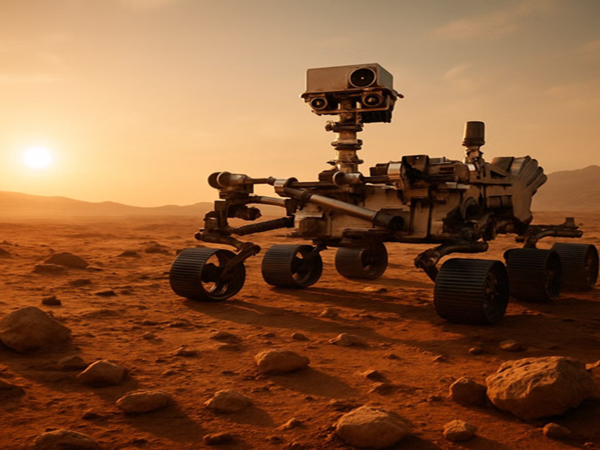
In today's modern era, Artificial Intelligence (AI) has become an integral part of our future. Using this technology, NASA, the world's largest space agency, has achieved a historic breakthrough. NASA's Perseverance rover has set a new record by driving autonomously on the challenging surface of Mars, entirely with the help of AI and without any human intervention.
The Path Traveled Without Human Assistance
Normally, controlling a rover on Mars requires scientists on Earth to meticulously plan every step of its movement. However, in tests conducted on December 8th and 10th, this rover surprised everyone by navigating its own path without any human assistance. This is the first and most significant event in the world of space science where a rover has made its own decisions and completed its journey without any instructions.
How Does This Technology Work?
Since Mars is approximately 225 million kilometers away from Earth, there is a significant delay in signal transmission. To overcome this challenge, scientists have used 'Generative AI' technology in the rover. With the help of this technology, the rover independently analyzed data from previous missions and, like a human, determined its waypoints based on images. Now, instead of waiting for human instructions, this rover can make safe decisions on its own while navigating difficult and uneven terrain.
Key Role of Indian Scientist Vandi Verma
This entire mission was led by NASA's Jet Propulsion Laboratory (JPL). Commenting on this historic achievement, JPL's senior engineer and Indian-origin scientist Vandi Verma stated that Generative AI is now going to completely transform the world of space science. She explained that whether it's identifying Martian rocks, determining its precise location, or choosing the safest path, AI is capable of performing all these tasks like a human, and even better, which will make future missions much easier.
The Path to the Future
According to NASA chief Jared Isaacman, this success demonstrates that our technological capabilities have advanced significantly. This type of "self-driving" technology will not only improve future missions but will also allow the rover to make quick decisions on challenging terrain despite the time delay in receiving signals from Earth. This will save time and greatly expand the scope of scientific discoveries.
Disclaimer: This content has been sourced and edited from Amar Ujala. While we have made modifications for clarity and presentation, the original content belongs to its respective authors and website. We do not claim ownership of the content.
-
Telangana reports second-highest typhoid cases in India

-
History Literature Festival to debut in Hyderabad this February

-
Iran seeks ‘fair, equitable negotiations’ with United States

-
Right-wing men demolish Mazar in Delhi’s Yamuna Ghat

-
ED raids in West Bengal linked to coal mining, transportation case