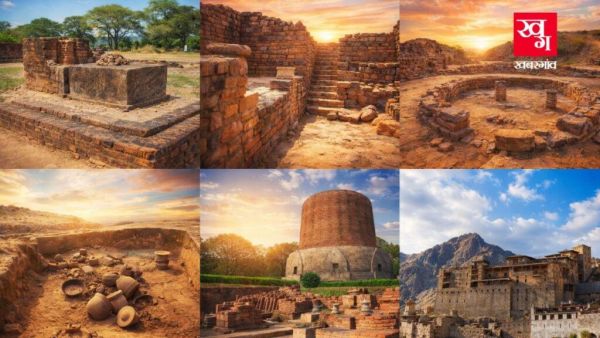
Union Finance Minister Nirmala Sitharaman presented the country’s General Budget 2025-26 on Sunday. He has announced that his government is allocating budget to develop 15 sites of archaeological importance in the country. The sites mentioned by the Finance Minister include sites ranging from the Harappan civilization to the ancient Mahabharata, the outline for whose development can now be prepared. The Finance Minister has proposed to create a National Destination Digital Knowledge Grid for these tourist destinations.
15 archaeological sites are mentioned from Rakhigarhi to Sarnath. Most of the sites are from the Buddhist period. Sites to Harappa and Mohenjodaro civilizations are also included in this list. The government wants to develop them as cultural sites. Guides will be appointed to tell about these sites, road construction will be improved, excavation will be done.
What are the places that are being emphasized?
- Lothal: A part of the ancient Indus Valley Civilization has been left in the Bhal area of Gujarat. In this port city there was Lothal, a city of the Indus Valley Civilization. This city of around 2400 BC is famous for its excellent architecture. There is a huge dockyard here, which is considered to be the oldest artificial port in the world. It was connected to the Arabian Sea through the old channel of Sabarmati river. Through this route, trade took place with Mesopotamia and Egypt. During the excavation in Lothal, a factory, copper objects, seals and a game resembling chess were found. There was an excellent system of drains here. It was discovered by Indian archaeologist S.R. Rao in 1954.
Lothal. Photo Credit: indiacinehub.gov.in/ - Dholavira: This ancient site is on Khadir Bet island in Kutch, Gujarat. It was the fifth largest city of the Indus Valley Civilization. It is in the middle of the Rann of Kutch. Two rivers named Mansar and Manhar flow here. A fort, a lower city and huge stone-like walls have been found here. There is also a sign board like shape here. Something is also written in Indus script. White sandstone has also been used here. This city was given global recognition by Jagatpati Joshi in 1967-68. This city is also included in the UNESCO World Heritage Site.
Dholavira. Photo Credit: gujarattourism.com - Rakhigarhi: This archaeological site is in Hisar, Haryana. Traces of Indus Valley Civilization are also found here. It is believed that Saraswati and Drishdwati rivers might have once existed here. It is one of the largest cities of the Harappan civilization. Its expanse is spread over 350 to 500 hectares. The excavation of Rakhigarhi gained momentum between 1997-1999. Then it got global recognition under the direction of archaeologist Amarendra Nath. There are solid brick houses here, drains and a better drainage system. There are also granaries for storing grains here. Earthen pots, terracotta bangles and stone gems have also been found here. Skeletons were also found here, research on which is being done.
Rakhigarhi. Photo Credit: Haryana Tourism - Adichanallur: This place is in Thoothukudi district of Tamil Nadu. Tamraparni river passes through here. A glimpse of the ancient civilizations of South India can be seen here. Here the remains of the dead were found in clay urns, which were from 1000 to 600 BC. Iron weapons, copper and other metal tools were found. The people of this civilization had knowledge of metallurgy. There was a systematic social system here. Some scholars consider it the center of Tamil culture. In the year 1876, detailed investigation was done here by Andrew Jaeger.
Adichanallur. Photo Credit: www.tnarch.gov.in - Sarnath: This city near Varanasi is a center of spiritual and historical heritage. Here Lord Buddha gave his first sermon after attaining enlightenment. The stupa here is the center of global attraction. The ‘Singh Chaturmukh Pillar’ built by Emperor Ashoka was found here. This is the national symbol of India. This city is the center of Buddhist and Jain cultures. Here the invader Mohammad Ghori had caused massive destruction. In the year 1905, the Archaeological Department started extensive excavations here. It attracted the attention of Buddhist and Jain followers from all over the world. This has also been declared a World Heritage by UNESCO.
Sarnath. Photo Credit: PTI - Hastinapur: Hastinapur is a city of Mahabharata period. It is said to be the capital of the Kuru dynasty. Excavation started here between 1950 and 1952 under the leadership of B Lal. Here we got a glimpse of the culture of 1200 to 800 BC. Evidence of Vedic period India was also found here. Evidence of floods has also been found here. The mound of Pandavas is also found here. Now many big Jain temples have been built here.
This city of Mahabharata period has now become the center of Jain culture. Photo Credit: UP Tourism - Leh Palace: In Ladakh people also know it as Lhachen Palkar. It is in Leh city and is an old royal palace. This palace was built by King Sengge Namgyal of the Namgyal dynasty in the year 1600 AD. This palace also shows the cultural unity of India and Tibet. It is also called Chhota Potala Palace. Potala Palace is in Lhasa. This palace is 9 storeys high. On the upper floors the royal family lived, on the lower floors there were animal and grain stores. This palace made of stone, mud and wood is very beautiful to look at. Dogra forces captured this place in the 19th century. Now this palace is under the protection of ASI.
Leh Palace. Photo Credit: incredibleindia.gov.in
What else will be special?
The Central Government has given a big boost to tourism, culture and heritage in the Union Budget 2026-27. While presenting the budget, Finance Minister Nirmala Sitharaman has said that emphasis will be laid on making India a global tourism hub. Transport connectivity will be improved in Himachal Pradesh, Uttarakhand, Jammu and Kashmir. The government will focus on improving nature trails and hiking sites. Turtle trails will be developed at places famous for sea turtle breeding in Odisha, Karnataka and Kerala.
The purpose of these trails is to make tourists aware of nature and conservation of rare species. Bird watching trails will be prepared at the places where migratory birds come. Tourism opportunities are going to increase in many lakes of Andhra Pradesh and Tamil Nadu. The government is emphasizing on the Buddhist circuit. Temples and monasteries will be conserved and pilgrimage centers will be built in Arunachal Pradesh, Sikkim, Assam, Manipur, Mizoram and Tripura.
What new is the government doing?
The government will develop 15 archaeological sites. Along with conservation, big plans will be made to attract tourists. 10,000 tour guides will be given world-class 12-week training with IIMs. National Council for Hotel Management will be upgraded to National Institute of Hospitality. Government
The National Destination Digital Knowledge Grid will be a digital documentation of all tourist destinations. It is expected that the budget will give a new direction to the tourism sector.
-
EXPLAINED: Why Uganda is being seen as a possible replacement for Pakistan

-
Amaal Mallik reveals the harsh reality of Bollywood, ‘Get limited payments,South earns 5 times more…’

-
Telangana reports second-highest typhoid cases in India

-
History Literature Festival to debut in Hyderabad this February
-
Iran seeks ‘fair, equitable negotiations’ with United States