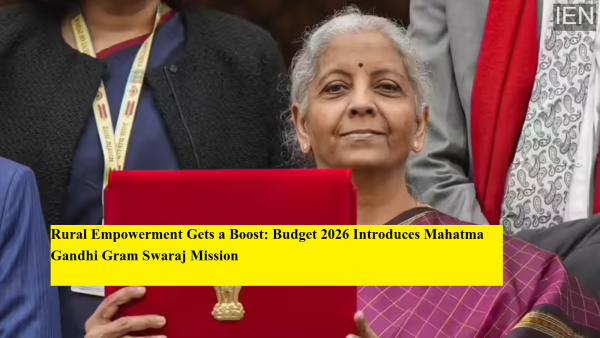
The Union Budget 2026 has placed a strong focus on strengthening India’s rural economy while advancing the vision of a self-reliant nation. With large-scale investments announced for infrastructure and traditional industries, the government has introduced the Mahatma Gandhi Gram Swaraj Mission, a flagship initiative aimed at empowering rural artisans, craftsmen, and small producers.
Finance Minister Nirmala Sitharaman announced an allocation of over ₹12.2 lakh crore for infrastructure development, alongside strategic reforms designed to revive traditional sectors. Among these, the Gram Swaraj Mission and the newly launched National Fibre Mission are expected to play a crucial role in reshaping rural livelihoods.
What Is the Mahatma Gandhi Gram Swaraj Mission?
The Mahatma Gandhi Gram Swaraj Mission is a comprehensive rural development initiative focused on strengthening village-based industries. The scheme aims to promote traditional skills, local manufacturing, and employment generation by connecting rural producers with modern technology and global markets.
Inspired by Mahatma Gandhi’s vision of self-sufficient villages, the mission seeks to ensure that economic growth reaches the grassroots level.
National Fibre Mission: A New Direction for the Textile Sector
As part of Budget 2026 reforms, the government has announced the National Fibre Mission, which will focus on natural fibres such as silk, wool, jute, and cotton. In addition, the mission will also support man-made and advanced fibres used in modern textiles.
The goal is to create a strong integration between traditional fibre-based industries and cutting-edge manufacturing techniques. This move is expected to enhance India’s competitiveness in the global textile market while preserving indigenous craftsmanship.
Revival of Handloom and Handicrafts
The budget has provided significant support to handloom and handicraft sectors, which form the backbone of rural employment in many regions. Under the Samarth 2.0 program, the government plans to collaborate with educational institutions, design schools, and large industries to modernize production processes.
Additionally, the establishment of mega textile hubs across the country is expected to increase production capacity, improve quality standards, and create new employment opportunities in rural areas.
One District, One Product Gets Expanded
A key feature of the Gram Swaraj Mission is the expansion of the One District, One Product (ODOP) initiative. Under this model, each district will identify and promote a unique local product based on regional expertise and resources.
Artisans will receive support at every stage—training, skill enhancement, design innovation, packaging, and marketing. The objective is to make district-level products globally competitive while ensuring fair income for local producers.
How Rural India Will Benefit
The mission is expected to bring transformational changes to the rural economy. By linking artisans to national and international markets, the initiative will help increase incomes and reduce migration to urban centers.
Skill development programs will enhance productivity, while improved market access will ensure better pricing for products. Beyond financial gains, the scheme also aims to revive pride in indigenous crafts and promote sustainable livelihoods.
Eligibility and Application Process
The government has confirmed that detailed guidelines regarding eligibility, registration, and benefits will soon be published on the official portal. Rural artisans, weavers, small manufacturers, self-help groups, and cooperatives are expected to be primary beneficiaries.
Applicants will be able to apply online once the portal goes live, ensuring transparency and ease of access.
A Step Toward Self-Reliant Villages
The Mahatma Gandhi Gram Swaraj Mission reflects a long-term commitment to inclusive growth. By combining tradition with innovation, the initiative seeks to build economically strong villages that contribute meaningfully to India’s development journey.
-
Arsenal Midfielder Mikel Merino Needs Foot Surgery But Should Be Fit For World Cup

-
India Secures Rights to Host 2027 Asian Rifle & Pistol Championship After Successful Bid

-
Fenerbahce Blames Al-ittihad For Collapse Of The N’Golo Kanté Transfer

-
Russian attacks on Ukraine 'don't signal seriousness' on peace: NATO chief

-
SSB, guarding Nepal, Bhutan borders, equipped with state-of-the-art surveillance equipment: Govt