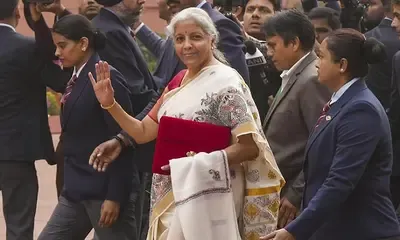
As Finance Minister Nirmala Sitharaman delivers the Union Budget 2026–27 in Parliament today, all eyes are on Part B of her speech, a section that commentators and experts say is likely to attract unusual attention and scrutiny this year.
Part B, traditionally the shorter segment of the Budget address, is expected to play an outsized role in shaping how India’s immediate priorities and longer-term economic strategy are understood by markets, businesses and global investors.
What Is Part B of the Budget Speech?
The Union Budget speech is delivered in two parts:
Part A typically reviews the economic performance, outlines the government’s fiscal stance, and presents key policy priorities.
Part B has historically focused on tax proposals, technical details and legislative aspects of the Budget.
In past decades, the bulk of strategic commentary has been concentrated in Part A, while Part B remained relatively narrow in scope.
A Strategic Shift This Year
For Budget 2026–27, government sources and analysts say that Part B will go beyond routine tax or technical announcements. Instead, it is expected to lay out a broader economic roadmap that balances both short-term policy actions and long-term structural goals.
This emphasis marks a possible departure from a 75-year convention in how budget speeches are structured, signaling an intent to use Part B as a strategic communications tool rather than a purely legislative or procedural segment.
Why the Focus Matters
Here are the key reasons Part B is in focus today:
1. Clearer Economic Vision
Sources say Part B is likely to be used to outline India’s long-term economic priorities, including structural reforms, investment focus areas, and growth strategies that go beyond the immediate Budget year. This is seen as a way to reassure global and domestic investors about India’s future direction.
2. Reform Narrative
Officials indicate that Part B will reflect the government’s broader reform agenda, including measures to simplify regulations, enhance competitiveness and strengthen key sectors like manufacturing, trade and exports. This “reform-forward” narrative aligns with the government’s push for sustained economic momentum.
3. Short-Term and Long-Term Balance
Unlike earlier budgets where Part B was essentially an add-on, the 2026 speech is expected to articulate both immediate priorities aimed at stimulating growth and structural objectives designed to shape India’s economic trajectory in the years ahead.
4. Strategic Signalling
By highlighting policy intentions and sector-wise focus in Part B, the government may be using the Budget speech to signal intent and build investor confidence amid a complex global economic landscape marked by geopolitical uncertainties and evolving trade relationships.
What Analysts Are Watching
Economists and market watchers will be looking for specific clues in Part B about:
how India plans to accelerate key reforms,
its vision for sectors such as manufacturing, technology and energy,
policy direction on trade and foreign investment, and
mechanisms for achieving long-term growth targets.
Given that Part B could now serve as a dual-purpose narrative, both legislative and visionary, its content may have implications that extend far beyond Budget Day itself.
While Finance Minister Sitharaman’s Budget speech as a whole is watched closely every year, Part B of the 2026 speech has emerged as a central focal point. Its expanded role in outlining India’s economic vision suggests a shift in how the government communicates strategy, making this section a key indicator of the policy and reform trajectory India intends to pursue in the coming years.
-
Clean-label food brand The Whole Truth closes $51 million funding round led by Sofina, Sauce.vc

-
Nvidia AI chip sales to China stalled by US security review: Report

-
US startup sets eyes on real-world AI applications in India

-
Singapore hosted over 1.2 million visitors from India in 2025

-
New Zealand to raise minimum wage for workers from April 2026