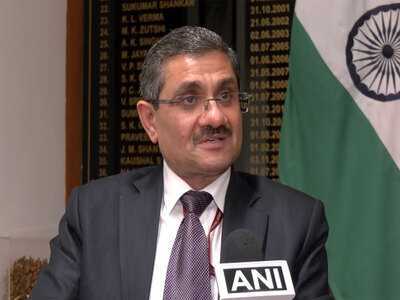
New Delhi, [India] February 3 (ANI): Central Board of Indirect Taxes and Customs (CBIC) Chairman Vivek Chaturvedi highlighted that the customs duty reforms introduced in the Union Budget 2026-27 are designed to catalyse domestic manufacturing, boost exports, and improve the ease of living for citizens.
Speaking to ANI, Chaturvedi said customs duty exemptions and protective measures have been selectively deployed across key sectors such as renewable energy, defence, MSMEs, healthcare, fisheries, and exports to make the Indian industry more resilient amid global headwinds and trade liberalisation.
"In the energy sector, customs duty exemption has been extended to sodium antimony, a key input for manufacturing solar glass panels. To protect MSMEs, particularly umbrella manufacturers facing heavy imports, the government has introduced a composite duty of 20 per cent or Rs 60 per umbrella, whichever is higher, on finished umbrellas, and 20 per cent or Rs 25 per kg on umbrella parts," he said.
Further, in defence, he said that exemptions have been granted for raw materials used in the maintenance and repair of defence aircraft. On the export front, duty exemptions have been provided for inputs used in manufacturing shoe uppers, supporting India's leather exports.
Healthcare has also received a boost, with customs duty exemption expanded to 17 anti-cancer drugs and seven additional rare diseases now eligible for duty-free imports, he highlighted.
For aquaculture and fisheries, the duty-free input limit under export-linked schemes has been increased from 1% to 3% of the FOB value, providing greater operational flexibility.
Alongside rate changes, the CBIC Chairman said, the government has introduced significant process reforms to reduce cargo dwell time and compliance burden. A major reform allows Indian-flag fishing vessels to harvest fish beyond territorial waters, including the Exclusive Economic Zone (EEZ), without treating such catch as imports when brought to the mainland.
To expand trusted trade participation, the Authorised Economic Operator (AEO) framework has been strengthened. Duty payment deferment for AEOs has been extended from fortnightly to monthly, allowing importers to pay duties on the first day of the succeeding month. Additionally, a new two-year scheme for eligible manufacturer-importers will offer AEO-equivalent benefits as a transition mechanism, he said.
The validity period for Advance Rulings on customs classification has been extended from three to five years, improving predictability for businesses.
A long-standing demand of exporters has been addressed by removing the Rs 10 lakh value cap on courier exports for commercial consignments. This is expected to benefit MSMEs exporting niche products such as bespoke garments and furniture.
To address export returns and rejected consignments, a digitised, risk-based system has been introduced to match export and re-import documents, reducing intrusive checks.
Chaturvedi said customs is investing heavily in a strong IT backbone, aiming to integrate courier and non-courier exports into a single customs platform. Further integration with partner government agencies under the Single Window Interface for Trade (SWIFT) is expected to streamline nearly 70% of import clearances. The system is targeted for completion within two years.
As part of tariff reforms, the government has undertaken a tariffication exercise, converting widely used concessional exemption rates into standard tariff rates to enhance certainty, he said.
"New tariff lines have also been introduced to reduce classification disputes, while obsolete or under-utilised exemptions have been withdrawn following review," he said.
For individual travellers, the government has revised baggage rules for the first time since 2016. The general free allowance has been increased from Rs 50,000 to Rs 75,000 per passenger and from Rs 15,000 to Rs 25,000 for foreign tourists.
Jewellery rules have been simplified, removing outdated value limits and retaining only weight limits 4of 0 grams for women and 20 grams for others, subject to conditions. Passengers carrying personal jewellery abroad can now avoid disputes by declaring it at departure and producing a certificate on return.
Transfer of Residence limits have also been enhanced, with the duty-free import allowance for household goods increased from Rs 5 lakh to Rs 7.5 lakh for those returning after three years abroad.
CBIC Chief said the customs duty and procedural reforms are designed to balance industry protection, global competitiveness, taxpayer predictability and citizen convenience, while ensuring faster and more transparent trade operations. (ANI)
-
Rajinikanth Gifts Gold Chain To Sanitation Worker Padma; Who Is She & Why Thalaivar Honoured Her? Deets Inside
-
Cat owners are only just learning why their pets knock items off tables

-
Frederique Constant presents thoughtfully crafted timepieces for this Valentine's Day

-
Keep Your Snapchat Account Safe: Step-by-Step Guide to Changing or Resetting Your Password

-
'I've been friends with Sarah Ferguson for years - there's more to come out about her'